
NITI Aayog Services Sector Growth Report Maps India’s Road to Inclusive Economic Transformation

The NITI Aayog Services Sector Growth Report marks a major milestone in India’s economic planning journey, shedding light on the evolving dynamics, opportunities, and challenges within the country’s services-led growth model. Released as part of NITI Aayog’s Services Thematic Series, the two reports focused on GVA trends and employment patterns offer a data-driven blueprint for making India’s services sector more inclusive, resilient, and globally competitive.
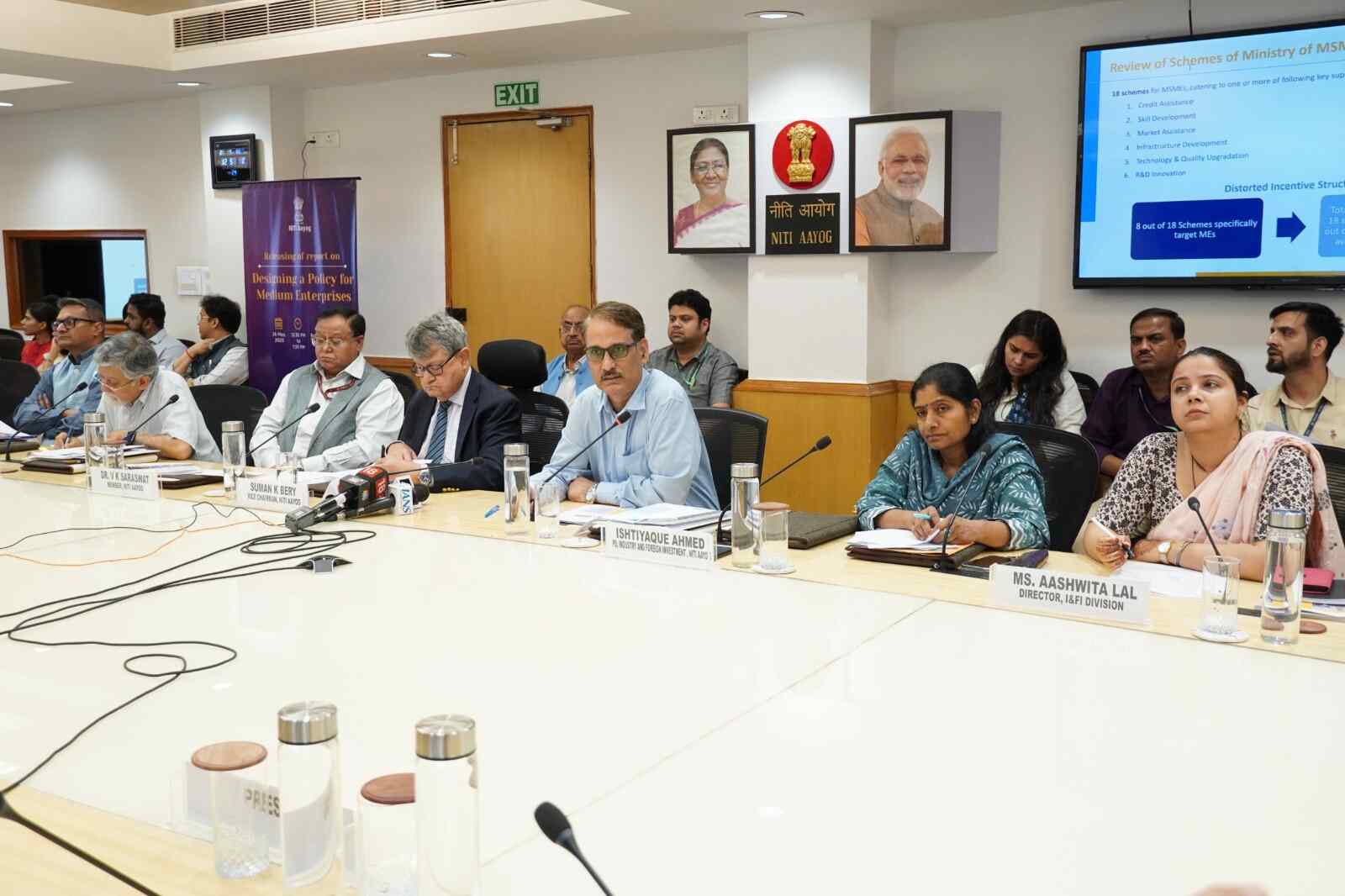
Thank you for reading this post, don't forget to subscribe!Launched by Shri B.V.R. Subrahmanyam, CEO of NITI Aayog, in the presence of Dr. Arvind Virmani, Member, NITI Aayog, and Dr. V. Anantha Nageswaran, Chief Economic Adviser, Government of India, the reports bring together insights from government officials, economists, and industry experts. Their release underlines the government’s recognition that the services sector is not just an engine of growth but also a foundation for equitable employment and digital transformation.
Assessing Services Sector Output and State-Level Dynamics in the NITI Aayog Services Sector Growth Report
The first report, titled “India’s Services Sector: Insights from GVA Trends and State-Level Dynamics”, offers a detailed examination of the sector’s contribution to India’s Gross Value Added (GVA). The findings reaffirm the services sector as the backbone of India’s economy, accounting for nearly 55% of India’s GVA in 2024–25.
What stands out is the sector’s increasing diversification across states. While developed states such as Maharashtra, Karnataka, and Tamil Nadu continue to dominate in financial, IT, and professional services, the report notes that emerging states including Odisha, Assam, and Jharkhand are steadily catching up. This trend points to greater regional balance and reflects the benefits of targeted policy interventions and digital connectivity across rural and semi-urban areas.
The study also highlights that inter-state disparities, though still evident, are narrowing. Investments in digital infrastructure, logistics networks, and innovation hubs are enabling new service ecosystems in previously lagging regions. However, the report cautions that to sustain this momentum, states must focus on ease of doing business, skill training, and public-private collaboration in emerging service domains such as fintech, healthcare, and tourism.
Employment Trends and Challenges Highlighted in the NITI Aayog Services Sector Growth Report
The second report, “India’s Services Sector: Insights from Employment Trends and State-Level Dynamics”, delves deep into the composition, quality, and inclusivity of employment generated by the services economy. It identifies a dual structure one part being the modern, high-productivity subsectors such as IT, telecommunications, and finance, which generate high value but limited jobs, and the other being traditional, low-wage subsectors such as retail trade, hospitality, and personal services, which employ large numbers but often under precarious conditions.
The report notes that services employment has been instrumental in India’s post-pandemic recovery, especially in urban and peri-urban regions. However, informality, gender gaps, and uneven job quality remain significant challenges. For instance, women’s participation in high-skill service jobs continues to lag behind men’s, while the rise of the gig economy has created both flexibility and insecurity for millions of workers.
The report also stresses the need to enhance skill alignment between education systems and market demands. Many states still face a shortage of trained personnel for sectors like logistics, e-commerce, digital finance, and health services areas projected to drive future employment.

Policy Roadmap for Inclusive and Balanced Growth
To address these structural challenges, the NITI Aayog Services Sector Growth Report lays out a four-part policy roadmap that focuses on formalisation, skill development, digital access, and regional balance.
- Formalisation: The report calls for stronger social protection frameworks for gig workers and MSME employees. Mechanisms such as contributory pension schemes, health insurance, and legal recognition for platform workers can help improve job security and quality of work.
- Skill Development: Targeted skilling initiatives for women and rural youth are essential to bridge gender and regional gaps. The integration of digital literacy, entrepreneurship training, and vocational skills will enable broader participation in the modern services economy.
- Digital and Infrastructure Access: Expansion of broadband connectivity, data centers, and urban logistics networks is critical to sustain growth. Tier-2 and Tier-3 cities can emerge as next-generation service hubs, reducing congestion in metros and spreading opportunities more evenly.
- Regional Balance: Encouraging service-sector clusters in smaller states can accelerate their integration into national and global value chains. The report recommends state-specific strategies, focusing on local strengths such as tourism, healthcare, education, and creative industries.
Pathway to Viksit Bharat @ 2047
Both reports converge on a central vision the role of the services sector as a key driver of India’s journey toward “Viksit Bharat @ 2047.” The insights point to the necessity of deepening digital integration, promoting innovation-led growth, and improving employment quality to transform India into a globally competitive services powerhouse.
As India moves toward a $10-trillion economy, the services sector’s contribution will go beyond GDP numbers it will shape the future of work, urbanisation patterns, and social inclusion. The report envisions a services-driven economy that is productive, equitable, and sustainable, ensuring that growth benefits reach every region and community.
Exam-Oriented Key Facts
- The services sector contributed around 55% of India’s GVA in 2024–25.
- The reports were launched in 2025 by B.V.R. Subrahmanyam, CEO, NITI Aayog.
- Themes: Output, employment trends, and state-level service dynamics.
- Policy Focus: Formalisation, skill development, digital access, regional inclusivity.
- Goal: Align services sector growth with the vision of Viksit Bharat @ 2047.
Conclusion
The NITI Aayog Services Sector Growth Report serves as both an analytical benchmark and a policy guide for India’s next phase of economic transformation. It reaffirms that the services sector is not merely a reflection of urban progress but a nationwide enabler of innovation, jobs, and opportunity.
By integrating productivity with inclusivity and strengthening the link between technology, skills, and employment, India can ensure that its services-led growth remains sustainable and equitable. The reports set the tone for a strategic and evidence-based approach to economic planning one that can turn India’s services potential into a defining strength for decades to come.