Fishing Ban Enforced to Protect Olive Ridley Turtles in Gahirmatha

Olive Ridley Turtle Fishing Ban Gahirmatha has come into effect in Odisha’s Kendrapada district, marking the beginning of a crucial seven-month conservation period from November 1 to May 31. The restriction aims to protect thousands of endangered Olive Ridley sea turtles during their annual mating and nesting season at the world-famous Gahirmatha Marine Sanctuary.
Thank you for reading this post, don't forget to subscribe!Known as one of the most important nesting grounds for Olive Ridleys globally, Gahirmatha is a jewel of India’s coastal ecosystem. Every year, the sanctuary’s pristine beaches transform into a bustling breeding ground for these gentle marine creatures, underscoring the area’s global ecological importance.
Olive Ridley Turtle Fishing Ban Gahirmatha: Conservation Measures and Patrolling Efforts
To ensure strict enforcement of the fishing ban, the Odisha Forest Department has strengthened its protection and surveillance network across the Gahirmatha region. Authorities have set up 14 turtle protection camps, including four offshore camps at Madali, Sasanipada, Ekakula, and Babubali islands.
Four patrolling boats have been deployed to monitor illegal fishing activities and ensure compliance with the ban. In addition, marine police units from Jamboo, Talachua, and Tantiapala, along with Coast Guard teams from Paradip, are assisting in continuous coastal surveillance.
Fishing has been prohibited within 20 km of the Gahirmatha coastline, which spans approximately 1,435 sq km, extending from Hukitola to Dhamra. The coordinated effort between the forest department, marine police, and Coast Guard highlights Odisha’s proactive approach to wildlife conservation.
Olive Ridley Turtle Fishing Ban Gahirmatha: Ensuring Safe Nesting and Hatchling Seasons
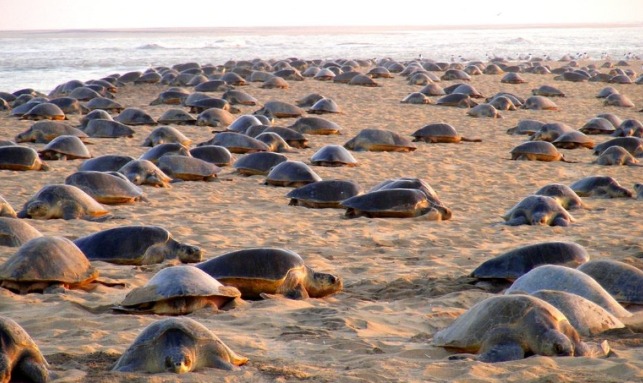
The annual migration of Olive Ridley turtles begins in November, when they start arriving in the Gahirmatha region for mating, followed by mass nesting events locally called arribadas around March.
Forest officials emphasize that ensuring a safe environment during this period is critical to the turtles’ reproductive success. To prevent accidental turtle entanglement and deaths in fishing nets, all mechanized trawlers are required to install Turtle Excluder Devices (TEDs) special escape hatches that allow turtles to exit nets unharmed while retaining the catch.
In addition, 14 navigational buoys have been placed along the sanctuary’s boundary for better demarcation and improved patrolling. These measures are expected to significantly reduce turtle mortality during the breeding season.
Olive Ridley Turtle Fishing Ban Gahirmatha: Ecological Significance of the Sanctuary
Declared a marine sanctuary in 1997, Gahirmatha holds the distinction of being the world’s largest rookery of Olive Ridley turtles. Each year, lakhs of turtles travel thousands of kilometers across the Indian Ocean to reach the Odisha coast, guided by instinct to their ancestral nesting beaches.
Earlier this year, between March 5 and March 10, 2025, over 6 lakh turtles laid eggs across various islands within the sanctuary, reaffirming Gahirmatha’s unmatched importance in global marine biodiversity.
Odisha accounts for nearly 50% of the global Olive Ridley turtle population and around 90% of India’s total turtle nesting activity. The conservation of Gahirmatha is, therefore, not just a local initiative—it represents a global commitment to protecting endangered marine life and preserving vital ecosystems.
The Olive Ridley turtle (Lepidochelys olivacea) plays a significant role in maintaining the health of marine ecosystems by controlling jellyfish populations and contributing to beach nutrient cycles. Protecting them helps sustain the balance of the entire coastal biodiversity web.
Olive Ridley Turtle Fishing Ban Gahirmatha: Facts and Key Insights
- Fishing Ban Duration: November 1 to May 31
- Sanctuary Area: 1,435 sq km (from Hukitola to Dhamra in Kendrapada district)
- Declared as Sanctuary: 1997
- World Record: Largest rookery of Olive Ridley turtles
- Recent Nesting Data: Over 606,000 turtles laid eggs in March 2025
These figures underline the significance of Gahirmatha as a critical global site for marine turtle conservation and the need for continued vigilance.
Olive Ridley Turtle Fishing Ban Gahirmatha: Balancing Livelihoods and Conservation
While the ban is essential for protecting marine life, it also affects local fishing communities that depend on coastal waters for their livelihoods. To mitigate the socio-economic impact, authorities have initiated awareness programs and alternative livelihood training for fishermen during the ban period.
Government officials and conservationists emphasize that the restriction is temporary but crucial. It not only ensures the survival of an endangered species but also contributes to sustainable fishery management in the long term. By allowing turtle populations to recover, the ban indirectly supports the regeneration of marine resources, benefiting local fishermen in future seasons.

Fishermen’s associations in Kendrapada have expressed their cooperation, acknowledging that protecting the Olive Ridleys is a shared responsibility. Many now advocate for eco-tourism initiatives centered around turtle conservation, which could provide new income opportunities while raising public awareness about marine wildlife protection.
Olive Ridley Turtle Fishing Ban Gahirmatha: Model for Marine Conservation
The Gahirmatha initiative serves as a benchmark for marine wildlife protection across India’s coastal states. Similar conservation strategies have been adopted in Rushikulya and Devi river mouths, also located in Odisha, but Gahirmatha remains the most successful and well-monitored site.
The region’s integrated approach combining scientific monitoring, community involvement, and law enforcement has made it a national model for biodiversity management. Conservationists believe that replicating this framework in other coastal regions could strengthen India’s overall marine protection network.
As global attention increasingly turns toward environmental sustainability, the Olive Ridley Turtle Fishing Ban Gahirmatha symbolizes how well-planned conservation policies can balance ecological preservation with community welfare. The sanctuary stands not only as a nesting ground for turtles but also as a beacon of coexistence between humans and nature.