PSLV-C62 Launch Anomaly During Third Stage Flight

PSLV-C62 Launch Anomaly became a key topic in India’s space news after the country’s first mission of 2026 faced a technical disturbance during flight. The launch began on a positive note with a smooth lift-off, but a problem was noticed near the end of the rocket’s third stage. The Indian Space Research Organisation has since begun a close review of flight data to understand what went wrong and how it may affect future missions.
Thank you for reading this post, don't forget to subscribe!The event has sparked discussion among space experts and enthusiasts, as India continues to expand its role in global satellite launches and commercial space services.
PSLV-C62 Launch Anomaly After Successful Lift-Off From Sriharikota
The PSLV-C62 rocket lifted off from the First Launch Pad at the Satish Dhawan Space Centre in Sriharikota, Andhra Pradesh. The early part of the mission followed the planned timeline, with the rocket performing normally through the initial stages.
This launch was important for several reasons. It marked the 64th flight of the Polar Satellite Launch Vehicle and the ninth dedicated commercial mission handled by NewSpace India Limited. The vehicle carried one main satellite and several smaller ones, reflecting India’s growing presence in both national and international space markets.
PSLV-C62 Launch Anomaly Observed During Third Stage Flight
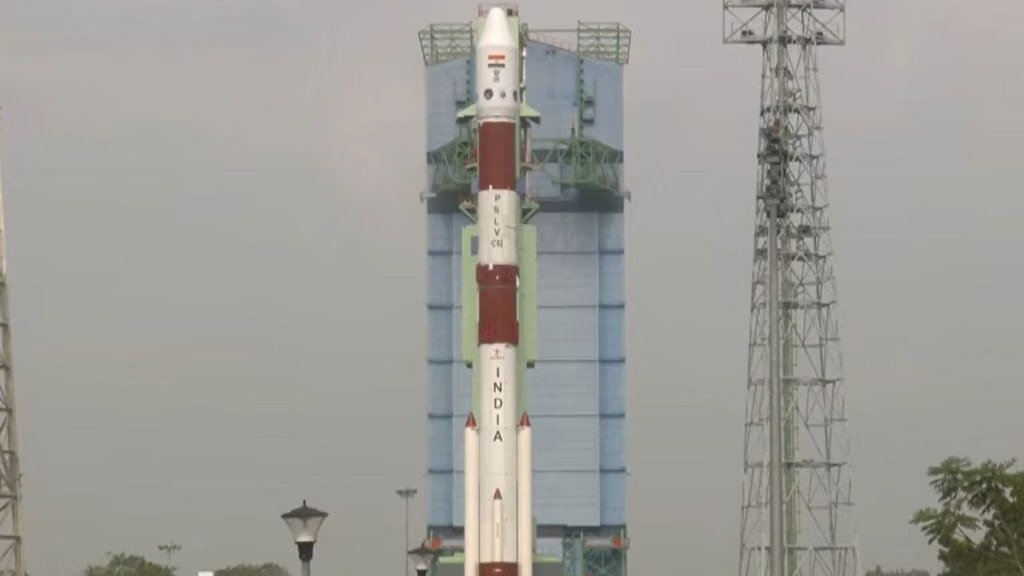
ISRO Chairman V Narayanan confirmed that engineers noticed increased disturbance near the end of the third stage of the rocket, known as PS3. Soon after, a deviation in the flight path was recorded, pointing to a possible technical issue.
While the earlier stages worked as expected, this sudden change required immediate attention. ISRO officials stated that all available flight data is being studied to identify the exact cause of the disturbance. Such detailed reviews are a routine part of space missions and help improve the reliability of future launches.
PSLV-C62 Launch Anomaly and Mission Payload Details
The PSLV-C62 carried the Earth Observation Satellite EOS-N1 as its primary payload. The satellite is designed to observe Earth’s surface and collect valuable data for environmental monitoring and other applications. EOS-N1 was developed in collaboration with partners from Thailand and the United Kingdom, highlighting international cooperation in space technology.
Along with EOS-N1, the rocket also carried 14 co-passenger satellites belonging to both Indian and foreign customers. These smaller satellites represent the growing demand for cost-effective launch services, an area where ISRO has built a strong reputation.
PSLV-C62 Launch Anomaly and Rocket Configuration
The PSLV-C62 is a four-stage launch vehicle that uses a combination of solid and liquid fuel stages. It stands 44.4 metres tall and has a lift-off weight of about 260 tonnes. For this mission, ISRO used the PSLV-DL configuration, which includes two solid strap-on motors to provide extra thrust during lift-off.
This flexible design has made the PSLV one of ISRO’s most reliable rockets, capable of placing satellites into different types of orbits. The EOS-N1 satellite was planned for a sun-synchronous orbit, which allows it to pass over the same area of Earth at the same local time each day, ensuring consistent data collection.
PSLV-C62 Launch Anomaly and Commercial Space Efforts
The mission also reflected ISRO’s increasing focus on commercial launches. NewSpace India Limited, ISRO’s commercial arm, handled the mission, reinforcing India’s role as a trusted launch service provider.
Despite the anomaly, the mission underlined the complexity of modern space operations. With more private companies and international clients relying on ISRO, each mission plays a role in strengthening confidence and improving technical standards.
PSLV-C62 Launch Anomaly and Technology Demonstrations
In addition to satellite deployment, PSLV-C62 was scheduled to support a technology demonstration. One of the key demonstrations involved the Kestrel Initial Technology Demonstrator, a small prototype re-entry vehicle developed by a Spanish start-up.

Such demonstrations are important for testing new ideas and designs in real space conditions. They help engineers understand how new systems behave during flight and re-entry, paving the way for future innovations in space travel and satellite recovery.
PSLV-C62 Launch Anomaly in the Context of India’s Space Journey
India’s space programme has grown steadily over the years, earning global recognition for its cost-effective and reliable missions. Occasional technical challenges are part of space exploration, and each issue provides valuable lessons.
ISRO’s quick response and transparent communication about the PSLV-C62 Launch Anomaly reflect its commitment to safety and continuous improvement. The detailed analysis underway is expected to guide adjustments and refinements in upcoming missions.
PSLV-C62 Launch Anomaly and the Road Ahead
As engineers study the flight data, attention remains focused on how the findings will shape future launches. With several missions lined up in 2026, including scientific, commercial and technology-testing flights, the insights gained from this event will play an important role.
The PSLV-C62 mission, despite the challenge, highlights India’s determination to advance in space science, support global partners and push technological boundaries.