Sweden Cashless Society Sets Global Digital Benchmark

Sweden Cashless Society has officially become a global reality, marking a historic transformation in how a nation handles money. Sweden is now recognized as the world’s first cashless country, setting a new benchmark for digital financial innovation and security. Citizens across the nation have fully transitioned from traditional paper currency to digital payment methods using mobile apps, debit and credit cards, and contactless technologies for almost every transaction.
Thank you for reading this post, don't forget to subscribe!The shift represents not just a technological milestone but also a cultural evolution, as cash has nearly disappeared from daily life. From bustling cities like Stockholm to quiet rural towns, digital payments now dominate a transformation that has taken just over a decade to achieve.
Sweden Cashless Society: The Digital Revolution Led by Swish
The foundation of Sweden’s journey toward a cashless future began with the launch of Swish, a real-time mobile payment app introduced in 2012. Developed collaboratively by several major Swedish banks, Swish revolutionized the way Swedes exchange money.
The app allows users to send and receive money instantly using a phone number, making transactions fast, secure, and accessible. From splitting restaurant bills to paying for groceries or donating at church, Swish quickly became an integral part of daily life. Its simplicity and reliability helped it gain massive popularity across all age groups.

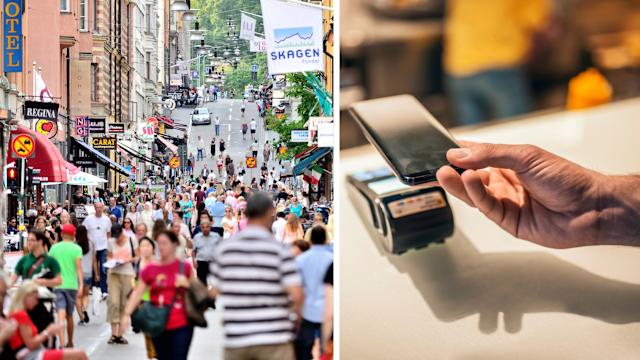
Today, it’s not uncommon to see signs reading “No cash accepted” in cafés, museums, retail shops, and even charity events. Street vendors, buskers, and small businesses have also adopted Swish and other mobile payment tools, effectively eliminating the need for coins and banknotes.
This nationwide digital adoption has created one of the world’s most efficient and transparent financial ecosystems, positioning Sweden Cashless Society as a global model for the future of digital economies.
Sweden Cashless Society: The Role of Riksbank and the e-Krona
The Riksbank, Sweden’s central bank and the world’s oldest monetary authority, has been at the forefront of this transformation. While commercial banks developed consumer-friendly payment platforms, the Riksbank focused on maintaining financial stability, inclusivity, and cybersecurity amid rapid digitisation.
One of its key initiatives is the ongoing pilot project for the e-krona a proposed state-backed digital currency designed to complement existing private payment systems. The e-krona aims to ensure that citizens continue to have access to secure, government-issued money, even as physical cash fades away.
The Riksbank’s research teams are also working on enhancing cybersecurity frameworks, preventing fraud, and ensuring data privacy in an increasingly digital economy. Another important focus is ensuring that elderly citizens and rural communities who may be less comfortable with technology are not left behind. Educational programs and simplified digital interfaces are being developed to make cashless transactions inclusive for all.
Through these efforts, the Sweden Cashless Society model demonstrates how innovation and regulation can work hand in hand to ensure financial equality and security.
Sweden Cashless Society: Impact on Daily Life
The transition to a cashless economy has profoundly changed how people interact with money. Physical wallets have been replaced by digital apps, and the once-common sound of coins and notes exchanging hands has nearly vanished.
Public transportation across Sweden from Gothenburg’s trams to Stockholm’s metro has gone entirely cash-free. Restaurants, cinemas, libraries, and even street markets accept digital payments only. The change has not only improved transaction speed and safety but also reduced costs associated with handling and securing physical currency.
For businesses, the benefits are clear: reduced theft risks, easier accounting, and faster payment processing. For citizens, digital payments mean convenience, transparency, and the ability to manage finances more efficiently through mobile apps and online banking tools.
Even traditional sectors like churches, local councils, and non-profit groups have integrated cashless donation systems. The seamless blend of innovation and social trust has helped Sweden achieve what many nations are still striving toward.
Sweden Cashless Society: Tourism and Digital Convenience
For international tourists, Sweden offers one of the smoothest digital travel experiences in the world. Contactless debit and credit cards are accepted almost everywhere—from Stockholm’s Royal Palace to Lapland’s ICEHOTEL. Travelers can easily navigate the country without ever needing to visit a currency exchange counter.
However, visitors should note that while most places accept international cards, apps like Swish require a Swedish bank account and BankID, which means foreign users cannot directly use the app. As a precaution, carrying a small amount of cash can be helpful when traveling to remote areas, rural cafés, or small ferry terminals where digital connectivity may be inconsistent.

Tourists are often amazed by how effortlessly payments are handled in Sweden, with everything from taxis to public restrooms operating through tap-to-pay systems. This high level of integration makes Sweden one of the easiest countries in the world to explore without cash.
Sweden Cashless Society: Global Influence and Future Outlook
Sweden’s achievement as the first cashless country has drawn global attention. Economists, policymakers, and financial experts worldwide are studying the Swedish model to understand how digital payment systems can be scaled while maintaining privacy, inclusion, and financial integrity.
The success of Sweden Cashless Society has already influenced neighboring countries like Norway, Finland, and Denmark, which are moving in the same direction. Even emerging economies such as India and Brazil have cited Sweden’s experience in formulating their digital payment policies.
The global banking sector views Sweden’s transition as proof that digital financial ecosystems can operate efficiently without relying on physical cash provided there is trust, robust infrastructure, and regulatory oversight.
As the Riksbank continues refining the e-krona, Sweden remains committed to ensuring its digital financial system is both resilient and inclusive. The focus now extends beyond convenience to building economic resilience, ensuring that digital transactions remain safe during cyberattacks, power outages, or technical disruptions.
Sweden Cashless Society not only represents a technological transformation but also a cultural and societal one. It showcases how innovation, public trust, and policy alignment can together redefine the very nature of money. Sweden’s journey from paper to pixels has not just reshaped its economy it has set a global precedent for the future of finance.