Tamil-Brahmi Inscriptions in Egypt Reveal Ancient Tamil-Roman Links

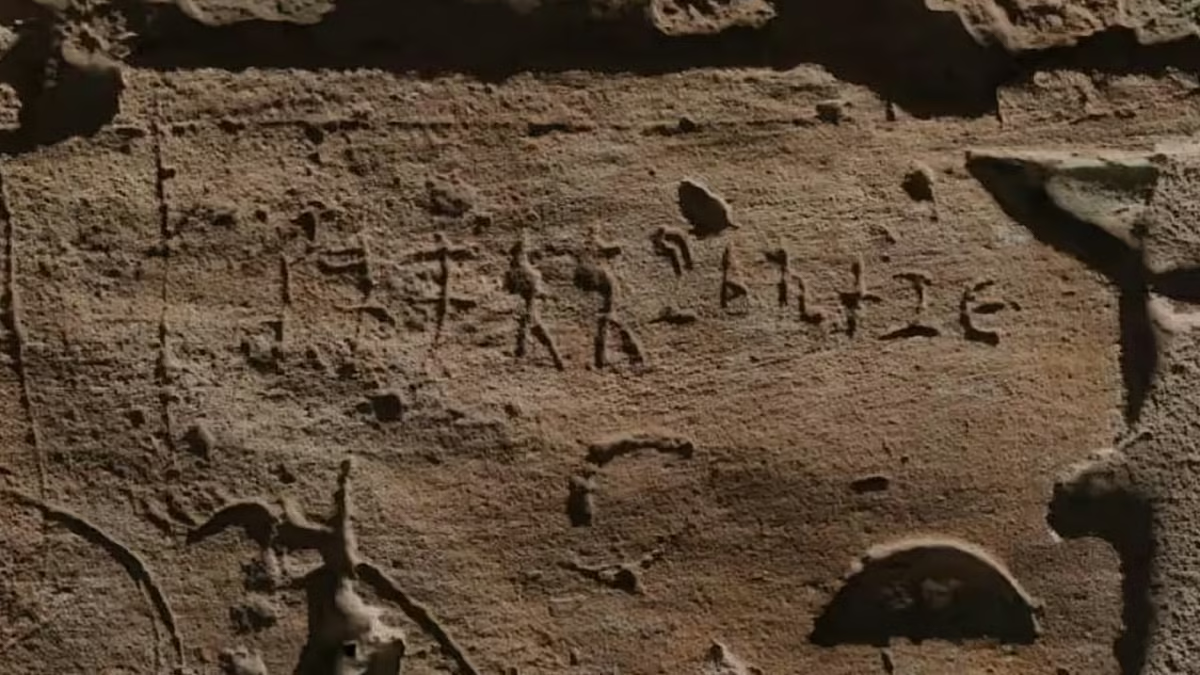
Tamil-Brahmi Inscriptions in Egypt has drawn global attention after a stunning archaeological discovery that reshapes our understanding of ancient connections between India and the Mediterranean world. Nearly 30 inscriptions written in Tamil-Brahmi, along with a few in Prakrit and Sanskrit, have been identified inside tombs in the famous Valley of the Kings. These inscriptions date back to the period between the 1st and 3rd centuries C.E., a time when the Roman Empire was at its height.
Thank you for reading this post, don't forget to subscribe!This finding is important not just for Indian history, but also for global history, as it offers clear proof that people from ancient Tamilagam travelled deep into Egypt, far beyond coastal trading ports.
Fieldwork That Changed Historical Understanding
The inscriptions were documented during fieldwork carried out in 2024–25 by scholars Charlotte Schmid of the French School of Asian Studies and Ingo Strauch of the University of Lausanne. Their research focused on six tombs located within the Theban Necropolis, the burial ground that includes the Valley of the Kings.
The team found that these inscriptions were carved casually on walls and corridors, much like visitor graffiti. This practice was common in the ancient world and is well known from thousands of Greek inscriptions found earlier in the same region.

Indian Visitors in the Valley of the Kings
The Valley of the Kings, located in modern-day Egypt, is best known as the burial site of Egyptian pharaohs. Finding Tamil-Brahmi Inscriptions in Egypt within these tombs was unexpected and exciting.
The inscriptions appear alongside Greek graffiti that were earlier recorded by French scholar Jules Baillet in 1926. This multilingual setting suggests that the tombs were popular destinations for travellers during the Roman period. Indian merchants or travellers, like their Greek counterparts, seem to have visited these sacred spaces and left their names behind.
Tamil Names That Speak Across Centuries
One of the most striking features of the discovery is the presence of clearly identifiable Tamil names. The name Cikai Koṟṟaṉ appears eight times across five different tombs. The word koṟṟaṉ is deeply rooted in Tamil culture and comes from koṟṟam, meaning victory or heroic slaying.
This term is closely associated with the Chera warrior goddess Koṟṟavai and with royal titles such as koṟṟavaṉ, meaning king. Such linguistic details leave little doubt about the Tamil origin of the individuals.
The same name tradition is seen elsewhere in Egypt. For example, Koṟṟapumāṉ was found written on a pottery sherd from Berenike, an important Red Sea port. Similar names are also mentioned in ancient Tamil texts like Purananooru, which refers to the Chera ruler Piṭtāṅkoṟṟaṉ.
More Tamil-Brahmi Inscriptions Identified
Apart from Cikai Koṟṟaṉ, researchers identified other Tamil-Brahmi inscriptions such as Kopāṉ varata kantan, which translates simply to “Kopāṉ came and saw.” This short sentence gives a very human touch to the discovery, showing that these travellers wanted to record their presence, much like tourists today.
Other names like Cātaṉ and Kiraṉ were also found. These names further strengthen the argument that most of the visitors came from southern India, especially the region known in ancient times as Tamilagam.
Trade Routes Between Tamilagam and the Roman World
The discovery of Tamil-Brahmi Inscriptions in Egypt adds a new layer to what we already know about trade between India and the Roman Empire. Archaeological work at Berenike had earlier revealed Indian goods such as pepper, beads, and textiles, along with Tamil-Brahmi inscriptions.
What makes the new findings special is their location. Instead of being limited to port cities, the inscriptions are found deep inside the Nile valley. This shows that Indian traders and travellers did not just stop at coastal markets but moved inland, interacting with local cultures and exploring important sites.
Cultural Exchange Beyond Commerce
These inscriptions are not just evidence of trade. They point to cultural exchange, curiosity, and shared spaces. Indian visitors walked the same corridors as Greek and Roman travellers, leaving behind marks that survived for nearly two thousand years.
The use of Tamil-Brahmi script, which was widely used in South India from around the 3rd century BCE, highlights the confidence these travellers had in their own language and identity, even when far from home.
A Window into Early Global Connections
The presence of Tamil-Brahmi Inscriptions in Egypt offers rare and powerful proof of early globalisation. It shows that ancient Tamilagam was not isolated but actively connected to distant regions through sea routes and land networks.
These findings bring the ancient world closer to us, revealing stories of movement, interaction, and cultural pride. They remind us that long before modern travel and communication, people crossed continents, shared ideas, and left lasting marks on history.