Yuan Porcelain Shipwreck Found Revealing 14th-Century Maritime Trade

The discovery of a Yuan Porcelain Shipwreck Found near the waters of Singapore has revealed important evidence about trade during the 14th century. Archaeologists uncovered a large cargo of blue-and-white porcelain believed to belong to the Yuan Dynasty period. The ship was likely travelling from China to Temasek, the historic settlement that existed on the site of present-day Singapore. Researchers say the shipwreck is around 650 years old and the findings were published in the Journal of International Ceramic Studies in June 2025.
Thank you for reading this post, don't forget to subscribe!Four-Year Underwater Excavation
The excavation was led by marine archaeologist Michael Flecker from Heritage SG, a subsidiary of the Singapore National Heritage Board. The research team spent four years exploring the site and recovering artifacts from the seabed.
Divers collected nearly 3.5 metric tonnes of ceramic fragments from the wreck. The work was extremely difficult because the area had strong currents and very poor underwater visibility. Because of these conditions, divers were able to conduct only one dive roughly every four weeks.
Among the recovered material, about 136 kilograms consisted of Yuan Dynasty porcelain, including several pieces that were nearly intact. Although the wooden structure of the ship had mostly disappeared, experts believe the vessel was a Chinese junk, a traditional sailing ship commonly used in Asian maritime trade.
Unique Designs Help Date the Shipwreck
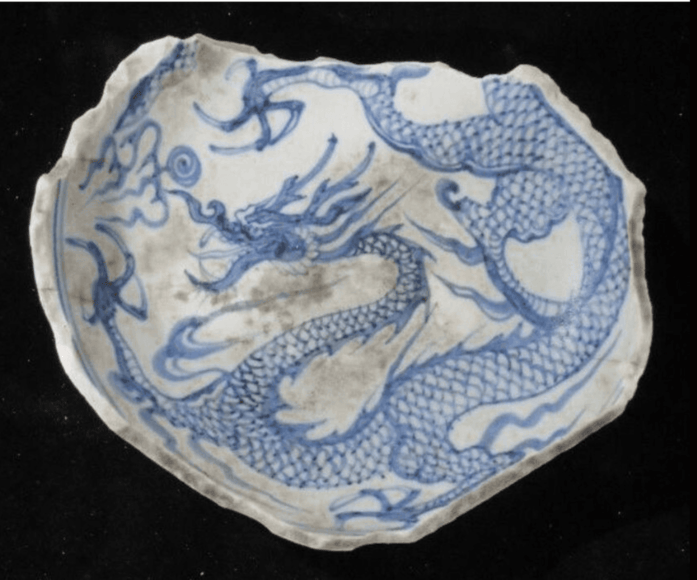
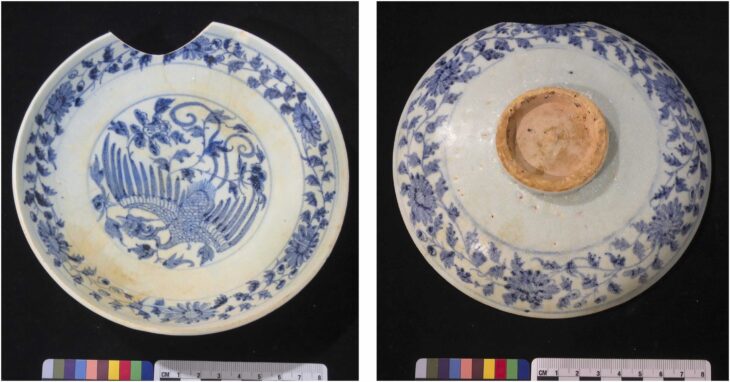
The porcelain cargo featured several artistic designs that helped researchers estimate the ship’s age. Some pieces displayed a four-clawed dragon, while others showed a phoenix surrounded by chrysanthemums.
One of the most important patterns discovered was the mandarin ducks in a lotus pond motif. Historians believe this design was linked to Emperor Wenzong, who ruled between 1328 and 1332. Initially used for imperial purposes, the motif later became more widely produced.
Based on these designs and historical events such as the Red Turban Rebellion and the eventual fall of the Yuan Dynasty in 1368, researchers estimate that the ship sank sometime between the late 1320s and 1371.
Yuan Porcelain and Global Trade
Blue-and-white porcelain from the Yuan period was highly valued across Asia and beyond. It was known for its strong, translucent quality and distinctive cobalt blue decoration. The cobalt pigment used in these ceramics was often imported from Persia.
Historians believe the ship carrying the porcelain likely departed from Quanzhou, a major trading port on China’s eastern coast. Its destination was Temasek, a prosperous 14th-century port known for active international trade.
The large quantity of porcelain found in the shipwreck suggests that Temasek had a wealthy population and strong demand for luxury goods.
Yuan Porcelain Shipwreck Found Highlights Mongol-Era Innovation
The Yuan Porcelain Shipwreck Found near Singapore provides new evidence of technological skill and cultural exchange during the Mongol-ruled Yuan Dynasty. Scholars say the discovery shows how advanced ceramic production and global trade networks flourished during this period.
The shipwreck also demonstrates how goods, ideas, and artistic styles travelled across regions through maritime routes, connecting China, Southeast Asia, and the wider world more than six centuries ago.