Battles of Panipat – A Complete Detailed History

The Battles of Panipat are among the most significant military events in Indian history. Fought on the plains of Panipat (in present-day Haryana), these three decisive battles changed the course of power in India multiple times. Each battle marked the rise and fall of powerful empires and shaped the political, social, and military history of the Indian subcontinent.
Thank you for reading this post, don't forget to subscribe!Panipat became a historical battlefield mainly because of its strategic location. It served as the gateway to Delhi for invaders coming from the northwest through the Khyber Pass and Punjab. Whoever controlled Panipat could easily march towards Delhi and establish dominance over North India.
There were three major Battles of Panipat:
- First Battle of Panipat (1526) – Beginning of the Mughal Empire
- Second Battle of Panipat (1556) – Consolidation of Mughal rule
- Third Battle of Panipat (1761) – Clash between Marathas and Afghans
Let us understand each of these battles in detail.
First Battle of Panipat (1526)
Introduction
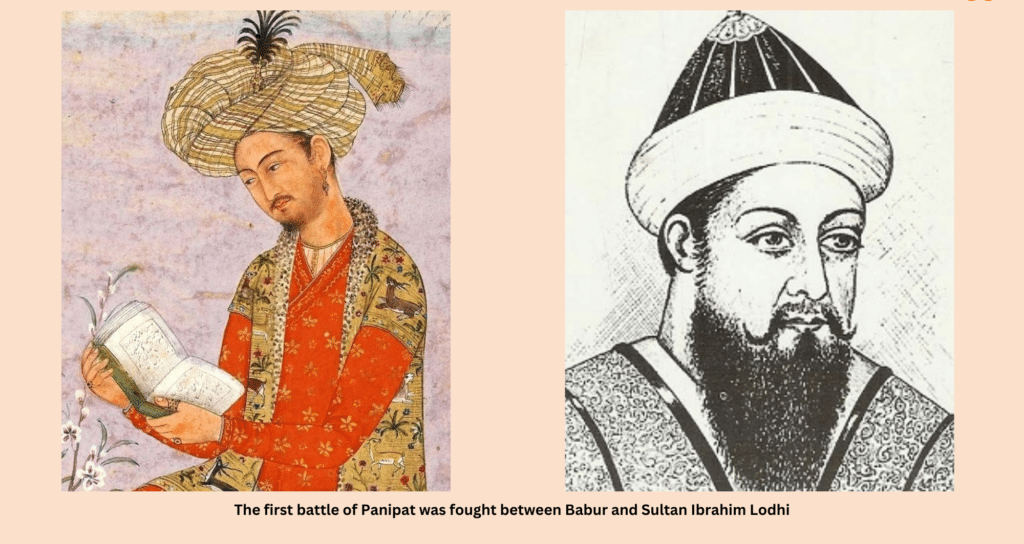
The First Battle of Panipat was fought on 21 April 1526 near a small village of Panipat (in present-day Haryana). It took place between Zahir-ud-din Babur and Ibrahim Lodi, the last Sultan of the Delhi Sultanate. This historic battle marked the beginning of the Mughal Empire in India and changed the course of Indian history.
Background
Babur, a ruler from Central Asia and a descendant of Timur and Genghis Khan, had long desired to conquer India. At the same time, the Delhi Sultanate under Ibrahim Lodi was weakening due to internal conflicts, poor leadership, and dissatisfaction among nobles. Many Afghan chiefs even invited Babur to invade India, hoping to replace Ibrahim Lodi.
The Battle
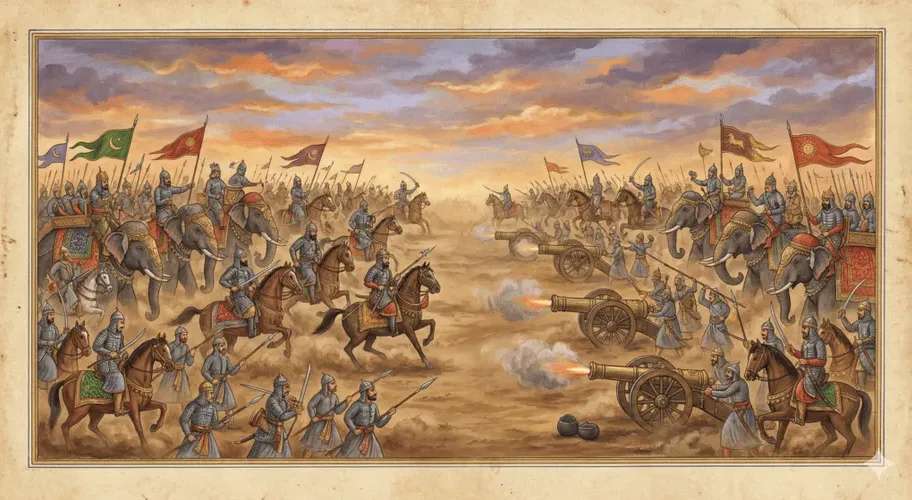
The First Battle of Panipat (21 April 1526) was fought between the invading forces of Babur and the Lodi Empire ruled by Ibrahim Lodi. It was one of the earliest battles in India where gunpowder and field artillery played a decisive role.
Military Strength
- Babur’s Army: Around 15,000 soldiers with 20–24 pieces of field artillery
- Ibrahim Lodi’s Army: Around 30,000–40,000 soldiers along with at least 1,000 war elephants
Despite having a smaller army, Babur had a major advantage modern firearms and artillery. In contrast, Ibrahim Lodi lacked field artillery.
The sound of Babur’s cannons created panic among Lodi’s elephants. Frightened elephants lost control and trampled their own soldiers, creating confusion and weakening Lodi’s army.
Babur’s Military Tactics
Babur’s victory was not only due to weapons but also because of his advanced military strategies:
Tulughma Strategy
- The army was divided into Left, Right, and Centre
- Each division was further split into Forward and Rear units
- This formation allowed Babur to surround the enemy from all sides, even with a smaller force
Araba System
- The central front line was protected using carts (araba)
- These carts were arranged in rows and tied together with animal hide ropes
- Cannons were placed behind these carts
- This setup allowed soldiers to fire safely while being protected from enemy attacks
These tactics were far more advanced than the traditional warfare methods used by Ibrahim Lodi.
Course of the Battle
The battle began with Babur’s artillery attacking the enemy lines. The loud explosions terrified the elephants of Ibrahim Lodi’s army, causing them to panic and run in different directions.
This led to chaos within Lodi’s army. Babur then used his Tulughma strategy to surround the enemy forces from all sides. His disciplined army attacked in a coordinated manner, while Lodi’s forces became disorganized.
Result
- Ibrahim Lodi was killed on the battlefield
- Babur defeated a much larger army
- The Mughal forces secured a decisive victory
The victory enabled Babur, the Timurid ruler of Kabulistan, to lay the foundation of the Mughal Empire in India.
Ibrahim Lodi was abandoned by many of his nobles and generals during the battle. After his death, several of them switched loyalty to Babur, accepting him as the new ruler of Delhi.
Interestingly, historians believe that if Ibrahim Lodi had survived a little longer, the outcome might have been different. Babur’s army had no reserves left, and his soldiers were getting tired. The battle could have turned in Lodi’s favor if it had continued for another hour.
Significance
- Marked the beginning of the Mughal Empire in India
- Ended the rule of the Delhi Sultanate
- Introduced gunpowder warfare and artillery in Indian battles
- Showed the importance of strategy over sheer numbers
The First Battle of Panipat remains one of the most important turning points in Indian history, as it laid the foundation for a powerful empire that ruled India for over three centuries.
Second Battle of Panipat (1556)
Introduction
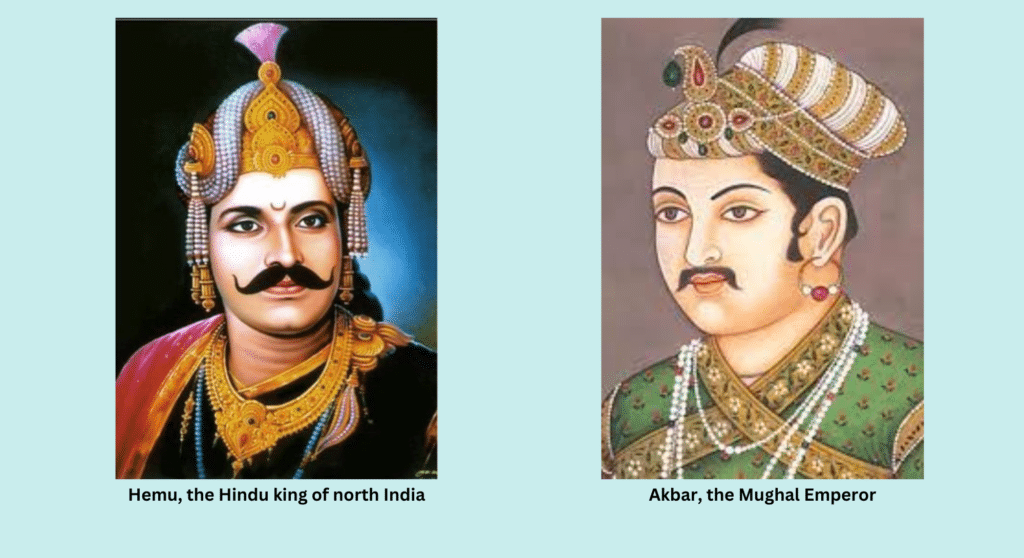
The Second Battle of Panipat was fought on 5 November 1556 between the forces of Akbar and Hem Chandra Vikramaditya, popularly known as Hemu, the Hindu king who ruled North India from Delhi. It resulted in a decisive victory for Akbar’s generals, Bairam Khan and Khan Zaman I.
Background
After Babur, his son Humayun ruled India but lost control to Sher Shah Suri. Though Humayun later regained power, he died on 24 January 1556 in Delhi. His son Akbar was crowned at Kalanaur on 14 February 1556, at the young age of 13.
At the time of Akbar’s accession:
- Mughal control was limited to Kabul, Kandahar, parts of Delhi, and Punjab
- The empire was politically unstable
Meanwhile, Hemu emerged as a powerful leader. He belonged to Rewari (present-day Haryana) and had earlier served as an adviser to Islam Shah Suri from 1545 to 1553. Between 1553 and 1556, Hemu:
- Served as Prime Minister and Chief of Army
- Won 22 battles against Afghan rebels
- Established his dominance over North India
Hemu captured Delhi after defeating Mughal forces and declared himself king, taking the title Samrat Hem Chandra Vikramaditya.
Military Strength
- Hemu’s Army:
- Around 30,000 experienced cavalry (Rajputs and Afghans)
- About 1,500 war elephants
- Strong artillery force
- Mughal Army:
- Around 10,000 cavalry
- 5,000 experienced veteran soldiers
Akbar and Bairam Khan did not directly participate in the battle. They were stationed about 5 Kos (8 miles) away from the battlefield. The young emperor was protected by a special guard of 5,000 highly trained troops and kept at a safe distance behind the battle lines.
Course of the Battle
Hemu personally led his army from atop an elephant and advanced in an organized and disciplined manner. His forces initially dominated the battlefield, and he was on the verge of defeating the Mughal army.
However, a sudden turning point changed everything:
- An arrow struck Hemu in the eye
- The arrow pierced through his head, rendering him unconscious
- Seeing their leader fall, Hemu’s army lost direction and morale
The absence of leadership created confusion, and his army soon fell into disarray.
Result
- The Mughal army defeated Hemu’s forces
- Hemu was later found and captured by Shah Quli Khan Mahram and brought to Akbar’s camp at Panipat
- Hemu was executed after the battle
- A cenotaph was later built by his supporters at Saudhapur village on Jind Road, Panipat
Significance
- Re-established Mughal rule in North India
- Strengthened the position of Akbar as emperor
- Ended the possibility of Afghan resurgence under Hemu
- Marked the beginning of Akbar’s long and powerful reign
The Second Battle of Panipat was a turning point that ensured the stability and expansion of the Mughal Empire in India.
Third Battle of Panipat (1761)
Introduction
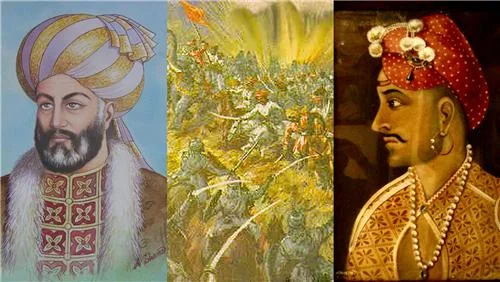
The Third Battle of Panipat was fought on 14 January 1761 at Panipat, about 60 miles north of Delhi. This historic battle took place between the Maratha Empire and the powerful Afghan ruler Ahmad Shah Durrani, also known as Ahmad Shah Abdali. He was supported by two important Indian allies the Rohilla Afghans of the Doab and Shuja-ud-Daulah, the Nawab of Awadh.
This battle is considered one of the largest and bloodiest battles of the 18th century, with massive loss of life in a single day during a traditional face-to-face war between two huge armies.
Background
The roots of this battle go back to the decline of the Mughal Empire. After the long Mughal-Maratha war (1680–1707), Mughal power weakened significantly, allowing the Marathas to expand rapidly.
Under Peshwa Baji Rao I, the Marathas:
- Captured Gujarat and Malwa
- Defeated the Mughals near Delhi in 1737
- Gained control over large parts of North India
This rapid expansion brought the Marathas into direct conflict with Ahmad Shah Abdali, who wanted to expand his influence in India.
In 1759, Abdali gathered a strong army from Pashtun tribes and attacked North India. He defeated several smaller Maratha forces in Punjab and formed a powerful alliance with the Rohilla Afghans of the Gangetic plains.
Alliances
The battle saw powerful alliances on both sides:
Maratha Side
- Led by Sadashiv Rao Bhau
- Supported by strong cavalry and trained infantry
Afghan Coalition
- Led by Ahmad Shah Abdali
- Supported by:
- Rohilla Afghans
- Shuja-ud-Daulah (Nawab of Awadh)
- Leadership support from Najib-ud-Daulah
Military Strength
The battle involved over 125,000 troops, making it one of the largest military confrontations of its time.
- Marathas:
- Strong artillery trained by the French
- Skilled cavalry and infantry
- Afghans:
- Heavy cavalry
- Mounted artillery such as zamburaks (camel-mounted guns) and jezails (long rifles)
The Afghan army had better mobility and battlefield coordination, which later proved crucial.
Role of Shuja-ud-Daulah
One of the most important turning points was the decision of Shuja-ud-Daulah, the Nawab of Awadh.
- Both Marathas and Afghans tried to gain his support
- By July 1760, he joined the Afghan side
- He provided financial and logistical support
This decision was a major blow to the Marathas. Without his help, the Afghan army might not have been able to continue such a long campaign in North India.
Cutting Off Supplies
This phase played a decisive role in the outcome of the battle.
- In August 1760, the Marathas captured Delhi
- They also won the Battle of Kunjpura against Afghan forces
- However, Abdali made a bold move by crossing the Yamuna River at Baghpat
This allowed him to:
- Cut off Maratha supply lines
- Surround their camp at Panipat
A two-month-long siege followed:
- Afghans blocked food and resources
- By November 1760, almost all supplies were cut
- By December, severe famine-like conditions developed
Thousands of:
- Soldiers died of starvation
- Animals and cattle perished
By early January 1761, the Maratha army was weak, hungry, and desperate.
Course of the Battle
With no supplies left, Maratha leaders requested permission from Sadashiv Rao Bhau to fight rather than die of starvation.
- The Marathas launched a desperate attack
- They marched out of their camp to break the siege
- A massive battle followed, lasting several hours and involving intense fighting
At first, the Marathas showed strong resistance, but:
- Afghan forces gradually gained control
- Abdali’s army successfully attacked the Maratha flanks
- Continuous fighting weakened the Maratha army
Casualties
The scale of destruction was enormous:
- Around 60,000–70,000 soldiers were killed in battle
- About 40,000 Maratha prisoners were executed the next day
- Many more were injured or captured
This made it one of the deadliest battles in Indian history.
Result
- Ahmad Shah Abdali emerged victorious
- Maratha forces suffered a crushing defeat
- Their expansion in North India was stopped
Aftermath
The consequences of the battle were long-lasting:
- Maratha power in North India weakened for nearly 10 years
- Political instability increased across the region
However, the Marathas were not completely destroyed.
Under Peshwa Madhavrao:
- The Marathas recovered their strength
- In 1771, they launched a campaign in North India
- They aimed to:
- Re-establish dominance
- Punish enemies like the Rohillas
- Regain lost territories
This revival marked the final chapter in the long story of Panipat.
Significance
The Third Battle of Panipat holds great importance in Indian history:
- One of the largest and bloodiest battles ever fought
- Temporarily ended Maratha dominance in North India
- Weakened Indian powers, making way for British expansion
- Showed the importance of logistics (supply lines) in warfare
Why Panipat Was Always the Battlefield
Interestingly, none of the battles were fought to capture Panipat itself.
Key Reason: Strategic Location
- Gateway to Delhi
- Close to important trade and military routes
- Flat terrain suitable for large armies
Invaders from Central Asia always passed through:
- Khyber Pass
- Punjab
- Then Panipat before reaching Delhi
Comparison of the Three Battles of Panipat
| Battle | Year | Main Forces | Winner | Impact |
|---|---|---|---|---|
| First | 1526 | Babur vs Ibrahim Lodi | Babur | Mughal Empire begins |
| Second | 1556 | Akbar vs Hemu | Akbar | Mughal rule restored |
| Third | 1761 | Marathas vs Abdali | Abdali | Maratha decline |
Overall Significance of Battles of Panipat
The Battles of Panipat were turning points in Indian history:
Political Impact
- Ended Delhi Sultanate
- Established Mughal Empire
- Later weakened Marathas
Military Impact
- Introduction of gunpowder warfare
- Use of advanced tactics
- Large-scale organized battles
Historical Impact
- Changed rulers of India multiple times
- Influenced future invasions
- Indirectly paved way for British dominance
Conclusion
The Battles of Panipat were not just wars but defining moments that reshaped Indian history. From the rise of the Mughal Empire to the fall of Maratha power, these battles influenced the political landscape for centuries.
Panipat remains a symbol of power struggles, strategic warfare, and historical transformation. Understanding these battles helps us better understand how India evolved through different phases of rule and conflict.
FAQs on Battles of Panipat
1. How many Battles of Panipat were fought?
There were three major Battles of Panipat fought in 1526, 1556, and 1761.
2. Who won the First Battle of Panipat?
Babur defeated Ibrahim Lodi and established the Mughal Empire.
3. Why is the Second Battle of Panipat important?
It re-established Mughal rule under Akbar.
4. Who fought in the Third Battle of Panipat?
The Marathas fought against Ahmad Shah Abdali and his allies.
5. Why was Panipat important?
It was the gateway to Delhi, making it strategically important for invasions.