


Delta – Meaning, Formation, Types, Importance and Threats

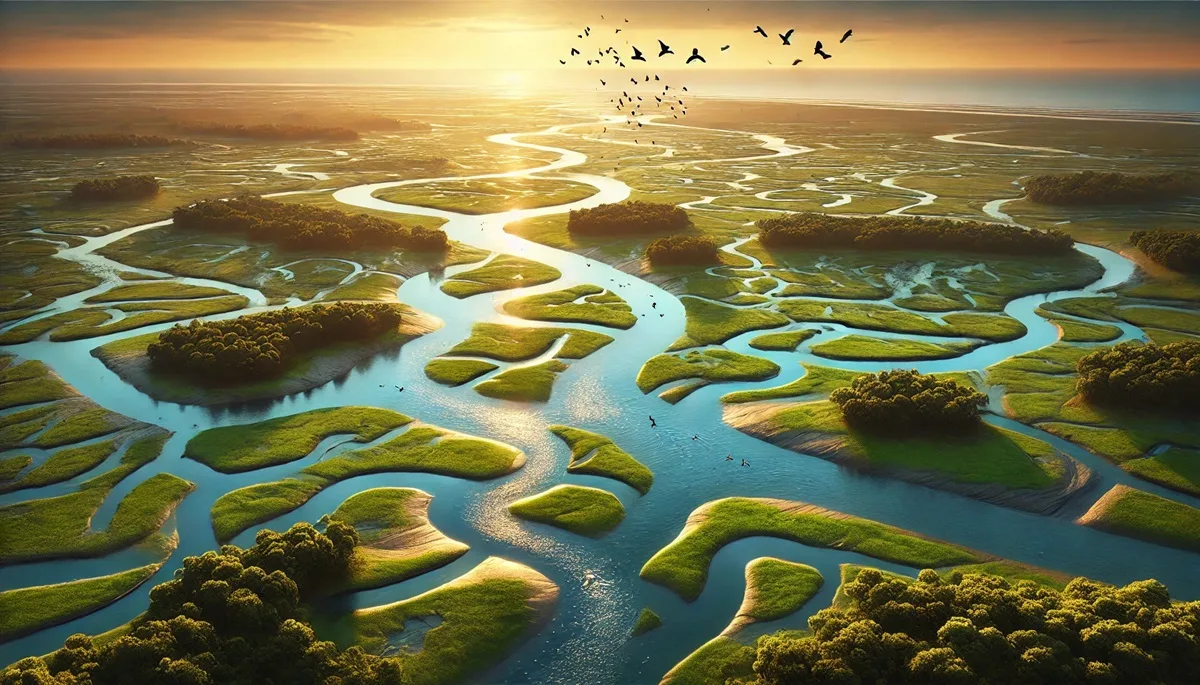
Delta is one of the most important landforms in physical geography. It is a depositional feature formed at the mouth of a river where it enters another water body like a sea, ocean, lake, or another river. Deltas are very fertile and support a large population around the world. They are also rich in biodiversity and play a major role in economic development.
Thank you for reading this post, don't forget to subscribe!What is a Delta?
A Delta is a landform created by the deposition of sediments carried by a river as it slows down near its mouth. These sediments accumulate over time and form a triangular or fan-shaped area.
- It is mainly formed in the old (senile) stage of a river.
- Deltas are usually low-lying wetlands.
- They are highly fertile because of the presence of fine sediments like silt and clay.
Related Terms
Wetlands
Wetlands are areas where water covers the land or is present near the surface for most of the year. These regions act as a transition between land and water ecosystems.
Mouth of a River
The mouth is the end of a river where it empties into another water body like a sea, ocean, or lake.
Formation of Delta
The formation of a Delta is a slow and continuous process. It takes hundreds to thousands of years.
Step-by-step Formation Process
- Flow of River Towards Mouth
As a river flows towards its end, the slope becomes gentle and the speed of the river decreases. - Loss of Carrying Capacity
Due to reduced speed, the river loses its ability to carry sediments like sand, silt, and clay. - Deposition of Sediments
- Heavier particles settle first near the river mouth.
- Lighter particles travel further and settle later.
- Formation of Channels (Distributaries)
The river breaks into smaller channels called distributaries. - Development of Deltaic Lobe
These distributaries deposit sediments in different directions, forming a lobe-like structure. - Growth of Delta
Over time, continuous deposition creates new land that extends into the water body.
Role of Silt
- Silt is rich in nutrients.
- It supports plant growth and forms the base of the food chain.
Structure of a Delta
A Delta is divided into three main parts:
1. Upper Delta Plain
- Located closest to the river.
- Dominated by river processes.
- Less affected by waves and tides.
2. Lower Delta Plain
- Located between upper delta and sea.
- Influenced by tides and waves.
3. Subaqueous Delta
- Located underwater.
- Contains the finest sediments.
- The outermost part is called the Prodelta.
Factors Affecting Delta Formation
Many natural factors control how a Delta forms and develops:
1. Climate
- Rainfall affects river flow and sediment supply.
2. Geological Structure
- Rock types influence sediment availability.
3. Sediment Supply
- More sediments lead to larger deltas.
4. Tectonic Stability
- Stable regions favor delta formation.
5. River Slope
- Gentle slope promotes deposition.
6. Wave and Tidal Action
- Strong waves can remove sediments.
- Weak waves allow deposition.
7. Flooding Pattern
- Floods bring large amounts of sediments.
Types of Deltas
Deltas are classified based on their shape and formation conditions. Each type of delta is formed under different environmental factors such as river flow, wave action, and sediment deposition.

1. Arcuate Delta (Fan-shaped Delta)
- Shape: Fan-shaped or triangular with a curved (bowed) outline.
- It has a convex margin facing the sea or ocean.
- Formed where river activity and wave action are balanced.
- Contains relatively coarse sediments.
- This is one of the most common types of deltas.
Examples:
- Nile Delta
- Ganges Delta
2. Bird’s Foot Delta (Finger Delta)
- Named because it looks like a bird’s claw or foot.
- Formed when river flow is stronger than wave action.
- Composed mainly of fine sediments carried by the river.
- The river divides into many long, narrow distributaries.
- Rare along ocean coasts because waves are usually stronger than river currents.
Example:
- Mississippi River Delta
3. Cuspate Delta
- Shape: Tooth-like or pointed.
- Formed where sediments are deposited along a straight coastline.
- Strong waves push sediments outward, creating a pointed shape.
Example:
- Tiber River Delta
4. Estuarine Delta
- Formed at the mouth of submerged rivers (estuaries).
- Sediments are deposited along the sides of the estuary.
- Common where rivers meet the sea in drowned valleys.
Examples:
- Seine River Delta
- Narmada Delta
- Tapi River Delta
5. Lacustrine Delta
- Formed when a river flows into a lake instead of a sea or ocean.
- Sediments settle in the still water of the lake.
Example:
- Lough Leane Delta
6. Truncated Delta
- Formed when sea waves and ocean currents erode an already formed delta.
- These deltas appear cut, dissected, or reduced in size due to erosion.
7. Abandoned Delta
- Formed when a river changes its course and leaves the old delta behind.
- The earlier delta becomes inactive and is called abandoned.
Examples:
- Yellow River Delta
- Hooghly Delta
Importance of Deltas
Deltas are extremely valuable for both humans and nature. They are not only fertile lands but also support civilizations, economies, biodiversity, and environmental protection systems. Below is a detailed and well-explained version of the importance of deltas with added information.
1. Cradle of Civilization (Human Civilization)
River deltas have been important to human societies for thousands of years because of their fertile soil and availability of water. Many of the world’s earliest civilizations developed in delta regions.
- The fertile alluvial soil made farming easy and productive.
- Regular flooding brought fresh nutrients to the land.
- People learned to live with natural flood cycles and used them for agriculture.
Examples
- Nile River Valley
- Tigris-Euphrates Basin
These regions supported large populations and became centers of culture, trade, and development.
2. Agriculture (Highly Productive Farming Regions)
Delta regions are among the most agriculturally productive areas in the world.
- The soil in deltas is rich in silt and alluvium, which contains nutrients.
- These nutrients help crops grow faster and healthier.
- Deltas support cultivation of crops like rice, wheat, sugarcane, and vegetables.
Additionally:
- The flat land makes irrigation easier.
- Water availability is high due to rivers and groundwater.
Examples
- Cauvery Delta
- Sacramento-San Joaquin Delta
These areas are often called the “food baskets” of their regions.
3. Economic Importance (Industrial and Commercial Activities)
Deltas play a major role in economic development.
- They are a source of sand and gravel, which are used in construction, highways, and infrastructure projects.
- Many deltas host large industrial and commercial centers.
- Ports and trade centers are often located in delta regions because of easy access to waterways.
However, sometimes there is conflict between industrial use and agriculture in these areas.
Examples
- Pearl River Delta
- Yangtze River Delta
These are among the most developed economic regions in the world.
4. Biodiversity Hotspots (Rich Ecosystems)
Deltas are among the most biodiverse ecosystems on Earth.
- They support a wide variety of plants, animals, birds, fish, and insects.
- Wetlands and mangroves provide ideal habitats for many species.
- Many rare and endangered species are found in delta regions.
Silt-rich water promotes plant growth, which supports the entire food chain from microorganisms to large animals.
Example
- Sundarbans
- It is the largest mangrove forest in the world.
- Home to the famous Royal Bengal Tiger and many unique species.
It is very important to protect these ecosystems to maintain ecological balance.
5. Natural Protection (Acts as a Buffer Region)
Deltas act as natural barriers against environmental disasters.
- They reduce the impact of cyclones, storms, and hurricanes.
- The wide, flat land slows down strong winds and water waves.
- Wetlands absorb excess water, reducing flood damage.
This helps protect inland areas and human settlements.
Example
- Mississippi River Delta
This delta helps in reducing the impact of strong hurricanes coming from the Gulf of Mexico.
Threats to Deltas
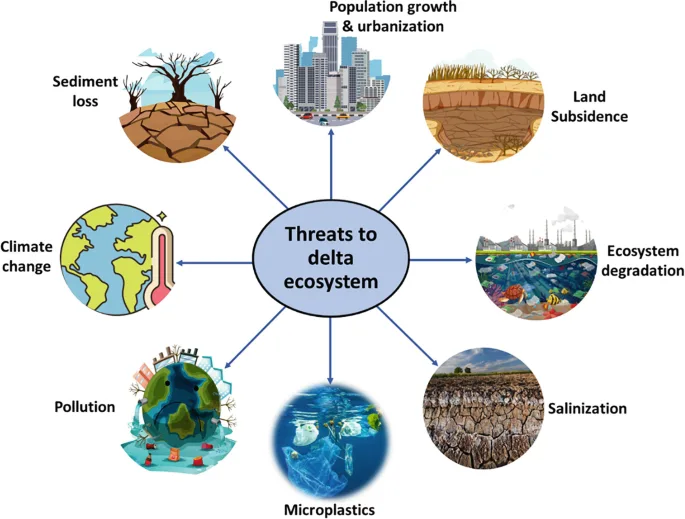
Despite their great importance for humans, agriculture, and biodiversity, deltas are under serious threat due to both natural and human activities. These threats are reducing their size, fertility, and ecological balance.
1. Dam Construction and River Management
One of the biggest threats to deltas is the construction of dams and excessive river management.
- Dams are built to control river flow, generate electricity, and provide water for irrigation, industries, and drinking purposes.
- While this helps human development, it creates serious problems for deltas.
How it affects deltas:
- Dams trap sediments (sand, silt, clay) that rivers carry.
- As a result, very little sediment reaches the delta.
- Without fresh sediment, the delta cannot grow or maintain its land.
- Over time, the delta starts shrinking.
Example:
- The Aswan High Dam has significantly reduced sediment flow to the Nile Delta, causing it to shrink.
Thus, although dams support development, they disturb the natural process of delta formation.
2. Seawater Intrusion
Seawater intrusion is another major problem affecting deltas.
- It happens when salty seawater enters freshwater areas.
- This usually occurs due to reduced river flow and excessive groundwater extraction.
Effects:
- Freshwater becomes salty (brackish or saline).
- Drinking water becomes unsafe.
- Agricultural land becomes less fertile.
- Crops get damaged due to salinity.
Example:
- In the Krishna Delta, seawater intrusion is turning freshwater into saline water.
Additional Concern:
- Increasing dams on rivers like the Krishna and Godavari reduce freshwater flow.
- Excessive groundwater and hydrocarbon extraction worsen the situation.
- This threatens both the ecosystem and millions of people living in delta regions.
3. Climate Change
Climate change is one of the most serious and long-term threats to deltas.
Major Impacts:
a) Sea Level Rise
- Rising sea levels submerge low-lying delta regions.
- This leads to loss of land and displacement of people.
b) Extreme Weather Events
- More frequent and stronger cyclones.
- Severe floods and longer droughts.
- Increased temperatures.
c) Changing River Flow
- Higher peak flows (more floods).
- Lower low flows (water scarcity).
Affected Regions:
- Irrawaddy Delta
- Ganges-Brahmaputra-Meghna Delta
- Mississippi River Delta
European Examples:
- Rhine-Meuse Delta
- Danube Delta
Climate change is increasing variability in weather and water flow, which directly affects delta ecosystems and human life.
4. Pollution
Pollution is a growing threat to deltas, especially due to human activities.
Sources of Pollution:
- Untreated sewage from cities
- Chemical fertilizers from agriculture
- Industrial waste
- Urban runoff
Effects:
- Leads to eutrophication (excess nutrients in water).
- Causes rapid growth of algae.
- Reduces oxygen levels in water.
- Creates hypoxic zones (dead zones) where aquatic life cannot survive.
Example:
- The Gulf of Mexico has a large dead zone due to pollution from the Mississippi River Delta.
Pollution not only damages aquatic life but also affects human health and livelihoods.
Important Facts About Deltas
- The Ganges-Brahmaputra Delta is the largest delta in the world.
- It spreads across India and Bangladesh and flows into the Bay of Bengal.
- The Sundarbans lies in this delta.
- It contains the world’s largest mangrove forest.
- The Selenga River Delta is the largest delta flowing into a freshwater lake.
Conclusion
Delta is a vital geographical feature formed by the deposition of sediments at the river’s mouth. It supports agriculture, biodiversity, and human civilization. However, increasing human activities and climate change are threatening these important ecosystems.
Protecting deltas is essential for maintaining ecological balance, ensuring food security, and safeguarding millions of people who depend on them.
FAQs on Delta
1. What is a Delta in geography?
A Delta is a landform formed at the mouth of a river due to the deposition of sediments like sand, silt, and clay when the river slows down and enters a larger water body.
2. How is a Delta formed?
A Delta is formed when a river loses its speed near its mouth and starts depositing sediments. Over time, these sediments accumulate and create new land, forming a Delta.
3. Why are Deltas very fertile?
Deltas are fertile because they contain nutrient-rich silt deposited by rivers. This silt supports agriculture and plant growth.
4. What are distributaries in a Delta?
Distributaries are smaller channels that branch off from the main river in a Delta region and help distribute water and sediments.
5. What are the main types of Deltas?
The main types of Deltas include:
- Arcuate Delta
- Bird’s Foot Delta
- Cuspate Delta
- Estuarine Delta
- Lacustrine Delta
6. Which is the largest Delta in the world?
The largest delta in the world is the Ganges-Brahmaputra Delta.
7. Why are Deltas important for humans?
Deltas are important because they support agriculture, provide resources, support biodiversity, and act as natural barriers against floods and cyclones.
8. What are the major threats to Deltas?
Major threats include:
- Dam construction
- Climate change
- Pollution
- Seawater intrusion
9. What is an abandoned Delta?
An abandoned Delta is formed when a river changes its course and leaves the old delta region without water flow.
10. Give an example of a famous Delta in India.
A well-known example is the Sundarbans, which is part of the Ganges Delta.