



Cross-Border Terrorism: A Major Security Challenge for India

Cross-Border Terrorism is one of the biggest security challenges faced by India and many other countries around the world. It threatens national security, creates fear among citizens, damages economic growth, and affects peace and stability. In recent years, India has continuously raised concerns about cross-border terrorism at international forums and called for stronger global cooperation to eliminate this threat.
What is Cross-Border Terrorism?
Cross-Border Terrorism refers to terrorist activities that are planned, supported, or carried out from the territory of one country against another country. In this form of terrorism, terrorist groups use the soil of one nation to launch attacks, spread violence, and create instability in neighboring countries.

It is often considered an undeclared form of war because it weakens a country through continuous small-scale attacks without direct military conflict. Terrorist organizations use violence, fear, and intimidation to achieve political, religious, or ideological goals.
According to the Prevention of Terrorism Act (POTA), 2002, terrorist activities include actions that threaten the unity, integrity, sovereignty, and security of India or create fear among the public through the use of explosives, weapons, or other dangerous methods.
Today, cross-border terrorism is not limited to physical attacks. It also includes cyber attacks, misinformation campaigns, proxy wars, funding of militant groups, and political warfare.
Why is Cross-Border Terrorism a Serious Threat?
Cross-border terrorism affects a nation in several ways:
| Impact Area | Effect |
|---|---|
| National Security | Increases security risks and border tensions |
| Human Lives | Causes deaths and injuries among civilians and security personnel |
| Economy | Damages business activities and investor confidence |
| Social Harmony | Creates fear and distrust among communities |
| International Relations | Strains diplomatic relations between countries |
Terrorist attacks not only cause immediate damage but also have long-term effects on society and development.
Factors That Encourage Cross-Border Terrorism
1. Porous Borders
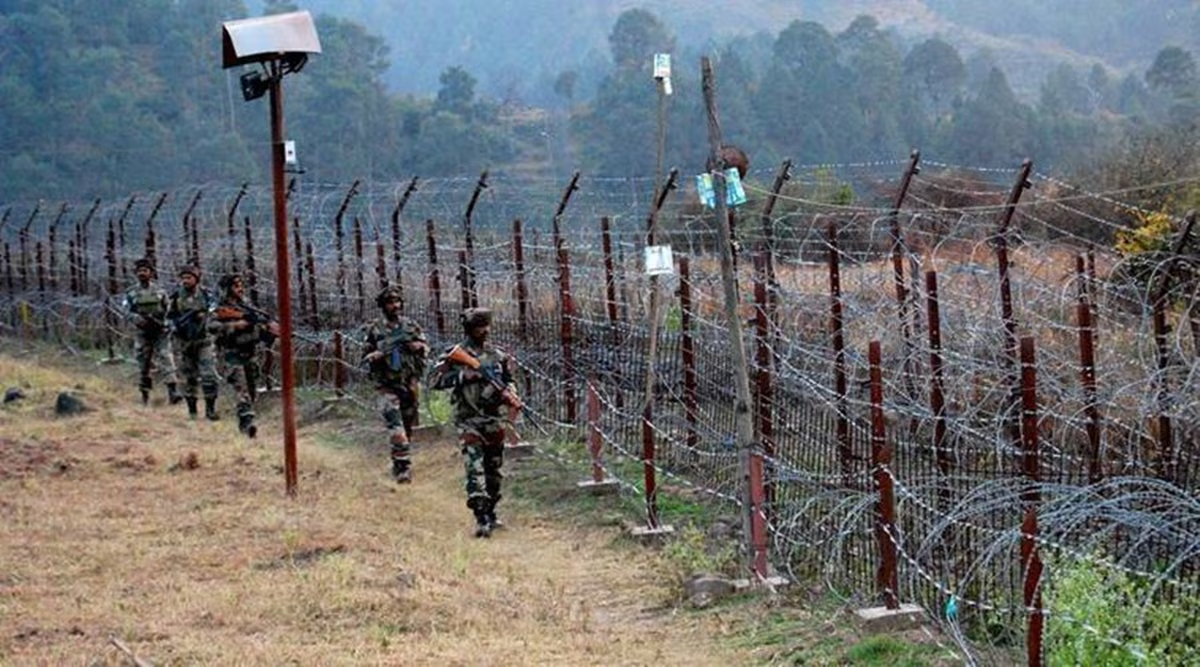
India shares long borders with several countries. Many of these borders pass through mountains, forests, rivers, deserts, and remote areas. Such geographical conditions make surveillance difficult and allow illegal crossings.
Due to these challenges, border security forces often face difficulties in monitoring every section of the border effectively.
2. Support from Non-State Actors
Certain terrorist organizations receive support from groups operating outside government control. These groups may provide training, weapons, financial assistance, shelter, and logistical support to terrorists.
Such support strengthens terrorist networks and helps them continue their activities across borders.
3. Local Assistance
Sometimes terrorists receive help from local individuals who may provide transportation, shelter, or information.
The reasons for such support can include:
- Financial incentives
- Fear of terrorist groups
- Lack of awareness
- Ethnic or cultural connections
- Dissatisfaction with local governance
4. Corruption
Corruption at border checkpoints can create opportunities for illegal entry and movement. Criminals and terrorists may exploit weak monitoring systems to cross borders using fake identities.
5. Smuggling Networks
Smuggling routes used for drugs, weapons, and counterfeit currency often become channels for terrorist activities. These networks help terrorists transport resources needed for attacks.
India’s International Borders
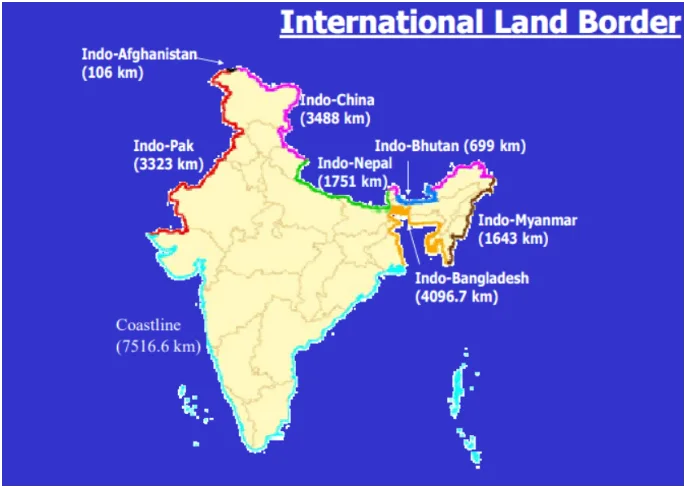
India has one of the largest border networks in the world.
| Border Type | Length |
|---|---|
| Land Border | 15,106.7 km |
| Coastline | 7,516.6 km |
India shares land borders with:
- Pakistan
- China
- Nepal
- Bhutan
- Bangladesh
- Myanmar
- Afghanistan (through the region claimed as part of Jammu and Kashmir)
India also shares maritime boundaries with several countries, including Bangladesh, Sri Lanka, Maldives, Myanmar, Thailand, Indonesia, and Pakistan.
The vast size of these borders makes security management a complex task.
Cross-Border Terrorism Along Different Borders
Indo-Pakistan Border
The India-Pakistan border is approximately 3,323 kilometers long and passes through Gujarat, Rajasthan, Punjab, and Jammu and Kashmir.
This border has witnessed infiltration attempts, terrorist activities, arms smuggling, and illegal movement of militants over the years.
Modern communication technology and digital financial systems have also made it easier for terrorist organizations to coordinate activities across borders.
Indo-Bangladesh Border
The India-Bangladesh border is around 4,096 kilometers long and passes through West Bengal, Assam, Meghalaya, Tripura, and Mizoram.
The border consists of rivers, forests, hills, and open land, making surveillance difficult.
Major concerns include:
- Illegal migration
- Smuggling of drugs
- Arms trafficking
- Fake currency circulation
These activities can indirectly support terrorist operations.
Indo-China Border
India shares a 3,488-kilometer border with China.
Although this border is less affected by illegal migration, it remains strategically important due to unresolved boundary disputes and security concerns.
Indian security forces maintain constant vigilance in these sensitive regions.
Indo-Nepal Border
The India-Nepal border is approximately 1,751 kilometers long and remains largely open.
People from both countries can move freely across many points.
While this arrangement supports friendly relations, it also creates challenges such as:
- Smuggling
- Fake currency circulation
- Illegal arms movement
- Terrorist infiltration
Indo-Bhutan Border
The India-Bhutan border extends for around 699 kilometers.
Dense forests in some areas have previously been used by militant groups to establish camps and carry out anti-India activities.
Indo-Myanmar Border
The India-Myanmar border stretches about 1,643 kilometers and passes through Arunachal Pradesh, Nagaland, Manipur, and Mizoram.
Some insurgent groups have historically operated in border regions, making cooperation between India and Myanmar important for regional security.
Maritime Security and Terrorism
Cross-border terrorism is not limited to land borders.
India’s long coastline also presents security challenges.
The 2008 Mumbai terrorist attacks demonstrated how terrorists could use sea routes to enter the country. Since then, coastal security has become a major focus area for India’s security agencies.
Protecting maritime borders requires:
- Coast Guard patrols
- Naval surveillance
- Coastal radar systems
- Port security measures
Steps Taken by India to Combat Cross-Border Terrorism
India has introduced several measures to strengthen national security.
National Investigation Agency (NIA)
The National Investigation Agency was established in 2008 after the Mumbai attacks.
Its main responsibilities include:
- Investigating terrorism-related cases
- Gathering intelligence
- Coordinating with other security agencies
Multi Agency Centre (MAC)
The Multi Agency Centre helps different intelligence and security organizations share information quickly.
This improves coordination and helps prevent terrorist attacks.
Combating Financing of Terrorism Cell
The Combating Financing of Terrorism Cell focuses on:
- Tracking terrorist funding
- Monitoring suspicious financial transactions
- Preventing fake currency circulation
Participation in FATF
India is a member of the Financial Action Task Force.
The organization develops international standards to combat money laundering and terrorist financing.
Border Infrastructure Development
The government has strengthened border security through:
- Border fencing
- Floodlighting
- Observation posts
- Surveillance cameras
- Drones
- Advanced sensors
Comprehensive Integrated Border Management System (CIBMS)
The Comprehensive Integrated Border Management System uses modern technology for border monitoring.
It includes:
- Thermal imaging devices
- Motion sensors
- Smart surveillance systems
- Command and control centers
These technologies improve detection and interception capabilities.
International Cooperation
India actively participates in global efforts against terrorism.
The country has consistently advocated stronger international action through organizations such as the United Nations and the Shanghai Cooperation Organization.
India has also promoted the proposed Comprehensive Convention on International Terrorism to establish a stronger global legal framework against terrorism.
The Way Forward
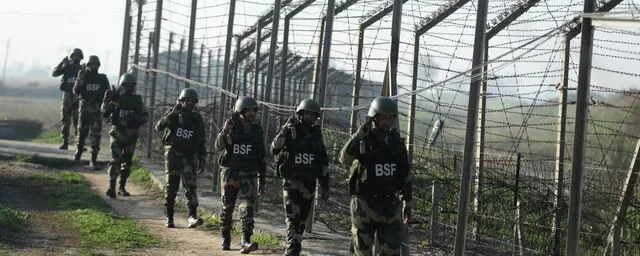
To effectively tackle cross-border terrorism, India needs a balanced approach that combines security measures, technology, diplomacy, and public cooperation.
Important steps include:
- Strengthening intelligence networks
- Enhancing border infrastructure
- Increasing use of modern surveillance technology
- Improving coordination among security agencies
- Expanding international cooperation
- Preventing terrorist financing
- Raising public awareness
- Improving coastal security
- Training specialized counter-terrorism forces
A combination of skilled manpower and advanced technology can significantly improve India’s ability to detect and prevent terrorist activities.
Cross-border terrorism remains a long-term challenge that requires continuous vigilance, strong national policies, and global cooperation. With improved border management, modern security systems, and coordinated international efforts, India can strengthen its defense against this serious threat and contribute to global peace and security.
FAQs on Cross-Border Terrorism
1. What is Cross-Border Terrorism?
Cross-Border Terrorism refers to terrorist activities planned or supported from one country and carried out in another country.
2. Why is cross-border terrorism dangerous?
It threatens national security, causes loss of life, damages the economy, and creates fear among citizens.
3. Which Indian border faces the highest terrorism-related challenges?
The India-Pakistan border has historically faced significant terrorism and infiltration-related challenges.
4. What is the role of the National Investigation Agency (NIA)?
The NIA investigates terrorism-related crimes and coordinates with security agencies to prevent terrorist activities.
5. What is CIBMS?
The Comprehensive Integrated Border Management System is a technology-based border surveillance system that helps detect infiltration and illegal movement.
6. How does terrorism financing support terrorist groups?
Funding helps terrorist organizations purchase weapons, recruit members, arrange training, and carry out attacks.
7. What role does technology play in border security?
Technology such as drones, sensors, thermal cameras, and surveillance systems helps monitor borders more effectively.
8. Why is international cooperation important against terrorism?
Terrorism often operates across multiple countries, making international coordination essential for intelligence sharing and law enforcement.