



National Supercomputer Mission: Building India’s Future in High-Performance Computing

National Supercomputer Mission is one of India’s most important technology initiatives aimed at developing world-class supercomputing infrastructure across the country. The mission was launched to strengthen India’s scientific research capabilities, improve technological innovation, and make the country self-reliant in the field of advanced computing.
In today’s digital age, massive amounts of data are generated every second. Solving complex scientific problems, predicting weather patterns, designing advanced medicines, and conducting national security operations require computing systems that are much more powerful than ordinary computers. This is where supercomputers play a crucial role.

What is a Supercomputer?
A supercomputer is a highly advanced computer capable of performing billions or even trillions of calculations within a second. Unlike normal computers used in homes and offices, supercomputers are designed to handle extremely large and complicated calculations.
The speed of a supercomputer is measured in units such as Teraflops and Petaflops.
| Unit | Meaning |
|---|---|
| Teraflop | One trillion calculations per second |
| Petaflop | One thousand trillion calculations per second |
| Exaflop | One billion billion calculations per second |
These powerful machines are used for scientific research, weather forecasting, space exploration, defense applications, and artificial intelligence.
Why Was the National Supercomputer Mission Launched?
India recognized the growing importance of high-performance computing in scientific and technological development. Many advanced countries such as the United States, China, and Japan had already built powerful supercomputing networks.
To ensure that Indian scientists and researchers had access to modern computing facilities, the Government of India launched the National Supercomputer Mission (NSM).
The mission aims to create a nationwide supercomputing infrastructure and develop indigenous technology so that India becomes less dependent on foreign hardware and software.
Background of the Mission
The National Supercomputer Mission was approved by the Government of India with a planned investment of around ₹4,500 crore over several years.
The mission is jointly implemented by:
| Implementing Agency | Role |
| Department of Science and Technology (DST) | Scientific coordination |
| Ministry of Electronics and Information Technology (MeitY) | Technology development |
| Centre for Development of Advanced Computing (C-DAC) | Supercomputer development |
| Indian Institute of Science (IISc), Bengaluru | Research support |
These institutions work together to build and operate India’s supercomputing ecosystem.
Objectives of the National Supercomputer Mission
The mission has several important goals:
1. Make India a Global Leader
The mission aims to place India among the leading nations in supercomputing technology.
2. Support Scientific Research
Researchers need powerful computing systems to solve complex scientific problems. NSM provides the infrastructure required for advanced research.
3. Develop Indigenous Technology
India wants to reduce dependence on imported technologies and build its own supercomputing systems.
4. Train Skilled Professionals
The mission plans to create a large pool of experts who can design, manage, and use supercomputers effectively.
5. Strengthen National Security
Advanced computing is important for defense simulations, cybersecurity, and strategic planning.
Key Features of the National Supercomputer Mission
The mission includes the establishment of more than 70 high-performance computing facilities across the country.
Some major features include:
- Creation of a nationwide supercomputing network.
- Development of indigenous hardware and software.
- Linking institutions through a common computing grid.
- Promotion of research and innovation.
- Training of thousands of students and professionals.
National Supercomputing Grid
One of the most significant components of the mission is the National Supercomputing Grid.
Under this system, supercomputers installed at different institutions are connected through the National Knowledge Network (NKN).
The National Knowledge Network is a high-speed digital network connecting universities, research institutions, laboratories, and educational organizations throughout India.
This network allows researchers from different locations to access computing resources efficiently.
PARAM Shivay: India’s Indigenous Achievement
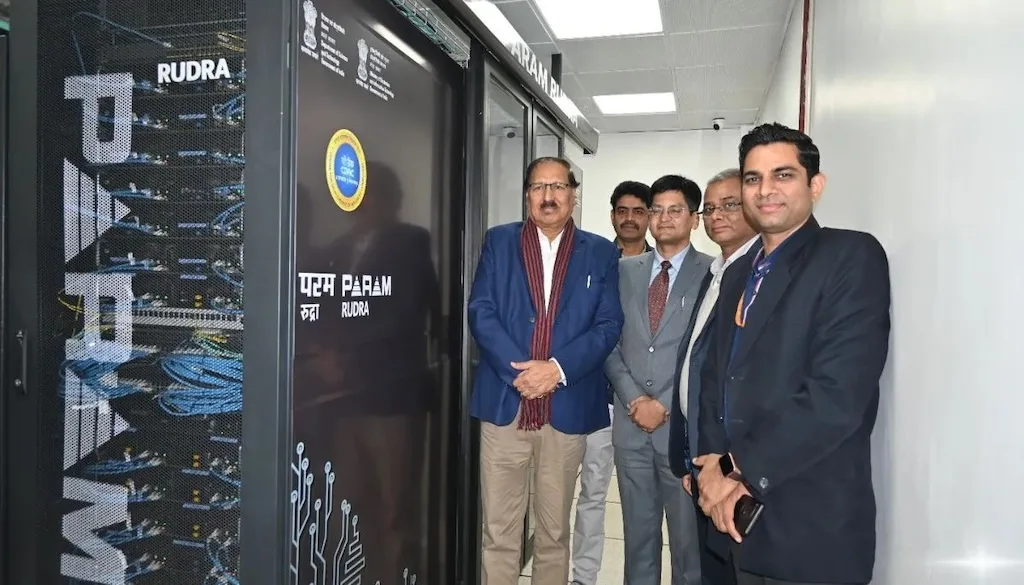
A major achievement under the National Supercomputer Mission was the development of PARAM Shivay.
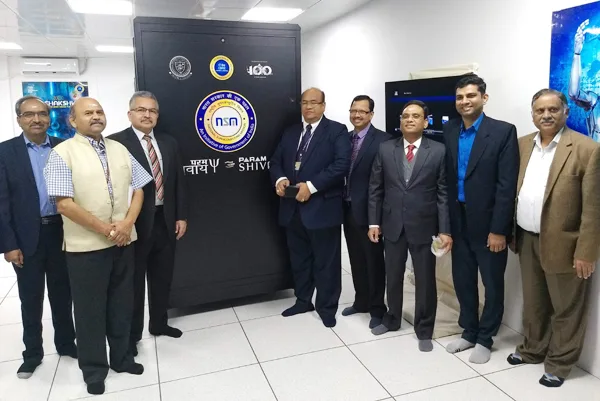
PARAM Shivay was designed and built by C-DAC and installed at the Indian Institute of Technology (BHU), Varanasi.
The system provides a peak computing performance of around 833 Teraflops and uses more than one lakh compute cores.
The successful development of PARAM Shivay demonstrated India’s capability to build advanced supercomputing systems domestically.
Other Important Supercomputers Under the Mission
Several educational institutions have received powerful supercomputing facilities.
| Institution | Computing Capacity |
| IIT Kharagpur | Advanced HPC Facility |
| IIT (BHU), Varanasi | Around 1 Petaflop |
| IIITM Pune | Around 650 Teraflops |
| Other Research Institutions | High-performance computing support |
These systems help students, scientists, and researchers perform advanced computational work.
India’s Supercomputing Journey
India’s supercomputer development began in the late 1980s.
At that time, India wanted to import Cray supercomputers from the United States. However, due to technology restrictions, the country could not obtain them.
As a result, India decided to build its own supercomputers.
This led to the establishment of the Centre for Development of Advanced Computing (C-DAC) in 1988.
PARAM 8000
In 1991, India successfully developed PARAM 8000, the country’s first indigenous supercomputer.
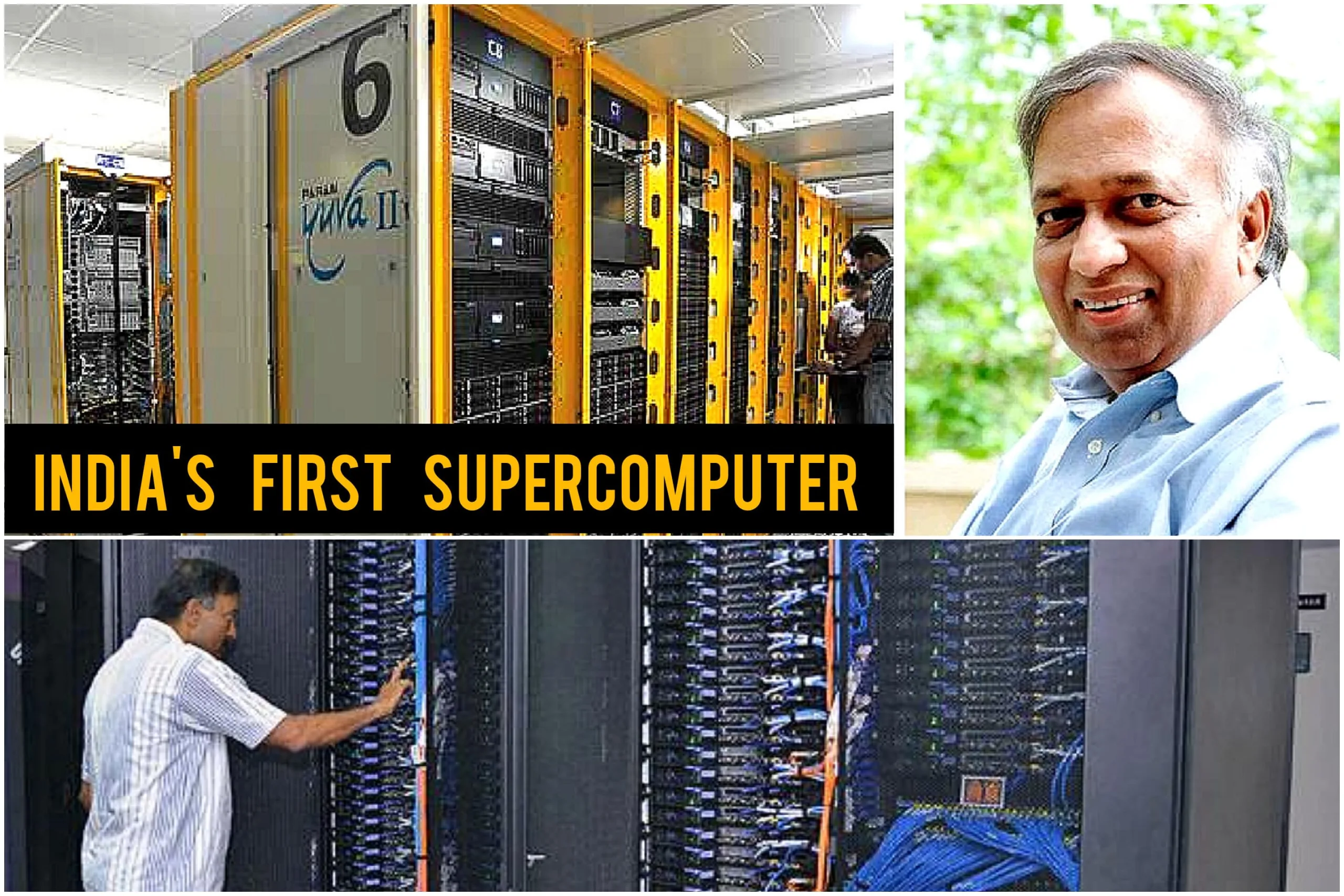
This achievement marked the beginning of India’s journey toward technological self-reliance in high-performance computing.
Applications of Supercomputers
Supercomputers have a wide range of applications that benefit society in many ways.
Weather Forecasting
Accurate weather prediction requires analyzing massive amounts of atmospheric data.
Supercomputers help forecast:
- Rainfall
- Cyclones
- Heatwaves
- Floods
- Droughts
Climate Change Studies
Scientists use supercomputers to understand climate change and its future impacts.
Healthcare and Drug Discovery
Researchers can simulate molecular interactions and develop new medicines faster.
Artificial Intelligence
AI systems require huge computational resources for training and data analysis.
Space Research
Supercomputers assist in studying galaxies, stars, black holes, and planetary systems.
Defense and National Security
They help perform defense simulations and strategic planning exercises.
Earthquake and Disaster Management
Scientists can predict disaster patterns and improve preparedness measures.
Financial Services
Banks and financial institutions use high-performance computing for risk analysis and fraud detection.
India’s Fastest Supercomputers
Over the years, India has developed several powerful supercomputers.
Pratyush
Pratyush is one of India’s most powerful supercomputers.
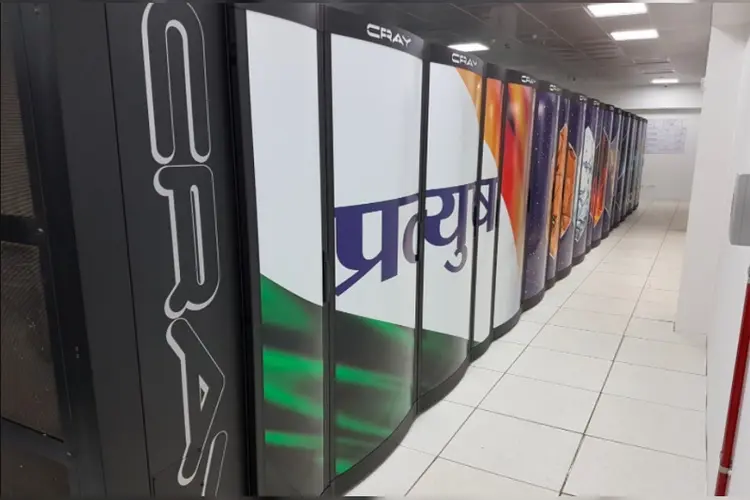
Installed at the Indian Institute of Tropical Meteorology (IITM), Pune, it has a peak performance of approximately 6.8 Petaflops.
Pratyush is widely used for:
- Climate modeling
- Monsoon forecasting
- Weather research
- Environmental studies
Mihir
Mihir is another advanced weather forecasting supercomputer located at the National Centre for Medium Range Weather Forecasting.
It plays an important role in improving weather prediction accuracy.
Benefits of the National Supercomputer Mission
The mission provides numerous advantages for India.
Boost to Research and Innovation
Researchers gain access to powerful computational tools, enabling faster scientific discoveries.
Support for Digital India
The mission supports India’s digital transformation and technological modernization.
Promotion of Make in India
Developing indigenous supercomputers reduces dependence on imported technologies.
Economic Growth
Advanced computing can improve industrial productivity and attract investment in research and development.
Human Resource Development
Thousands of students and professionals receive specialized training in high-performance computing.
Better Public Services
Improved weather forecasting, disaster management, healthcare research, and agricultural planning directly benefit citizens.
Challenges Facing the Mission
Despite its achievements, the mission faces several challenges.
Dependence on Imported Components
Many advanced hardware components still need to be imported.
High Cost
Building and maintaining supercomputers requires significant financial investment.
Skilled Workforce Requirements
Operating supercomputers demands highly trained professionals.
Coordination Among Agencies
The mission involves multiple organizations, making coordination and management challenging.
Rapid Technological Changes
Supercomputing technology evolves quickly, requiring continuous upgrades and investments.
Future of Supercomputing in India
The future of the National Supercomputer Mission looks promising.
India is increasingly focusing on:
- Artificial Intelligence
- Quantum Computing
- Big Data Analytics
- Cybersecurity
- Advanced Scientific Research
As indigenous technologies improve, India is expected to build more powerful and energy-efficient supercomputers.
Future systems may reach exascale computing levels, enabling calculations that are currently impossible.
The development of domestic hardware manufacturing capabilities will further strengthen India’s position in the global technology landscape.
Importance of the Mission for Students
The National Supercomputer Mission creates opportunities for students in:
- Computer Science
- Artificial Intelligence
- Data Science
- Electronics Engineering
- Computational Biology
- Climate Science
- Aerospace Engineering
Students can gain hands-on experience with advanced computing systems and contribute to cutting-edge research projects.
Final Thoughts
National Supercomputer Mission represents a major step toward technological self-reliance and scientific advancement in India. By building a nationwide network of supercomputers, supporting research institutions, and developing skilled professionals, the mission is helping India strengthen its position in the global technology sector.
With growing applications in artificial intelligence, weather forecasting, healthcare, defense, and scientific research, supercomputers will continue to play a vital role in India’s development. As the mission progresses, it is expected to drive innovation, enhance research capabilities, and contribute significantly to the country’s digital and technological future.
FAQs on National Supercomputer Mission
1. What is the National Supercomputer Mission?
The National Supercomputer Mission (NSM) is a Government of India initiative launched to develop a network of supercomputers across the country and strengthen scientific research and technological innovation.
2. When was the National Supercomputer Mission launched?
The mission was approved in 2015 and is jointly implemented by the Department of Science and Technology (DST) and the Ministry of Electronics and Information Technology (MeitY).
3. What is the main objective of the National Supercomputer Mission?
Its main objective is to make India a global leader in supercomputing, support advanced research, and develop indigenous high-performance computing technologies.
4. What is a supercomputer?
A supercomputer is an extremely powerful computer capable of performing trillions of calculations per second, used for complex scientific and engineering tasks.
5. What is PARAM Shivay?
PARAM Shivay is one of the first supercomputers developed under the National Supercomputer Mission. It was built by C-DAC and installed at IIT (BHU), Varanasi.
6. Which organizations are implementing the National Supercomputer Mission?
The mission is being implemented by:
- Department of Science and Technology (DST)
- Ministry of Electronics and Information Technology (MeitY)
- Centre for Development of Advanced Computing (C-DAC)
- Indian Institute of Science (IISc), Bengaluru
7. How many supercomputers are planned under the mission?
The mission aims to establish more than 70 high-performance computing facilities across India.
8. What is the National Knowledge Network (NKN)?
The National Knowledge Network is a high-speed network that connects universities, research institutions, and laboratories, enabling access to supercomputing resources.