Temperature Inversion – Complete Explanation, Types, Causes and Effects

Temperature Inversion is an important concept in physical geography and meteorology. Under normal atmospheric conditions, the temperature of air decreases with increase in altitude. This normal pattern is known as the normal lapse rate, where temperature falls by about 1°C for every 165 metres in the lower atmosphere (troposphere).
Thank you for reading this post, don't forget to subscribe!However, sometimes this normal pattern gets reversed. Instead of decreasing, the temperature increases with height. This unusual condition is called temperature inversion.
In simple words, temperature inversion means a reversal of normal temperature conditions in the atmosphere, where warm air lies above cold air instead of the usual cold-over-warm structure.
This phenomenon may seem simple, but it has major impacts on weather, climate, pollution, agriculture, and human life.
Meaning and Definition of Temperature Inversion
Temperature inversion can be defined as:
A meteorological condition in which a layer of warm air overlies a layer of colder air, reversing the normal temperature pattern in the troposphere.
Normally:
- Warm air is near the ground
- Cold air is above
During inversion:
- Cold air is near the ground
- Warm air is above
This creates a stable atmospheric condition, where vertical movement of air is restricted.
Normal Lapse Rate vs Temperature Inversion
Normal Lapse Rate
- Temperature decreases with height
- Air near surface is warmer
- Air can rise easily → leads to cloud formation and rainfall
Temperature Inversion
- Temperature increases with height
- Cold air is trapped near surface
- Air cannot rise → stable conditions
This difference is very important in understanding weather patterns.

How Temperature Inversion Occurs
Temperature inversion occurs mainly due to:
- Cooling of the earth’s surface
- Lack of air movement
- Specific weather conditions
There are two main mechanisms:
- Cooling of lower air layers
- Warming of upper air layers
Favourable Conditions for Temperature Inversion
Certain environmental and atmospheric conditions make temperature inversion more likely:
1. Long Winter Nights
During long nights, the earth loses heat rapidly through terrestrial radiation. If heat loss is greater than incoming solar radiation, the surface becomes very cold, cooling the air near it.
2. Clear and Cloudless Sky
Clouds act like a blanket and trap heat. When the sky is clear:
- Heat escapes easily
- Rapid cooling occurs
- Inversion develops quickly
3. Dry Air Near Surface
Dry air does not absorb heat effectively. So:
- Heat radiates quickly into space
- Surface cools faster
- Inversion forms easily
4. Calm or Slow Wind
Strong winds mix air layers and prevent inversion. But when air is calm:
- No mixing of warm and cold air
- Cold air remains trapped below
5. Snow-Covered Ground
Snow reflects solar radiation and also loses heat quickly. This leads to:
- Extreme cooling of surface
- Strong inversion conditions
Types of Temperature Inversion
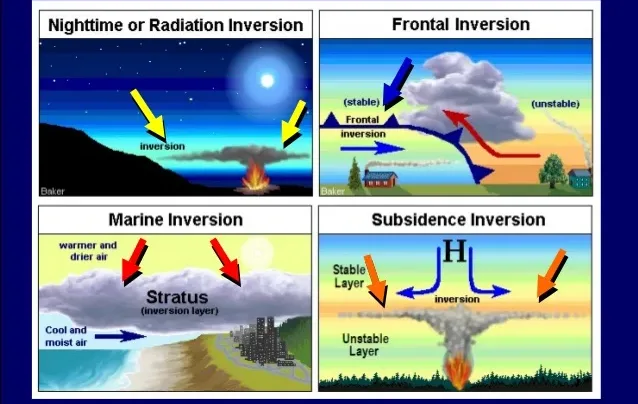
Temperature inversion can occur under different atmospheric conditions, ranging from the ground surface to higher altitudes. Because of this variation, temperature inversion is classified based on height above the Earth’s surface and type of air movement involved.
Broadly, temperature inversion is divided into two main types:
1. Non-Advectional Temperature Inversion
This type of inversion occurs without horizontal movement of air. It mainly depends on local atmospheric conditions, such as cooling of the surface or vertical movement of air.
A. Radiation Inversion (Surface Temperature Inversion)
Radiation inversion is the most common type of temperature inversion, especially near the Earth’s surface.
How It Forms
- It develops when the Earth’s surface loses heat rapidly through terrestrial radiation, especially during clear nights.
- The air in contact with the cold surface also cools down and becomes colder than the air above it.
- As a result, a layer of cold air forms near the ground, while warmer air remains above, creating inversion.
- If the surface air temperature falls below its dew point, fog may form.
Key Features
- Occurs mainly during clear, cloudless nights
- Strongest in winter season
- More common in higher latitudes
- In tropical and middle latitudes, it forms during cold nights and disappears during the day
Effects
- Formation of fog, frost, and dew
- Reduced visibility
- Cold conditions near the ground
B. Subsidence Inversion (Upper Surface Temperature Inversion)
Subsidence inversion occurs at higher altitudes due to the downward movement of air.
How It Forms
- A large mass of air descends (subsides) from higher altitudes
- As it descends, it gets compressed due to increased atmospheric pressure
- This compression causes the air to heat up
- The upper air becomes warmer than the lower air, creating inversion
Key Features
- Occurs in high-pressure areas
- Produces a very stable atmosphere
- Can persist for a longer duration than surface inversion
- Also called upper surface temperature inversion
Regions
- Common over northern continents during winter (dry atmosphere)
- Occurs over subtropical oceans
- Associated with large high-pressure systems
2. Advectional Temperature Inversion
This type of inversion occurs due to the horizontal movement of air (advection). It is influenced by terrain and interaction of different air masses.
A. Valley Inversion (Intermontane Valley Inversion)
This type is commonly found in mountainous and valley regions.
How It Forms
- During night, mountain slopes lose heat rapidly through radiation
- The air near the slopes becomes cold, dense, and heavy
- This cold air flows downward along the slopes and accumulates in the valley bottom
- As a result, a cold air layer settles in the valley, while the upper layers remain warmer
Detailed Process
- The surface cools faster than upper layers
- Cold air gets condensed and heavy
- Due to sloping terrain, it moves downward and collects at the lowest point
- This creates a zone of low temperature in valleys, opposite to normal conditions
Key Features
- Cold air trapped in valleys
- Warmer air above
- Opposite of normal vertical temperature distribution
Examples
- Himalayan valleys
- Alpine mountain regions
Effects
- Formation of frost
- Accumulation of fog
- Extremely cold conditions in valley bottoms
B. Frontal or Cyclonic Inversion
This type of inversion occurs when two different air masses (warm and cold) meet, usually along a front.
How It Forms
- When a warm air mass meets a cold air mass, the warm air (being lighter) rises above
- The cold air (being heavier) sinks below
- This creates a layer where warm air lies above cold air, forming inversion
Key Features
- Has a sloping structure, unlike other inversions which are mostly horizontal
- Common in temperate regions
- Associated with cyclonic weather conditions
Effects
- Leads to precipitation in different forms (rain, snow, etc.)
- Causes unstable weather conditions
- The inversion is temporary and gets destroyed as weather changes
Effects of Temperature Inversion
Temperature inversion has wide-ranging impacts on weather, environment, and human life.
1. Impact on Weather and Climate
- Prevents vertical air movement
- Leads to stable atmospheric conditions
- Reduces cloud formation
2. Formation of Fog
When cold air near surface reaches dew point:
- Water vapor condenses
- Fog forms
This reduces visibility significantly.
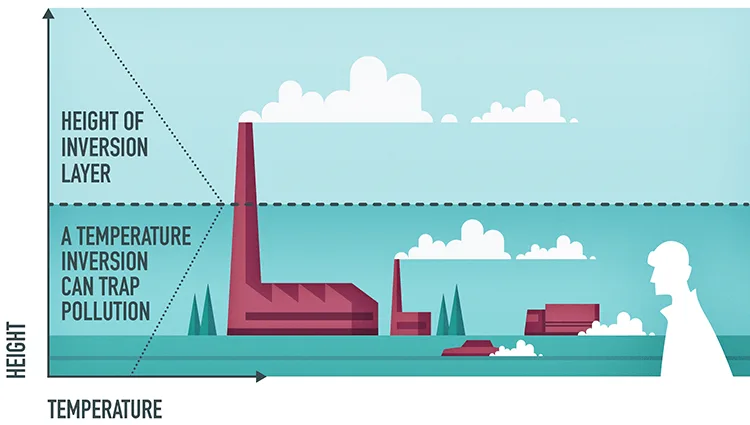
3. Air Pollution and Smog
One of the most serious effects.
- Pollutants like smoke and dust get trapped
- No vertical mixing
- Leads to smog formation
This is common in cities like:
- Delhi
- Los Angeles (historically)
4. Reduced Rainfall
- Air cannot rise to form clouds
- No convection currents
- Results in low rainfall
This affects agriculture negatively.
5. Frost Formation
- Cold air near surface causes frost
- Damages crops
- Common in valleys and plains during winter
6. Reduced Visibility
- Fog and pollution reduce visibility
- Affects:
- Road transport
- Air travel
- Railways
7. Impact on Agriculture
- Crops may get damaged due to frost
- Reduced rainfall affects yield
- However, sometimes it protects crops from extreme cold winds
8. Thunderstorms and Tornadoes
Though inversion generally stabilizes air, when it breaks:
- Sudden release of energy occurs
- Can lead to intense thunderstorms or tornadoes
9. Small Diurnal Temperature Variation
- Day and night temperature difference becomes small
- Due to stable atmospheric conditions
Importance of Temperature Inversion
Temperature inversion is not always harmful. It has both positive and negative effects.
Positive Aspects
- Helps in formation of dew (useful for crops in dry regions)
- Maintains stable weather conditions
Negative Aspects
- Causes pollution problems
- Leads to fog and accidents
- Reduces agricultural productivity
Temperature Inversion in India
In India, temperature inversion is common during:
- Winter season
- Especially in northern plains
Major Affected Areas
Reasons
- Calm winds
- High pollution levels
- Cold nights
Real-Life Example
A well-known example of temperature inversion effects is:
Delhi Smog
During winter:
- Cold air gets trapped near surface
- Pollutants accumulate
- Thick smog forms
This leads to:
- Health problems
- Transport disruption
- Poor air quality
Conclusion
Temperature inversion is a crucial meteorological phenomenon that plays a major role in shaping weather patterns and environmental conditions. It represents a reversal of the normal temperature structure, where warm air overlies cold air, creating a stable atmospheric condition.
While it may seem like a simple process, its effects are far-reaching from fog formation and pollution trapping to reduced rainfall and agricultural impacts.
Understanding temperature inversion is important for:
- Weather forecasting
- Environmental protection
- Urban planning
- Disaster management
With increasing pollution and climate change, temperature inversion has become even more significant in modern times, especially in urban areas.
FAQs on Temperature Inversion
1. What is temperature inversion in simple words?
It is a condition where temperature increases with height instead of decreasing.
2. When does temperature inversion occur?
It usually occurs during winter nights, especially when the sky is clear and winds are calm.
3. Why is temperature inversion dangerous?
Because it traps pollutants near the ground, causing smog and health problems.
4. What is the difference between lapse rate and inversion?
Lapse rate means temperature decreases with height, while inversion means temperature increases with height.
5. Where is temperature inversion common in India?
It is common in northern plains like Delhi, Punjab, and Uttar Pradesh during winter.