Cyclone: Complete Guide to Formation, Types, Impacts and Management

Cyclone is one of the most powerful and destructive natural phenomena on Earth. It refers to a system of winds rotating inward toward a low-pressure center. These winds move in an anticlockwise direction in the Northern Hemisphere and clockwise in the Southern Hemisphere due to the effect of Earth’s rotation.
Thank you for reading this post, don't forget to subscribe!Cyclones are usually associated with heavy rainfall, strong winds, thunderstorms, and storm surges, making them one of the most dangerous natural disasters, especially for coastal regions.
The word cyclone comes from the Greek word “Kyklos”, meaning a coil or circle, symbolizing the circular motion of winds. The term was first used by Henry Piddington, who studied storms in the Indian Ocean and compared them to coiled serpents.
In recent years, cyclones have gained attention due to extreme weather events like Cyclone Amphan (2020) and Cyclone Nisarga (2020), which caused widespread damage in India.
What is a Cyclone?
A cyclone is defined as a large-scale air mass that rotates around a strong center of low atmospheric pressure. Air flows from high-pressure areas to low-pressure areas, and due to the Earth’s rotation (Coriolis force), the air starts spinning.
Key Features of Cyclones
- Low-pressure center (Eye)
- Strong rotating winds
- Heavy rainfall and thunderstorms
- Formation over oceans (mostly tropical cyclones)
- Large diameter (can extend up to hundreds of kilometers)
Types of Cyclones
Cyclones are broadly classified into two main categories:
1. Tropical Cyclones
These cyclones develop over warm ocean waters in tropical regions.
2. Extratropical Cyclones
These cyclones occur in temperate regions and are associated with weather fronts.
Tropical Cyclones
Meaning
Tropical cyclones are violent and intense circular storms that originate over warm tropical oceans and move toward coastal areas, causing large-scale destruction through strong winds, very heavy rainfall, and storm surges. They are considered one of the most devastating natural calamities in the world due to their widespread impact on life, property, and the environment.
Characteristics
- Develop between the Tropic of Cancer and Tropic of Capricorn
- Require warm sea surface temperatures (above 27°C)
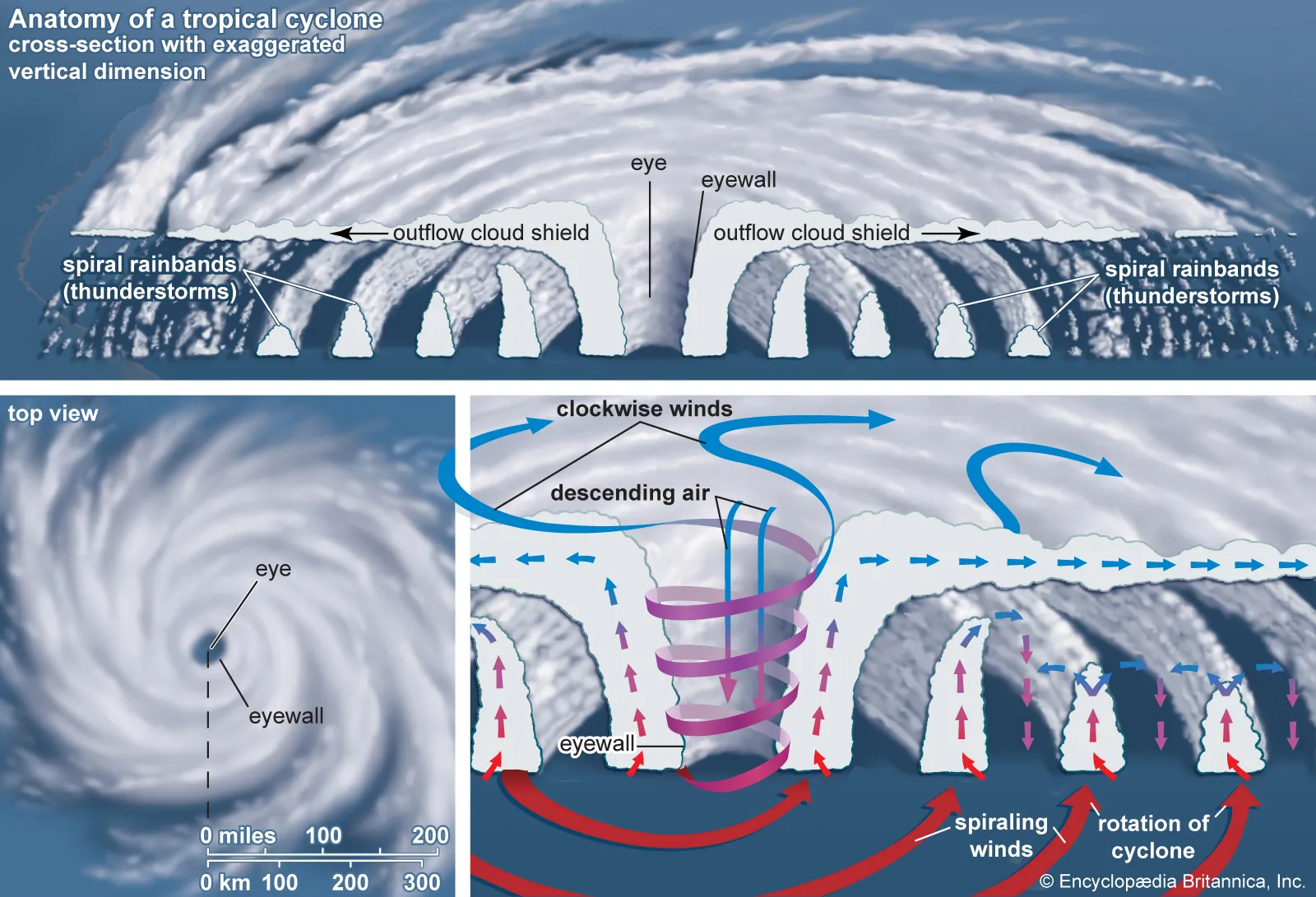
- Have a well-defined center called the Eye (low-pressure center)
- Associated with spiral cloud bands and intense thunderstorms
- Extremely destructive in nature due to combined effects of wind, rain, and sea waves
Conditions Necessary for Formation of Tropical Cyclones
Tropical cyclones originate and intensify over warm tropical oceans when certain favourable conditions are present:
- Large Sea Surface with High Temperature
- Temperature must be higher than 27°C to provide sufficient energy through evaporation.
- Presence of the Coriolis Force
- Helps in the rotation of winds, giving the cyclone its circular motion.
- Low Vertical Wind Shear
- Small variations in wind speed allow the storm to develop vertically without disruption.
- Pre-existing Low Pressure Area
- A weak low-pressure system or cyclonic circulation acts as the starting point.
- Upper Air Divergence
- Helps in removing rising air, maintaining continuous upward motion and strengthening the system.
Stages of Tropical Cyclone Formation
The development cycle of tropical cyclones is divided into three major stages:
1. Formation and Initial Development Stage
- The formation begins with the transfer of heat and water vapour from the warm ocean surface to the air above, mainly through evaporation.
- Warm, moist air rises upward, creating low pressure at the surface.
- This rising air cools and condenses, forming massive vertical cumulus clouds.
- Continuous convection leads to the gradual organization of the storm system.
2. Mature Stage
- As the cyclone intensifies, air rises rapidly in powerful thunderstorms.
- The rising air spreads outward at the tropopause level, creating high pressure aloft.
- This results in downward movement (subsidence) of air, which warms by compression.
- A distinct warm ‘Eye’ (low-pressure center) is formed at the core.
- The cyclone develops a concentric pattern of dense, highly turbulent cumulonimbus cloud bands, especially visible in the Indian Ocean region.
- This stage is marked by maximum wind speed, heavy rainfall, and full cyclone strength.
3. Modification and Decay Stage
- The cyclone begins to weaken when its source of warm, moist air is reduced or cut off.
- This usually happens when:
- The cyclone makes landfall, or
- It moves over cold ocean waters
- The system loses energy, leading to a decrease in wind speed, pressure difference, and internal heat, eventually causing the cyclone to dissipate.
Structure of a Tropical Cyclone
A tropical cyclone has three main structural components:
1. Eye
- The central calm region of the cyclone
- Characterized by clear skies and low pressure
- Typically ranges from 20–50 km in diameter
2. Eyewall
- Surrounds the eye
- Contains the strongest winds and heaviest rainfall
- Most dangerous part of the cyclone
3. Rainbands
- Spiral bands of clouds extending outward
- Produce continuous rainfall and thunderstorms
- Can affect areas far from the cyclone’s center
Nomenclature of Cyclones
Cyclones are named to improve communication and awareness.
Naming Authority
The naming process is managed by the World Meteorological Organization (WMO).
Indian Ocean Naming System
Countries like India, Bangladesh, Sri Lanka, Myanmar, Oman, Pakistan, Maldives, and Thailand contribute names.
Examples
- Amphan
- Fani
- Hudhud
- Titli
- Vayu
Different Names of Cyclones Across the World
Cyclones are known by different names in different regions:
| Region | Name |
|---|---|
| Atlantic Ocean | Hurricanes |
| Pacific Ocean | Typhoons |
| Indian Ocean | Cyclones |
| Australia | Willy-willies |
| USA (local storms) | Tornadoes |
Extratropical Cyclones
Definition
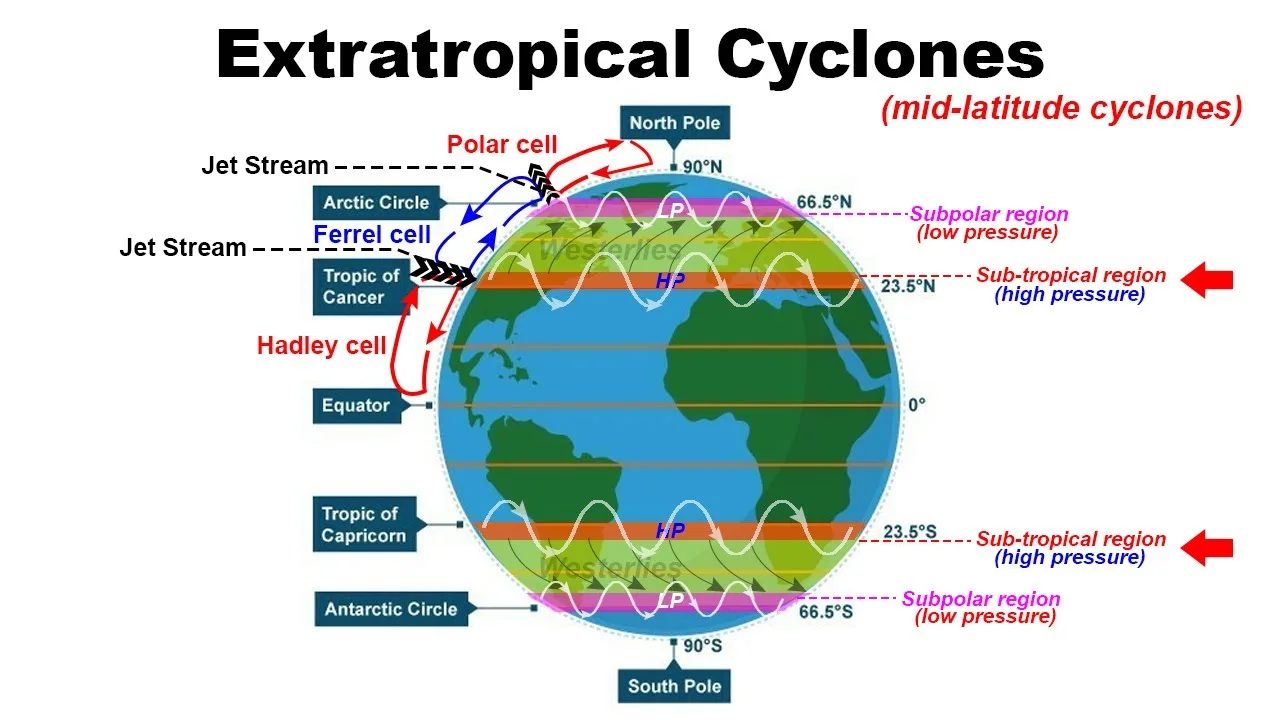
Extratropical cyclones are large weather systems that occur outside the tropical regions. They are also known by several names such as:
- Temperate cyclones
- Mid-latitude cyclones
- Frontal cyclones
- Wave cyclones
- Mid-latitude depressions
These cyclones are different from tropical cyclones because they form in regions where there is a strong contrast in temperature.
Location
Extratropical cyclones are mainly found in the mid-latitudinal regions between 35° and 65° latitude in both the Northern and Southern Hemispheres.
These regions are important because they are the meeting zones of:
- Warm tropical air masses
- Cold polar air masses
This meeting leads to the formation of fronts, which are essential for the development of these cyclones.
Movement
- These cyclones generally move from west to east due to prevailing westerly winds.
- They are more active and stronger during the winter season because the temperature difference between air masses is higher.
Formation of Extratropical Cyclones
The formation of extratropical cyclones is best explained by the Polar Front Theory.
Step-by-Step Formation Process
- Meeting of Air Masses
Warm and moist air from tropical regions meets cold and dry air from polar regions. This boundary is called the polar front. - Density Difference
The cold air is denser and heavier, so it stays near the ground.
The warm air is lighter, so it is forced to rise above the cold air. - Creation of Instability
This rising of warm air creates instability in the atmosphere, leading to the development of clouds and precipitation. - Formation of Low Pressure
As warm air rises, it reduces pressure at the surface, creating a low-pressure area at the center. - Inflow of Air
Surrounding air rushes in to fill this low-pressure area. Due to the rotation of the Earth (Coriolis force), the air starts rotating. - Cyclone Development
This rotating system of air develops into an extratropical cyclone.
Important Note
Extratropical cyclones are generally less violent than tropical cyclones, but they cover a larger area and can bring:
- Continuous rainfall
- Snowfall
- Strong winds
They are very different from tropical cyclones, which form over warm oceans with uniform temperatures, while extratropical cyclones develop due to temperature differences between air masses.
Air Mass and Fronts
Air Mass
An air mass is a very large body of air in which the temperature and moisture (humidity) remain almost the same throughout. These air masses can cover hundreds of thousands of square miles, making them extremely vast in size.
There is usually very little change in temperature and humidity across the horizontal extent of an air mass. When an air mass stays over a homogeneous region (such as oceans or large plains) for a long time, it slowly takes on the characteristics of that region. For example:
- Air over oceans becomes moist
- Air over land becomes dry
Fronts
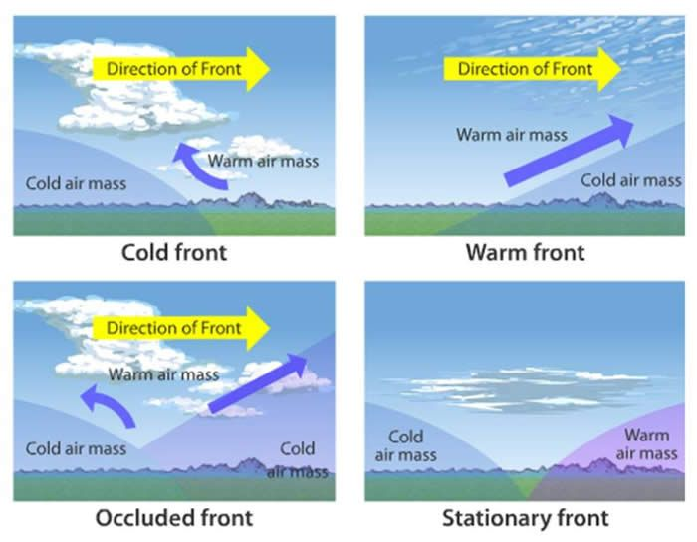
When two different air masses with distinct properties (temperature and humidity) come into contact, the boundary between them is called a front.
Fronts are very important in weather systems because they are responsible for sudden weather changes, cloud formation, and rainfall.
Types of Fronts
- Cold Front
When a cold air mass moves towards and replaces a warm air mass, the boundary formed is called a cold front. It usually brings heavy rainfall and thunderstorms. - Warm Front
When a warm air mass moves towards a cold air mass, it forms a warm front. It generally causes light to moderate rainfall over a large area. - Stationary Front
When neither air mass moves significantly and the boundary remains still, it is called a stationary front. It may lead to prolonged cloudy weather and light rain. - Occluded Front
When a cold air mass completely lifts a warm air mass off the ground, it forms an occluded front. This often results in complex weather conditions and rainfall.
Fronts mainly occur in the middle latitudes and are characterized by sharp differences in temperature and pressure. These differences force air to rise, leading to cloud formation and precipitation.
Anticyclones
An anticyclone is the opposite of a cyclone. It is a system of winds moving outward from a high-pressure center.
Features of Anticyclones
- High-pressure center
- Winds move outward from the center
- Clockwise rotation in the Northern Hemisphere
- Associated with clear, dry, and calm weather
Cyclones in India
India is highly vulnerable to cyclones due to its long coastline and geographic location near warm tropical waters. These conditions make the country one of the most cyclone-prone regions in the world.
Tropical Cyclones in India
Tropical cyclones in India mainly originate over the Bay of Bengal, Arabian Sea, and the Indian Ocean. Among these, the Bay of Bengal is more active and generates a higher number of cyclones.
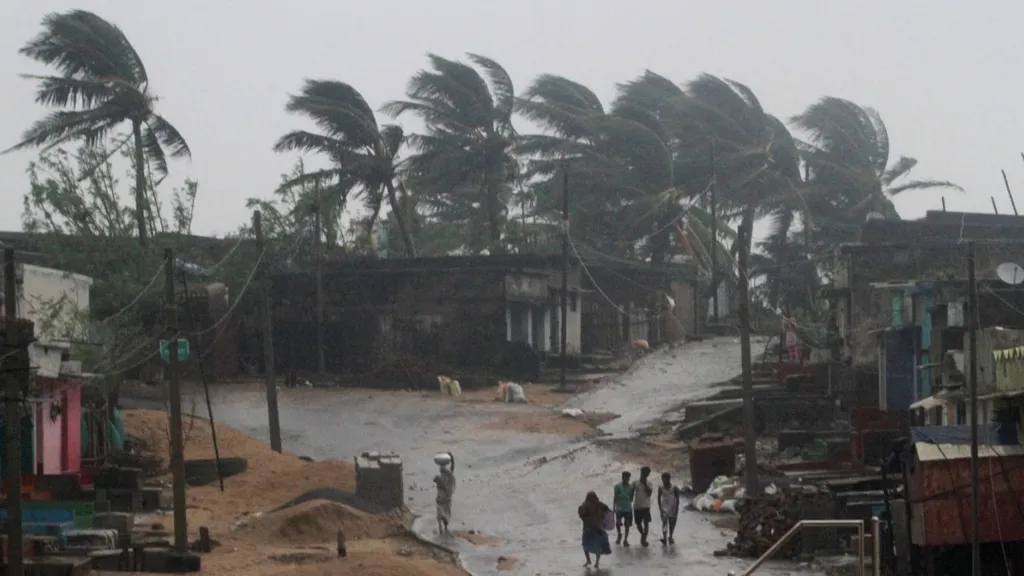
These cyclones are characterized by very high wind velocity, intense rainfall, and severe storm surges, which lead to large-scale destruction, especially in coastal areas.
Regions Affected
The most cyclone-prone states in India include:
These states are more vulnerable because of their direct exposure to the sea and low-lying coastal geography.
Nature of Destruction
Most tropical cyclones in India are extremely destructive due to strong winds and heavy rainfall. The damage caused by cyclones can be understood through three major elements:
1. Strong Winds / Squalls
- Cyclones produce very high-speed winds that can destroy houses, buildings, and infrastructure.
- Communication systems, electric poles, and trees are often uprooted.
- This leads to heavy loss of life and property.
2. Torrential Rainfall and Inland Flooding
- Cyclones bring widespread and intense rainfall over large areas.
- Flooding becomes a major problem, especially for people who lose their homes.
- Heavy rains cause soil erosion and weaken embankments, increasing flood risk.
3. Storm Surge
- Storm surge is the abnormal rise of sea level during a cyclone.
- It floods low-lying coastal areas, submerging villages and towns.
- It leads to loss of human and animal life.
- It also causes:
- Coastal erosion
- Destruction of vegetation
- Reduction in soil fertility due to saltwater intrusion
Cyclone Disaster Management in India
Effective cyclone management is very important to reduce damage and save lives. It includes both structural and non-structural measures.
Structural Measures
These involve physical construction and infrastructure development:
- Construction of cyclone shelters for safe evacuation
- Building cyclone-resistant houses and buildings
- Development of roads, bridges, culverts, and drainage systems
- Construction of saline embankments to prevent seawater intrusion
- Maintenance of surface water tanks
- Strengthening of communication and power transmission networks
Non-Structural Measures
These focus on planning, awareness, and preparedness:
- Early warning dissemination systems to alert people in advance
- Coastal zone management to reduce risk in vulnerable areas
- Awareness programs to educate people about safety measures
- Disaster risk management strategies
- Capacity building of government agencies and local communities
Government Initiative
India has taken major steps to manage cyclone risks through the National Cyclone Risk Mitigation Project (NCRMP), which is implemented with assistance from the World Bank.
This project focuses on:
- Enhancing disaster preparedness
- Reducing vulnerability of coastal communities
- Improving early warning systems
- Strengthening infrastructure
Western Disturbances
Western Disturbances are a type of extratropical cyclone and are one of the most important weather phenomena affecting northern parts of India.
Origin
Western Disturbances originate in the Mediterranean region and travel eastward towards the Indian subcontinent, carried by the westerly winds.
Detailed Explanation
A Western Disturbance is essentially a low-pressure system that develops outside the tropical region. As it moves towards India, it carries moisture from the Mediterranean Sea and nearby water bodies. When it reaches the northwestern parts of India, it causes sudden changes in weather conditions.
This phenomenon is usually associated with:
- Cloudy skies
- Sudden rainfall
- Thunderstorms
- Increase in night temperatures
Impact in India
Western Disturbances bring winter and pre-monsoon rainfall to North-West India. They mainly affect regions such as:
- Punjab
- Haryana
- Delhi
- Western Uttar Pradesh
These disturbances are responsible for a significant portion of rainfall in these regions during winter months.
Importance
Western Disturbances play a crucial role in Indian agriculture:
- They provide essential moisture for Rabi crops, especially wheat
- Help maintain soil moisture levels
- Support agricultural productivity in dry winter seasons
It is estimated that about 5–10% of India’s total annual rainfall comes from Western Disturbances, making them highly significant despite their limited duration.
Recent Cyclones in India (2020 Example)
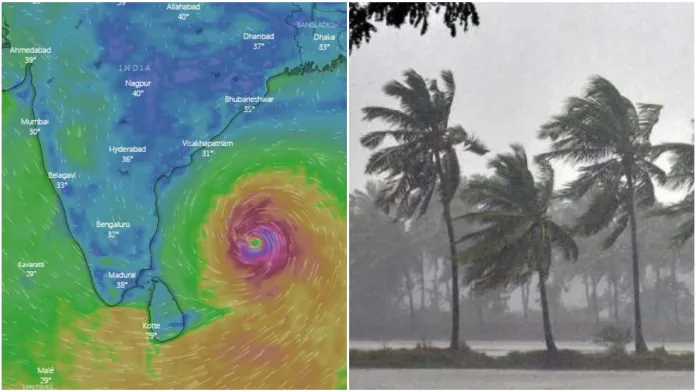
Cyclone Amphan
- Origin: Bay of Bengal
- Category: Super Cyclone
- Impact: Severe damage in West Bengal and Odisha
Cyclone Nisarga
- Hit Maharashtra coast
- Rare event after 129 years in Mumbai
Why Cyclones are Increasing?
- Climate change
- Rising sea surface temperatures
- Global warming
- Changing wind patterns
Prevention and Preparedness
While cyclones cannot be stopped, their damage can be reduced:
- Early warning systems
- Disaster preparedness
- Coastal regulation
- Plantation of mangroves
- Strong infrastructure
Conclusion
Cyclones are among the most dangerous natural disasters, causing massive destruction to life and property. Understanding their formation, types, and impacts is crucial for effective disaster management. With improved technology, early warning systems, and proper planning, the risks associated with cyclones can be significantly reduced.
India, being highly vulnerable, must continue strengthening its disaster management systems and spreading awareness among people to minimize losses in the future.
FAQs on Cyclone
1. What is a cyclone?
A cyclone is a system of winds rotating around a low-pressure center, causing storms and rainfall.
2. What are the types of cyclones?
Two main types: Tropical cyclones and extratropical cyclones.
3. What causes cyclones?
Warm ocean water, low pressure, and Earth’s rotation are the main causes.
4. Why are cyclones dangerous?
Due to strong winds, heavy rainfall, and storm surges.
5. Which area in India is most affected by cyclones?
The eastern coast, especially Odisha and West Bengal.