Monsoon in India: Climate & Impact

Monsoon in India
Monsoon in India is one of the most important climatic phenomena that shapes the life, economy, agriculture, and culture of the country. The word “monsoon” refers to seasonal reversal of winds accompanied by changes in precipitation. In India, the climate is mainly described as a monsoon-type climate, where rainfall is highly seasonal and unevenly distributed.
Thank you for reading this post, don't forget to subscribe!Across the world, monsoons are generally experienced in tropical regions roughly between 20° North and 20° South latitude. However, the Indian monsoon system is unique because of its complexity, variability, and strong influence on human life.
In Asia, monsoon climate is mainly found in South Asia and Southeast Asia, but India experiences one of the most prominent monsoon systems in the world.
India has four main seasons, but two of them are directly related to monsoon:
- Southwest Monsoon Season (June–September)
- Retreating or Northeast Monsoon Season (October–November)
Types of Monsoon in India
1. Southwest Monsoon (Summer Monsoon)
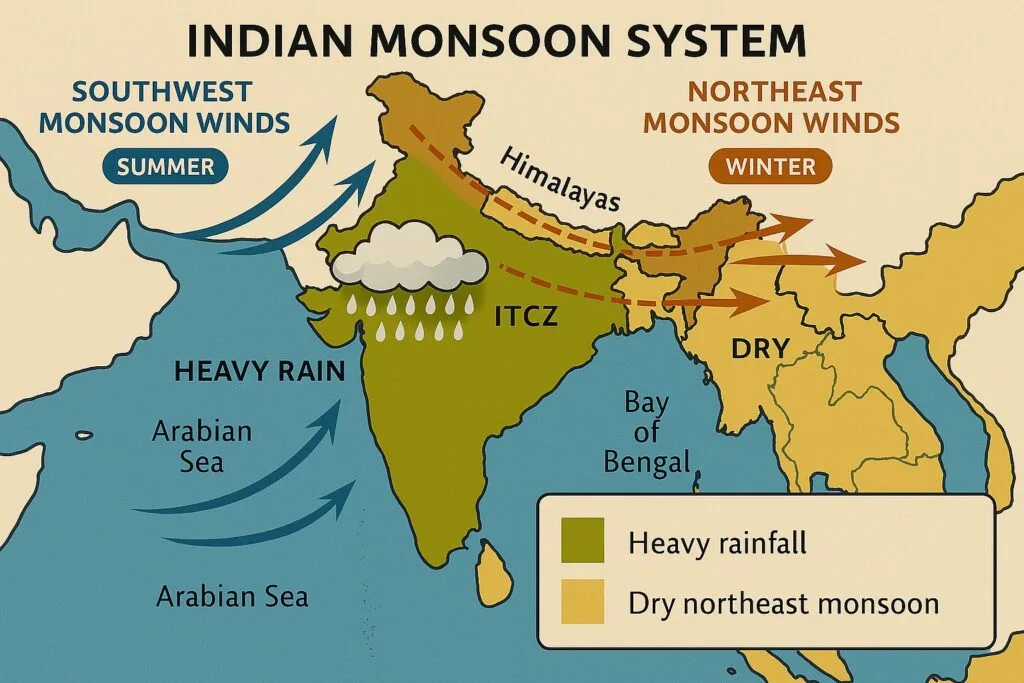
The southwest monsoon is the primary rainy season in India. It begins in June and continues till September. During this period, India receives around 75–80% of its annual rainfall.
This monsoon is called “southwest” because the winds blow from the southwest direction toward the Indian landmass.
2. Retreating Monsoon (Northeast Monsoon)
The retreating monsoon occurs during October and November. During this phase, the monsoon winds withdraw from the Indian subcontinent.
- Northern India becomes dry
- Southern India, especially the Coromandel Coast, receives rainfall
Factors Influencing Monsoon in India
The formation of monsoon in India depends on several geographical and atmospheric factors:
1. Differential Heating of Land and Water
Land heats up faster than water. During summer:
- Indian landmass becomes very hot → low pressure develops
- Surrounding oceans remain cooler → high pressure develops
This pressure difference causes moist winds to move toward India.
2. Inter Tropical Convergence Zone (ITCZ)
The Inter Tropical Convergence Zone (ITCZ) is a low-pressure belt near the equator where trade winds converge.
- It shifts northward during summer
- Reaches the Indo-Gangetic Plain
- Acts as a monsoon trough, attracting rain-bearing winds
3. High Pressure over Indian Ocean
A high-pressure area near Madagascar (around 20°S) influences the intensity of monsoon winds.
4. Tibetan Plateau Heating
The Tibetan Plateau becomes extremely hot during summer:
- Creates strong low pressure at high altitude
- Strengthens monsoon circulation
5. Jet Streams
- Westerly Jet Stream moves north of the Himalayas
- Tropical Easterly Jet Stream develops over India
These jet streams play a crucial role in the onset and intensity of monsoon.
6. Southern Oscillation (SO)
Southern Oscillation refers to changes in air pressure between:
- Eastern Pacific Ocean
- Indian Ocean
This variation influences monsoon strength.
7. El Niño Effect
El Niño is a warming of ocean water along the coast of Peru.
- Weakens trade winds
- Reduces rainfall in India
- Often leads to drought conditions
Mechanism of Southwest Monsoon
The monsoon mechanism is a complex process involving atmospheric circulation.
Step-by-Step Process
- In June, the Sun is overhead at the Tropic of Cancer
- ITCZ shifts northward
- Southeast trade winds cross the equator
- Due to Earth’s rotation (Coriolis force), winds turn southwest
- Winds pick up moisture from the Indian Ocean
- Reach India as rain-bearing winds
Branches of Southwest Monsoon
The monsoon winds divide into two main branches:
1. Arabian Sea Branch
- Hits Western Ghats
- Causes heavy rainfall in Kerala, Karnataka, Maharashtra
2. Bay of Bengal Branch
- Moves toward Northeast India
- Deflected by Arakan Hills
- Causes rainfall in Assam, West Bengal, and Northern Plains
Break in Monsoon
Monsoon rainfall is not continuous. It occurs in phases:
- Heavy rainfall for a few days
- Followed by dry periods
This phenomenon is called “break in monsoon” and is linked to the movement of the monsoon trough.
Retreating Monsoon Season
During October–November:
- Winds start withdrawing from India
- Skies become clear
- Temperature rises temporarily → called “October Heat”
Rainfall Pattern
- Northern India → dry weather
- Southern Peninsula → heavy rainfall
Rainfall occurs due to:
- Cyclonic depressions from the Andaman Sea
- Tropical cyclones affecting coastal areas
Importance of Monsoon in India
Positive Impacts
1. Agriculture
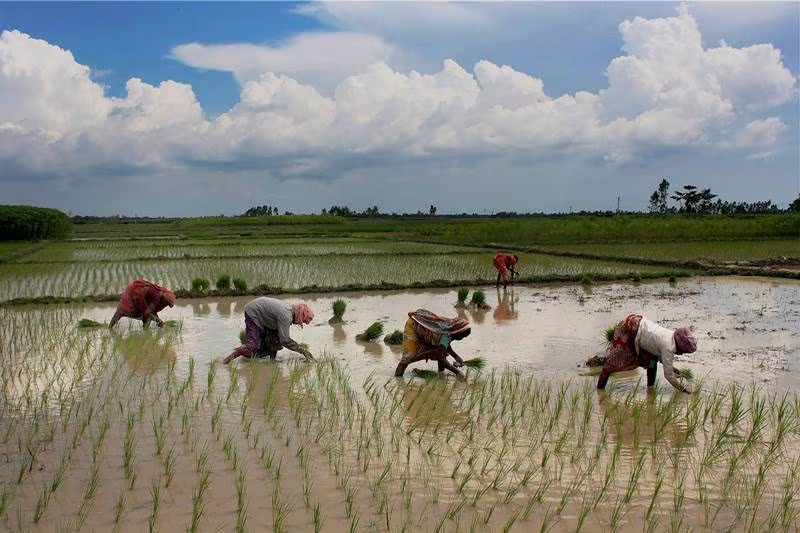
- About 64% of India’s population depends on agriculture
- Monsoon provides essential water for crops
- Determines success or failure of farming
2. Water Resources
- Recharges rivers, lakes, and reservoirs
- Supports irrigation and drinking water supply
3. Hydroelectric Power
- Dams filled by monsoon water generate electricity
4. Crop Diversity
Different rainfall patterns allow growth of:
- Rice in high rainfall areas
- Wheat in moderate rainfall regions
5. Cultural Influence
Monsoon affects:
- Food habits
- Clothing styles
- Housing patterns
Negative Impacts
1. Floods and Droughts
- Excess rainfall → floods
- Lack of rainfall → droughts
2. Soil Erosion
Heavy rains wash away fertile soil.
3. Landslides
Common in hilly regions like the Himalayas and Northeast India.
4. Economic Loss
Damage to:
- Crops
- Infrastructure
- Livelihoods
Monsoon Prediction in India
Early Methods
Earlier, forecasts were based on:
- Snow cover
- Historical data
Modern Methods
The India Meteorological Department (IMD) now uses:
- Statistical models
- Numerical weather prediction models
Data Collection Tools
- Weather stations
- Satellites
- Radars
- Weather balloons
Challenges in Monsoon Prediction
Despite advanced technology, prediction is still difficult due to:
- Lack of sufficient data
- Poor quality weather stations
- Gaps in ocean and soil data
- Models not fully adapted to Indian conditions
- Limited skilled manpower
Recent Initiatives by India
In India, accurate monsoon prediction is extremely important for both farmers and policymakers. Farmers depend on timely rainfall for activities like sowing, harvesting, and irrigation. At the same time, policymakers need reliable monsoon data for decisions related to compensation, minimum support price (MSP), disaster management, and water planning. Therefore, improving monsoon forecasting and providing timely advisories has become a national priority.
To achieve this, the Government of India has launched several important initiatives:
1. Monsoon Mission of India
The Monsoon Mission was launched in 2012 by the Ministry of Earth Sciences with the aim of improving the accuracy of monsoon forecasts.
This mission uses advanced scientific methods such as:
- High-resolution climate models
- Super parameterization techniques
- Data assimilation systems
These modern technologies help improve forecasting skills of the India Meteorological Department (IMD).
A major achievement of this mission was in 2017, when IMD used the dynamical model developed under Monsoon Mission for the first time to prepare operational seasonal forecasts of monsoon rainfall in India.
Objectives of Monsoon Mission:
- To improve seasonal and intra-seasonal monsoon forecasts
- To improve medium-range weather forecasts
2. Agro-Meteorological Advisories
The India Meteorological Department (IMD), in collaboration with the Indian Council of Agricultural Research (ICAR), provides district-level agro-meteorological advisories to farmers.
- These advisories are delivered through 130 agro-met field units
- Information is shared in local (vernacular) languages so farmers can easily understand
These advisories help farmers in important farming decisions such as:
- Managing sowing when rainfall is delayed
- Changing crop varieties based on rainfall conditions
- Spraying pesticides during suitable weather
- Managing irrigation during heavy rainfall forecasts
This system helps reduce crop losses and improve agricultural productivity.
3. Flood Forecasting Support
The India Meteorological Department (IMD) also provides weather-related data to the Central Water Commission (CWC).
- This helps in issuing timely flood warnings
- Reduces damage to life and property during heavy rainfall and floods
4. Indo-US Research Collaboration
In 2018, India and the United States conducted a joint research expedition to better understand the monsoon system.
- The Indian research vessel “Sagar Nidhi” was sent from Chennai
- The mission focused on studying the Bay of Bengal, which plays a key role in monsoon formation
- Scientists collected important ocean and atmospheric data
This collaboration aims to improve monsoon prediction models in the future.
5. National Supercomputing Mission
Accurate monsoon forecasting requires powerful computers to process huge amounts of weather data.
The National Supercomputing Mission helps India to:
- Build high-performance computing systems
- Process large climate datasets quickly
- Improve accuracy of weather and monsoon predictions
This initiative is essential for providing timely and reliable forecasts across the country.
Global Warming and Monsoon
Climate change is increasingly affecting monsoon patterns in India. There has been a noticeable change in the intensity, duration, frequency, and spatial distribution of monsoon rainfall. These changes are believed to be linked to global warming, but it is still too early to draw a definite conclusion.
Some of the major observed changes include:
- Irregular rainfall patterns
- Increased intensity of storms
- Sudden heavy downpours
- Changes in the timing of monsoon onset and withdrawal
If these changes are truly a result of global warming, they may become permanent and even accelerate in the future. However, if they are due to natural climate variability, such as El Niño, the monsoon system may return to its normal pattern over time. Therefore, more scientific data and detailed reanalysis are required to clearly separate the impact of global warming from natural climatic variations.
Future of Monsoon in India
With rising global temperatures, the atmosphere is expected to hold more moisture. This will likely lead to:
- Heavier and more intense rainfall
- Increased year-to-year variability (inter-annual variability)
- More frequent extreme weather events
These changes will make the monsoon more unpredictable, requiring better planning and preparedness.
India must prepare for:
- Flood management strategies
- Drought control measures
- Efficient and sustainable use of water resources
Way Forward
India’s growing population increases the demand for food and water. To ensure food security, a significant portion of monsoon water, which is currently wasted, should be stored effectively for:
- Irrigation purposes
- Hydroelectric power generation
There is also a strong need to:
- Invest more in accurate and reliable monsoon prediction systems
- Use advanced technology and supercomputing for better forecasting
- Improve water resource management
With a warming climate, increased atmospheric moisture will result in heavier rainfall and greater variability. India must be prepared to handle these challenges through proper planning and infrastructure.
To ensure long-term sustainability of India’s climate system, both national and international efforts are necessary. At the national level, policies like the National Action Plan on Climate Change should be strengthened. At the global level, cooperation under frameworks such as the UN Framework Convention on Climate Change (UNFCCC) is essential.
In a world that is interconnected, addressing climate change requires shared responsibility and collective action for a sustainable future.
FAQs on Monsoon in India
1. What is monsoon in India?
Monsoon in India refers to seasonal winds that bring heavy rainfall, mainly during June to September.
2. Why is monsoon important for India?
It supports agriculture, water supply, and the economy.
3. What causes monsoon rainfall?
It is caused by pressure differences, ITCZ movement, and ocean-atmosphere interactions.
4. What is El Niño effect?
It is the warming of Pacific Ocean water that weakens Indian monsoon rainfall.
5. Which areas receive rainfall during retreating monsoon?
Mainly the southeastern coast of India, especially Tamil Nadu.