


Higher Education in India: Challenges, Reforms and Future Prospects

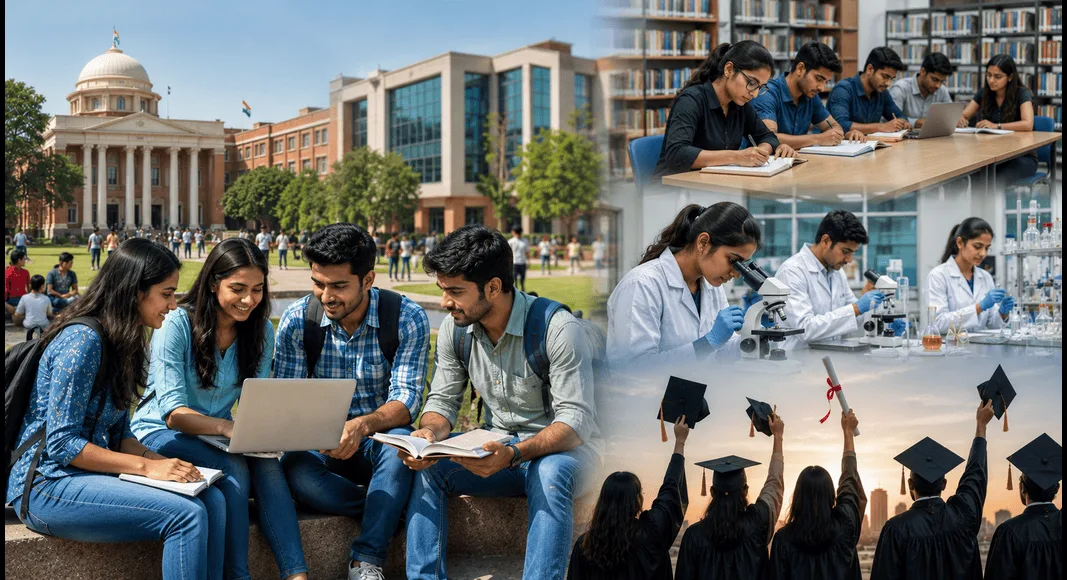
Higher Education in India plays a vital role in shaping the country’s future. It helps students gain advanced knowledge, develop professional skills, and contribute to economic and social development. India has one of the largest higher education systems in the world, ranking third after China and the United States in terms of student enrollment.
Thank you for reading this post, don't forget to subscribe!Since independence, India has witnessed remarkable growth in the number of universities, colleges, and educational institutions. Today, thousands of students pursue undergraduate, postgraduate, doctoral, and professional courses across the country. Despite this expansion, the sector continues to face several challenges related to quality, accessibility, research, infrastructure, and employability.
The development of higher education is essential for creating a skilled workforce, promoting innovation, and helping India become a global knowledge economy.
What is Higher Education?
Higher education refers to education provided after completing school-level studies. It includes:
- Undergraduate courses such as BA, BSc, BCom, BTech, MBBS, etc.
- Postgraduate courses such as MA, MSc, MBA, MTech, etc.
- Doctoral and research programs such as PhD.
- Professional and vocational education.
Higher education institutions include universities, colleges, institutes of national importance, research institutions, and technical institutes.
Growth of Higher Education in India
India’s higher education sector has grown significantly over the decades.
Major developments include:
- Establishment of central, state, and private universities.
- Growth of technical institutions like IITs, NITs, and IIITs.
- Expansion of medical, management, and law education.
- Increase in enrollment of students from diverse backgrounds.
- Introduction of online and distance learning programs.
Despite these achievements, Indian institutions still face difficulties in competing with top global universities.
Only a limited number of Indian institutions have consistently secured high positions in international university rankings. This highlights the need for continuous reforms and improvements.
Importance of Higher Education in India
Higher education contributes to national development in several ways:
Skill Development
It helps students acquire specialized knowledge and practical skills required for employment.
Economic Growth
A skilled workforce increases productivity and supports industrial and technological development.
Research and Innovation
Universities and research institutions generate new knowledge, inventions, and solutions to societal problems.
Social Progress
Education promotes equality, social mobility, and better living standards.
Global Competitiveness
Strong universities help a country compete internationally in science, technology, business, and innovation.
Major Challenges of Higher Education in India
Although the sector has expanded rapidly, several issues continue to affect its quality and effectiveness.
1. Low Enrollment Rate
One of the biggest challenges is the relatively low Gross Enrolment Ratio (GER).
GER refers to the percentage of eligible students enrolled in higher education.
Many developed countries have much higher enrollment rates than India. A large number of students still do not pursue higher studies due to financial difficulties, lack of awareness, or limited access to institutions.
2. Lack of Equity
Access to higher education is not equal across different sections of society.
Several inequalities exist:
- Rural students often have fewer opportunities.
- Students from Scheduled Castes (SCs) and Scheduled Tribes (STs) face barriers.
- Regional disparities remain significant.
- Some states have many colleges, while others have very few.
As a result, educational opportunities are unevenly distributed.
3. Regional Imbalance
Most top institutions are located in urban and metropolitan areas.
Students from remote and rural regions often need to travel long distances or relocate to pursue higher education.
This creates financial and social challenges for many families.
4. Poor Quality of Education
Many institutions focus heavily on rote learning rather than practical understanding.
Students often memorize information instead of developing critical thinking and problem-solving skills.
This affects their ability to compete in modern workplaces.
5. Inadequate Infrastructure
Many public universities and colleges suffer from poor infrastructure.
Common problems include:
- Insufficient classrooms
- Outdated laboratories
- Poor library facilities
- Lack of digital resources
- Inadequate hostel facilities
Good infrastructure is essential for effective teaching and learning.
6. Shortage of Qualified Faculty
India faces a significant shortage of trained and experienced teachers in higher education.
Many institutions have vacant teaching positions.
Consequences include:
- Large class sizes
- Reduced student-teacher interaction
- Lower quality of education
- Increased dependence on temporary faculty
A strong education system requires competent and motivated teachers.
7. High Student-Teacher Ratio
The number of students per teacher in India remains higher than in many developed countries.
When teachers have too many students, they cannot provide individual attention, mentoring, or academic support.
Reducing this ratio is important for improving educational outcomes.
8. Outdated Curriculum
In many institutions, course content does not match current industry requirements.
Problems include:
- Excessive focus on theory
- Limited practical exposure
- Lack of industry collaboration
- Slow curriculum updates
As a result, graduates often struggle to meet employer expectations.
9. Employability Issues
Many graduates possess academic degrees but lack job-ready skills.
Employers frequently report gaps in:
- Communication skills
- Technical skills
- Problem-solving abilities
- Teamwork and leadership
This contributes to unemployment and underemployment among educated youth.
10. Accreditation and Quality Assurance
Accreditation helps measure the quality of educational institutions.
However, many colleges and universities have not undergone proper quality assessment.
Without regular accreditation, it becomes difficult to ensure educational standards.
11. Regulatory Challenges
India’s higher education sector is regulated by multiple bodies.
These include:
- University Grants Commission (UGC)
- All India Council for Technical Education (AICTE)
- National Council for Teacher Education (NCTE)
The presence of multiple regulators can create confusion, delays, and administrative inefficiencies.
12. Weak Research Culture
Research is a crucial component of quality higher education.
However, India faces several research-related challenges:
- Limited funding
- Low research output
- Few interdisciplinary projects
- Limited industry collaboration
- Low PhD enrollment in some fields
Compared to leading countries, India’s investment in research and development remains relatively low.

Government Initiatives to Improve Higher Education
Recognizing these challenges, the Government of India has launched several initiatives.
Education Quality Upgradation and Inclusion Programme (EQUIP)
EQUIP is a long-term plan designed to improve:
- Quality of education
- Student enrollment
- Research excellence
- Global rankings
The program aims to make higher education more inclusive and globally competitive.
Revitalising Infrastructure and Systems in Education (RISE)
RISE focuses on improving educational and research infrastructure.
Its objectives include:
- Modern laboratories
- Better research facilities
- Upgraded campuses
- Improved academic resources
Higher Education Financing Agency (HEFA)
HEFA provides financial support for developing educational infrastructure.
It helps institutions obtain funds without increasing the financial burden on students.
Learning Outcome-Based Curriculum Framework (LOCF)
The LOCF encourages outcome-based education.
It focuses on what students should:
- Know
- Understand
- Apply
- Achieve after completing a course
This approach promotes active learning and skill development.
Graded Autonomy
The government has introduced graded autonomy for universities and colleges.
Institutions with strong performance receive greater freedom in:
- Designing courses
- Conducting examinations
- Managing academic activities
This encourages innovation and institutional excellence.
Global Initiative of Academic Networks (GIAN)
GIAN invites distinguished international experts to teach in Indian institutions.
Benefits include:
- Exposure to global knowledge
- Improved teaching quality
- International collaboration
All India Survey on Higher Education (AISHE)
AISHE collects comprehensive data on higher education institutions.
The survey helps policymakers understand trends and make informed decisions.
National Institutional Ranking Framework (NIRF)
NIRF ranks educational institutions based on:
- Teaching quality
- Research output
- Graduation outcomes
- Inclusivity
- Public perception
The rankings encourage institutions to improve performance.
The Role of Technology in Higher Education
Technology is transforming higher education in India.
Key developments include:
Online Learning
Students can access courses from anywhere through digital platforms.
Massive Open Online Courses (MOOCs)
MOOCs provide affordable education to large numbers of learners.
Digital Libraries
Online resources make learning more accessible.
Virtual Classrooms
Technology enables interactive learning beyond physical campuses.
Artificial Intelligence and Data Analytics
Modern technologies are helping institutions improve learning outcomes and administrative efficiency.
Way Forward for Higher Education in India
To build a world-class higher education system, several reforms are needed.
Strengthen Governance
Educational institutions should have transparent and accountable management systems.
Improve Funding
Greater investment in education and research is necessary.
Enhance Research
Universities should encourage innovation, scientific inquiry, and interdisciplinary research.
Modernize Curriculum
Courses should be updated regularly to match industry needs.
Promote Skill-Based Learning
Practical training, internships, and vocational education should be integrated into academic programs.
Increase Faculty Recruitment
More qualified teachers should be recruited and provided with continuous professional development.
Expand Digital Education
Online learning platforms should be strengthened to reach students in remote areas.
Encourage International Collaboration
Partnerships with foreign universities can improve educational quality and global exposure.
Improve Accreditation
Regular quality assessment should become mandatory for all institutions.
Focus on Inclusiveness
Special efforts should be made to support disadvantaged groups and underserved regions.
Conclusion
Higher Education in India is one of the largest and most important sectors of the country’s development. It plays a crucial role in creating skilled professionals, researchers, innovators, and future leaders. Although India has made significant progress since independence, several challenges such as low enrollment, poor infrastructure, faculty shortages, outdated curriculum, and weak research culture still need attention.
Government initiatives such as EQUIP, RISE, HEFA, NIRF, AISHE, and GIAN have contributed positively to the sector. However, sustained reforms, greater investment, technological integration, and stronger quality standards are necessary to achieve global excellence.
A strong higher education system will not only empower India’s youth but also help the country emerge as a leading knowledge and innovation hub in the world.
FAQs About Higher Education in India
1. What is higher education?
Higher education refers to education pursued after completing school, including undergraduate, postgraduate, diploma, and doctoral programs.
2. Why is higher education important in India?
Higher education helps develop skilled professionals, promotes research, supports economic growth, and improves career opportunities.
3. What is the Gross Enrolment Ratio (GER)?
GER is the percentage of students enrolled in higher education compared to the total eligible population in the relevant age group.
4. What are the major challenges in higher education in India?
Major challenges include low enrollment, poor infrastructure, faculty shortages, outdated curriculum, and limited research opportunities.
5. Why is research important in higher education?
Research promotes innovation, scientific advancement, technological development, and solutions to social and economic problems.
6. What is the role of the University Grants Commission (UGC)?
The UGC regulates higher education institutions, maintains standards, and provides financial assistance to universities and colleges.
7. What is NIRF?
The National Institutional Ranking Framework (NIRF) ranks educational institutions based on teaching, research, graduation outcomes, inclusivity, and perception.
8. What is the EQUIP programme?
Education Quality Upgradation and Inclusion Programme (EQUIP) is a government initiative aimed at improving the quality and accessibility of higher education.
9. How does technology help higher education?
Technology supports online learning, digital libraries, virtual classrooms, research collaboration, and access to quality education.
10. How can India improve its higher education system?
India can improve higher education through better funding, quality faculty, modern curriculum, stronger research, digital education, and effective governance.