



Nanotechnology: Uses, Benefits and Challenges

Nanotechnology is one of the most advanced fields of science today. It is changing the way we live, work, and use technology. From medicine and agriculture to electronics and energy, nanotechnology is creating new possibilities. It helps scientists build materials and devices at an extremely small scale. At the same time, it also raises important questions about safety, ethics, and proper regulation.
Thank you for reading this post, don't forget to subscribe!What is Nanotechnology?
Nanotechnology is a branch of science and engineering that deals with designing, creating, and using materials or devices at a very tiny scale called the nanoscale.
A nanometer (nm) is extremely small. One nanometer is one-billionth of a meter. To understand this size, a human hair is around 80,000 to 100,000 nanometers wide.
Nanotechnology works by controlling atoms and molecules to create materials with special properties. At this tiny level, materials can behave very differently from normal-sized materials.
Scientists use molecular simulation and computer models to study how atoms and molecules behave. This helps them create better nanomaterials and nanodevices.
What are Nanomaterials?
Nanomaterials are materials that have structures smaller than 100 nanometers in at least one dimension. These materials often show unique strength, conductivity, or chemical properties.
Nanomaterials can be classified in different ways.
Based on Origin
Natural Nanomaterials:
These occur naturally in nature. They can be found in the Earth’s crust, volcano ash, or biological systems.
Artificial Nanomaterials:
These are created by humans in laboratories or industries for special purposes.
Based on Dimensions
0D Nanomaterials (Zero-Dimensional):
All three dimensions are below 100 nm. Examples include nanospheres and quantum dots.
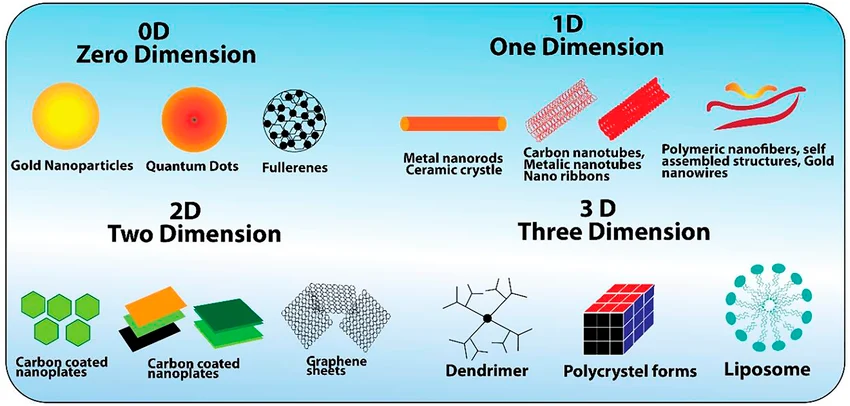
1D Nanomaterials (One-Dimensional):
Two dimensions are nanoscale, while one dimension is larger. Examples include nanotubes and nanowires.
2D Nanomaterials (Two-Dimensional):
One dimension is nanoscale. Examples include graphene and nanofilms.
3D Nanomaterials (Three-Dimensional):
These are larger materials containing nanoscale structures. Examples include bundles of nanowires.
Based on Composition
Organic Nanomaterials:
Made from organic molecules such as polymers, lipids, and proteins.
Inorganic Nanomaterials:
Made from metals, metal oxides, or non-carbon compounds.
Carbon-Based Nanomaterials:
Made mostly of carbon. Examples include graphene and carbon nanotubes.
Composite Nanomaterials:
Made by combining two or more nanomaterials to improve performance.
Important Properties of Nanomaterials
Nanomaterials are special because their properties change at the nanoscale.
Mechanical Strength
Nanomaterials are often stronger and lighter than normal materials. This makes them useful in cars, aircraft, and machines.
Quantum Effects
At nanoscale, quantum effects become important. This helps in making advanced semiconductors and quantum devices.
Better Catalytic Activity
Nanomaterials have a larger surface area compared to their volume. This helps chemical reactions happen faster.
Magnetic Properties
Some nanoparticles show strong magnetic behavior, which is useful in data storage and medical imaging.
What are Nanodevices?
Nanodevices are tiny devices built using nanotechnology. These devices can process electrons, light, chemicals, or mechanical signals.
Examples include nanosensors, nanochips, and nanorobots.
Uses of Nanodevices
- Quantum electronics
- Medical sensors
- Pollution control
- Information storage
- Chemical detection
Applications of Nanotechnology
Nanotechnology is used in many industries.
1. Computer and Electronics Industry
Modern electronics are becoming smaller and more powerful because of nanotechnology.
Nanotechnology helps in:
- Making smaller chips
- Faster processors
- Better sensors
- High-performance memory devices
Carbon nanotubes may replace traditional silicon chips in the future.
Important nanotech-based technologies include:
- Smart sensors
- Nanochips
- Quantum computing
- Optoelectronics
- Lab-on-a-chip devices
Nanotechnology is also a key part of the Fourth Industrial Revolution, along with Artificial Intelligence (AI), Internet of Things (IoT), and 3D printing.
2. Medicine and Healthcare
Nanotechnology is transforming healthcare.

Medical Imaging
Special nanoparticles improve scanning technologies such as MRI and CT scans.
Examples:
- Iron oxide nanoparticles for MRI
- Gold nanoparticles for CT scans
- Quantum dots for imaging
Drug Delivery
Nanoparticles can deliver medicines directly to affected body parts. This reduces side effects.
Uses include:
- Cancer treatment
- Targeted chemotherapy
- Controlled drug release
Wound Healing
Silver nanoparticles are used in bandages to prevent infection.
Nanorobots
In the future, nanorobots may:
- Deliver drugs inside the body
- Perform microsurgery
- Detect diseases early
3. Agriculture
Nanotechnology improves farming and crop production.
Nano Fertilisers
These improve nutrient delivery to plants, increasing productivity.
Nano Pesticides
These provide targeted delivery and reduce harmful effects on the environment.
Nano Coatings
Nano polymer coatings help seeds germinate better under suitable conditions.
Benefits:
- Better crop growth
- Lower chemical usage
- Improved food quality
4. Food and Bioprocessing Industry
Nanotechnology improves food safety and packaging.
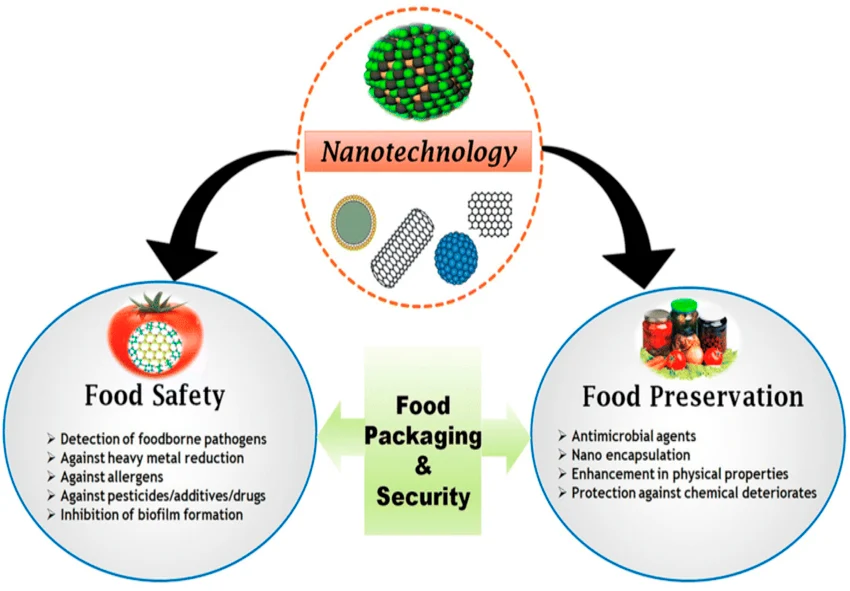
Applications include:
- Quality monitoring
- Better storage systems
- Improved food packaging
Nanocomposite films make packaging:
- Stronger
- Heat resistant
- More biodegradable
5. Manufacturing Industry
Automotive Industry
Nanotechnology helps build lighter vehicles with better fuel efficiency.
Uses:
- Lightweight alloys
- Anti-rust coatings
- Better catalysts
- Real-time vehicle sensors
Aerospace Industry
Aircraft need materials that are both strong and light. Nanotechnology helps achieve this.
Electronics Manufacturing
Nanotechnology allows miniaturization of devices like smartphones, laptops, and wearables.
Construction Industry
Nanomaterials improve concrete strength and reduce weight.
6. Energy Sector
Nanotechnology helps produce and store energy more efficiently.
Solar Energy
Nanomaterials improve solar cell performance and reduce costs.
Battery Storage
Nanotechnology improves battery life and charging speed.
Hydrogen Storage
Graphene-based systems improve hydrogen storage for fuel-cell vehicles.
7. Environmental Protection
Nanotechnology helps reduce pollution and clean the environment.
Water Purification
Nanofilters remove bacteria, viruses, and toxic substances from water.
Groundwater Cleanup
Iron nanoparticles break down harmful chemicals underground.
Oil Spill Cleanup
Special nanoparticles can break oil into biodegradable compounds.
Wind Energy
Carbon nanotube-based materials create stronger wind turbine blades.
Growth of Nanotechnology in India
India has made major progress in nanotechnology research.
Early Development
9th Five-Year Plan (1998–2002)
This was the first time nanomaterials were included in India’s science goals.
Research began in:
- Robotics
- Superconductivity
- Nanomaterials
In 2001, the Department of Science and Technology (DST) formed an expert group on nanomaterials.
10th Five-Year Plan (2002–2007)
Nanoscience became more organized.
The National Nanoscience and Nanotechnology Initiative (NSTI) was launched to:
- Build research infrastructure
- Support scientific studies
- Develop nanomedicine
This later led to the Nano Science and Technology Mission (NSTM) in 2007.
12th Five-Year Plan (2012–2017)
The focus shifted toward practical applications and product development.
Major Institutions Supporting Nanotechnology in India
Institute of Nano Science and Technology (INST), Mohali
A major institute dedicated to nanotechnology research.
Department of Biotechnology (DBT)
Works on:
- Nano healthcare
- Agriculture
- Food safety
- Drug delivery
Centre for Materials for Electronics Technology
Supports nanomaterials for electronics and semiconductors.
International Collaborations
India also works with other countries through programs like:
- International Conference on NanoScience and NanoTechnology
- Indo-US Nanotechnology Conclave
These partnerships help in knowledge sharing and innovation.
Important Indian Innovations in Nanotechnology
C. N. R. Rao
He is known as the Father of Indian Nanotechnology.
His research on:
- Carbon nanotubes
- Inorganic nanotubes
made major contributions to nanoscience.
Water Purification
Scientists at Banaras Hindu University developed carbon nanotube filters.
Benefits:
- Remove viruses
- Remove bacteria like E. coli
- Reusable and heat resistant
Healthcare Detection Kits
The Defence Research and Development Establishment developed a rapid typhoid detection kit using nanotechnology.
It detects infection within 1–3 minutes.
Energy Generation
Researchers at Indian Institute of Science found that liquid flowing through carbon nanotubes can generate electricity.
This may help build self-powered pacemakers.
Drug Delivery Research
Researchers at University of Delhi developed nanoparticle-based drug delivery systems.
These improve medicine effectiveness while reducing side effects.
Challenges of Nanotechnology
Although nanotechnology has great potential, there are many challenges.
Safety and Toxicity
Scientists still do not fully understand how some nanomaterials affect human health and the environment.
More testing is needed.
High Cost
Producing nanomaterials is expensive.
This makes large-scale use difficult.
Scalability Problems
Many successful laboratory experiments are hard to reproduce on an industrial scale.
Weak Regulations
Current laws are not fully designed for nanotechnology.
New safety standards are needed.
Public Trust
Some people worry about:
- Safety
- Long-term effects
- Effectiveness
This can slow adoption.
Need for Teamwork
Nanotechnology requires experts from many fields:
- Physics
- Chemistry
- Biology
- Engineering
Coordinating such teams can be difficult.
Patent and Legal Issues
Because the field is growing rapidly, ownership and patent disputes may increase.
Future of Nanotechnology
Nanotechnology has a bright future.
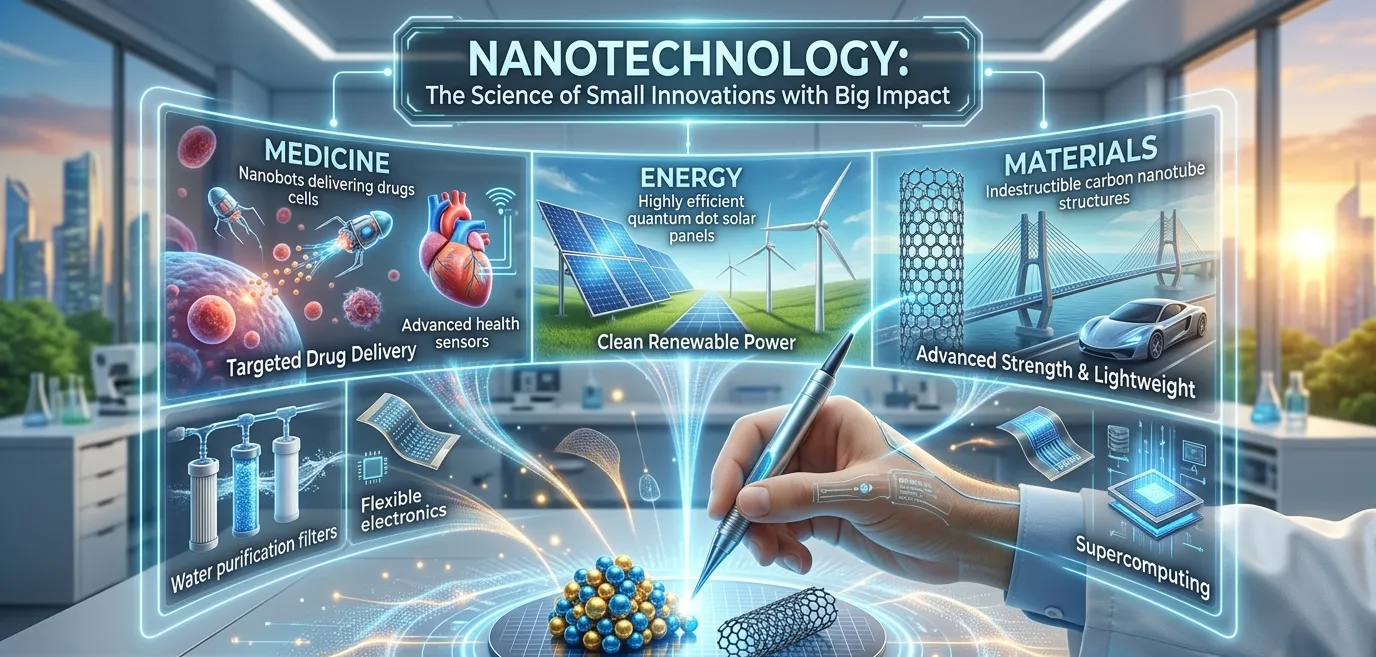
Important steps for future growth include:
More Research
Governments and industries should invest more in nanotechnology research.
Strong Safety Rules
Clear regulations are needed to ensure safe use.
Public Awareness
People should understand both benefits and risks.
Better Industry Partnerships
Research institutions and companies should work together to turn lab discoveries into real products.
Nanotechnology has the power to change medicine, farming, energy, electronics, and environmental protection. If developed responsibly, it can become one of the most important technologies of the future.
FAQs
1. What is nanotechnology in simple words?
Nanotechnology is the science of working with extremely tiny materials at the atomic or molecular level.
2. Where is nanotechnology used?
It is used in medicine, electronics, agriculture, energy, construction, and environmental cleanup.
3. Who is called the Father of Indian Nanotechnology?
C. N. R. Rao is known as the Father of Indian Nanotechnology.
4. What are nanomaterials?
Nanomaterials are materials with structures smaller than 100 nanometers.
5. Why is nanotechnology important?
It helps create stronger, lighter, and smarter materials and devices.