


Five Year Plans in India: History, Objectives and All 12 Plans Explained

Five Year Plans in India played a major role in shaping the country’s economy after independence. These plans were created to guide economic growth, reduce poverty, improve industries, increase agricultural production, and raise the standard of living of people. From 1951 to 2017, India followed a planned development model through a series of Five Year Plans.
Thank you for reading this post, don't forget to subscribe!The government used these plans to decide how money and resources should be spent over five years. Each plan focused on different priorities depending on the country’s needs at that time. Some plans focused more on agriculture, while others emphasized industries, education, infrastructure, and employment.
History of Five Year Plans
The idea of economic planning became important during the 1940s and 1950s. At that time, India was preparing for independence and leaders were thinking about how to rebuild the economy.
In 1944, a group of leading industrialists prepared a proposal for a planned economy. This proposal became famous as the Bombay Plan. It supported strong government involvement in economic development.
Planning became even more important after India gained independence in 1947. The country faced many challenges such as poverty, low industrial output, poor agricultural productivity, and unemployment.
The first person to implement a Five Year Plan was Joseph Stalin in the Soviet Union in 1928. Inspired by this model, India adopted a similar planning system.
India started its first Five Year Plan in 1951.
Concept of Five Year Plans
The concept of a Five Year Plan is simple. The Government of India prepares a development plan for five years by estimating income, expenses, goals, and priorities.
Government spending was divided into two parts:
Non-Plan Budget
This budget covered regular yearly expenses such as salaries, pensions, maintenance, and administration.
Plan Budget
This budget was used for long-term development projects such as dams, roads, industries, education, and irrigation.
The Indian economy followed Five Year Plans from 1951 to 2017.
The plans were designed and monitored by the Planning Commission. In 2015, it was replaced by NITI Aayog.
NITI Aayog introduced:
- 3-year Action Agenda
- 7-year Medium-Term Strategy
- 15-year Vision Document
First Five Year Plan (1951–1956)
The First Five Year Plan was launched under Prime Minister Jawaharlal Nehru.
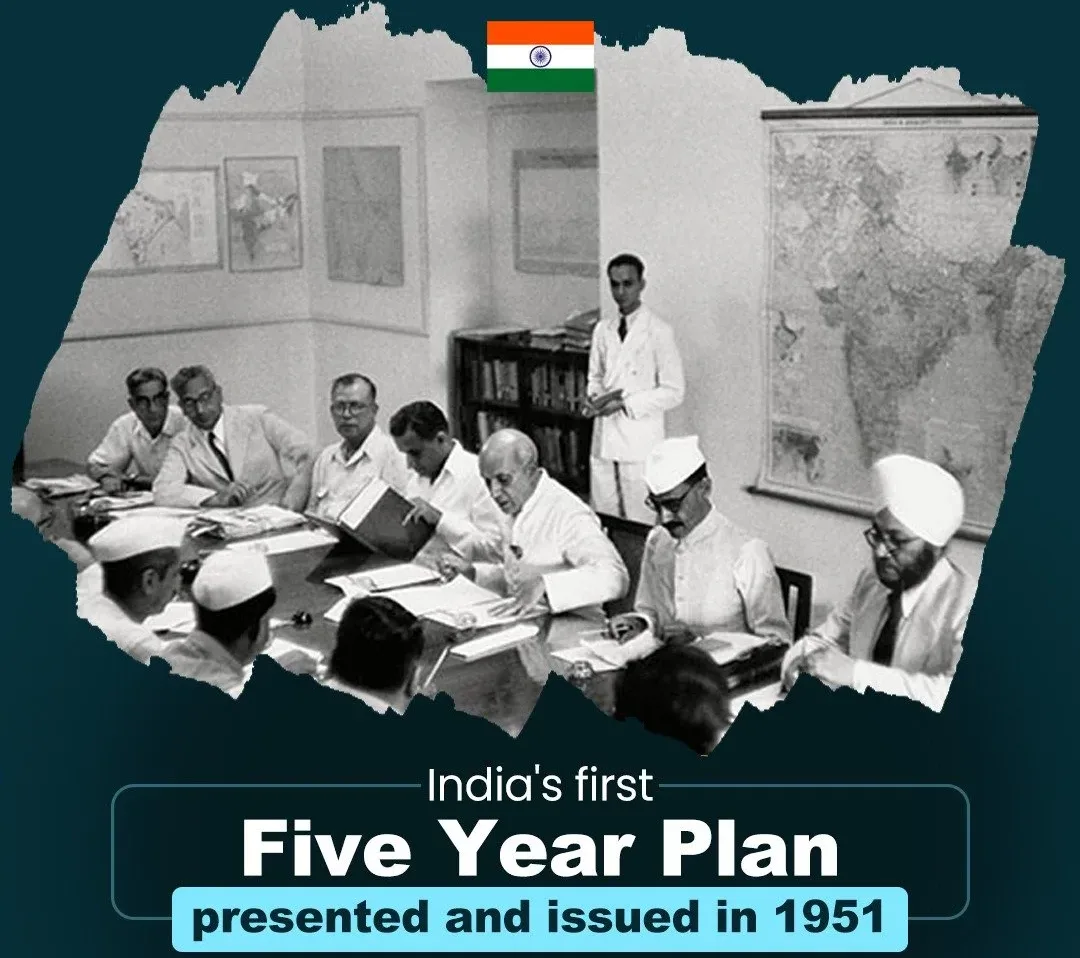
This plan mainly focused on agriculture because food production was very low after independence. India needed better irrigation and farming support.
Major features:
- Focus on agriculture and irrigation
- Large investment in dams
- Improvement in rural development
- Increase in food grain production
A major project during this plan was the Bhakra Nangal Dam.
The plan followed the Harrod-Domar Model, which emphasized savings and investment.
Five Indian Institutes of Technology (IITs) were also established during this period.
- Target growth rate: 2.1%
- Actual growth rate: 3.6%
This plan was considered successful.
Second Five Year Plan (1956–1961)
The Second Plan focused on rapid industrial growth.
It was prepared under economist Prasanta Chandra Mahalanobis.
Major features:
- Focus on heavy industries
- Expansion of public sector
- Industrialization
- Import protection through tariffs
The government wanted India to produce more machines, steel, and industrial goods domestically.
- Target growth rate: 4.5%
- Actual growth rate: 4.27%
This plan helped build India’s industrial base.
Third Five Year Plan (1961–1966)
The Third Plan aimed to make India self-reliant in food production.
Major features:
- Focus on agriculture
- Increase wheat production
- Development responsibilities to states
- Expansion of education
- Panchayat elections
However, this plan faced major difficulties.
Two wars badly affected the economy:
- Sino-Indian War
- Indo-Pakistani War of 1965
Because of these problems, the plan failed.
- Target growth rate: 5.6%
- Actual growth rate: 2.4%
After this, India declared Plan Holidays (1966–1969).
Fourth Five Year Plan (1969–1974)
This plan started under Prime Minister Indira Gandhi.
Its main goal was growth with stability and self-reliance.
Major features:
- Based on Gadgil Formula
- Focus on self-reliance
- Bank nationalization
- Agricultural growth
The government nationalized 14 major banks.
The Green Revolution improved farming output significantly.
The Drought Prone Area Programme was also launched.
- Target growth rate: 5.6%
- Actual growth rate: 3.3%
Fifth Five Year Plan (1974–1978)
The Fifth Plan focused strongly on poverty reduction and employment.
Its famous slogan was Garibi Hatao.
Major features:
- Poverty reduction
- Employment generation
- Power sector development
- Highway development
- Minimum basic needs
The Minimum Needs Programme was introduced by D.P. Dhar.
It aimed to provide:
- Safe drinking water
- Health services
- Rural roads
- Education
- Target growth rate: 4.4%
- Actual growth rate: 4.8%
The plan performed better than expected.
Rolling Plan (1978–1980)
After the Fifth Plan, political instability affected planning.
The government led by Morarji Desai rejected the Fifth Plan.
A Rolling Plan was introduced.
In this system:
- Progress was reviewed every year
- Targets were revised annually
- Resource allocation changed based on performance
This gave more flexibility than fixed five-year planning.
Sixth Five Year Plan (1980–1985)
When Indira Gandhi returned to power, the Sixth Plan was introduced.
Major features:
- Beginning of economic liberalisation
- Reduction of price controls
- Family planning
- Rural banking support
During this plan, the National Bank for Agriculture and Rural Development was established.
NABARD helped improve rural finance and agricultural credit.
- Target growth rate: 5.2%
- Actual growth rate: 5.7%
This plan was successful.
Seventh Five Year Plan (1985–1990)
This plan was introduced under Prime Minister Rajiv Gandhi.
Its main aim was modernization through technology.
Major features:
- Improve industrial productivity
- Use modern technology
- Increase food production
- Generate employment
- Reduce poverty
The government promoted technological advancement in industries.
It also aimed to make India more self-reliant.
- Target growth rate: 5.0%
- Actual growth rate: 6.01%
This plan performed very well.
Annual Plans (1990–1992)
The Eighth Plan was delayed because of economic and political instability.
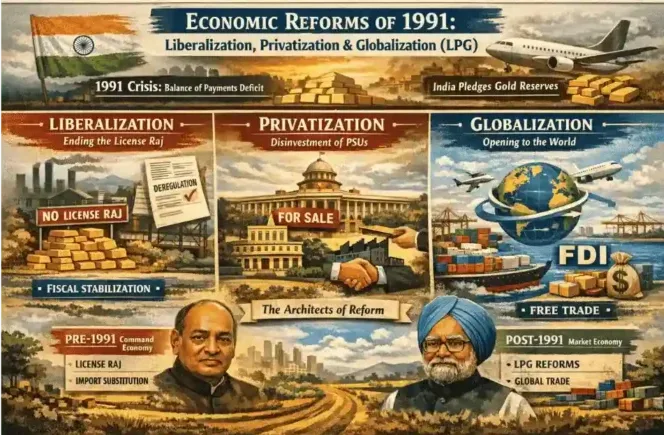
India faced a serious foreign exchange crisis.
During this time, reforms were introduced under Prime Minister P. V. Narasimha Rao.
The famous LPG reforms began:
- Liberalisation
- Privatisation
- Globalisation
These reforms changed the Indian economy significantly.
Eighth Five Year Plan (1992–1997)
This plan focused on modernization and human development.
Major features:
- Industrial modernization
- Population control
- Poverty reduction
- Employment generation
- Infrastructure development
- Tourism growth
India became a member of the World Trade Organization on 1 January 1995.
The plan also encouraged decentralization through Panchayats and Nagar Palikas.
- Target growth rate: 5.6%
- Actual growth rate: 6.8%
This was one of the most successful plans.
Ninth Five Year Plan (1997–2002)
This plan started when India completed 50 years of independence.
It was introduced during the government of Atal Bihari Vajpayee.
Major features:
- Poverty elimination
- Better quality of life
- Public-private partnership
- Social justice
- Primary education for all
The plan focused on balancing economic growth with social welfare.
Special attention was given to weaker sections of society.
- Target growth rate: 7.1%
- Actual growth rate: 6.8%
Tenth Five Year Plan (2002–2007)
The Tenth Plan focused on inclusive growth.
Major objectives:
- 8% annual GDP growth
- Reduce poverty by half
- Create 80 million jobs
- Reduce regional inequality
It also focused on reducing gender inequality in education and wages.
- Target growth rate: 8.1%
- Actual growth rate: 7.6%
This plan improved economic performance.
Eleventh Five Year Plan (2007–2012)
The main theme of this plan was Rapid and More Inclusive Growth.
Major features:
- Higher education expansion
- IT education
- Environmental sustainability
- Gender equality
- Clean drinking water
The Right to Education Act was introduced during this period.
This law made education free and compulsory for children aged 6–14 years.
The plan was prepared by C. Rangarajan.
- Target growth rate: 9%
- Actual growth rate: 8%
This plan made education more accessible.
Twelfth Five Year Plan (2012–2017)
This was India’s final Five Year Plan.
Its theme was Faster, More Inclusive and Sustainable Growth.
Major objectives:
- Improve infrastructure
- Electricity in all villages
- Better school access
- Improve higher education
- Reduce gender gap
- Increase green cover
The plan aimed to create jobs outside agriculture as well.
Environmental sustainability became an important focus.
- Initial target growth rate: 9%
- Approved growth rate: 8%
End of Five Year Plans in India
In 2015, the government replaced the Planning Commission with NITI Aayog.
This marked the gradual end of the traditional Five Year Plan model. By 2017, India officially moved away from Five Year Plans.
The new approach focuses on:
- Cooperative federalism
- Policy innovation
- Long-term strategy
- Faster implementation
Instead of fixed five-year planning, India now uses flexible development strategies based on changing economic needs.
Importance of Five Year Plans in India
Five Year Plans played a major role in India’s development. They helped:
- Increase agricultural production
- Build industries
- Improve education
- Reduce poverty
- Expand infrastructure
- Create employment
Even though India no longer uses the traditional Five Year Plan system, these plans laid the foundation of modern India’s economic growth.
FAQs on Five Year Plans in India
1. What are Five Year Plans in India?
Five Year Plans were economic development plans made by the Government of India for five-year periods to guide growth and development.
2. When did India start Five Year Plans?
India started the First Five Year Plan in 1951.
3. How many Five Year Plans were there in India?
India had 12 Five Year Plans from 1951 to 2017.
4. Which body prepared Five Year Plans?
The Planning Commission prepared and monitored the plans.
5. Why were Five Year Plans stopped?
They were replaced after the creation of NITI Aayog, which uses a more flexible planning model.