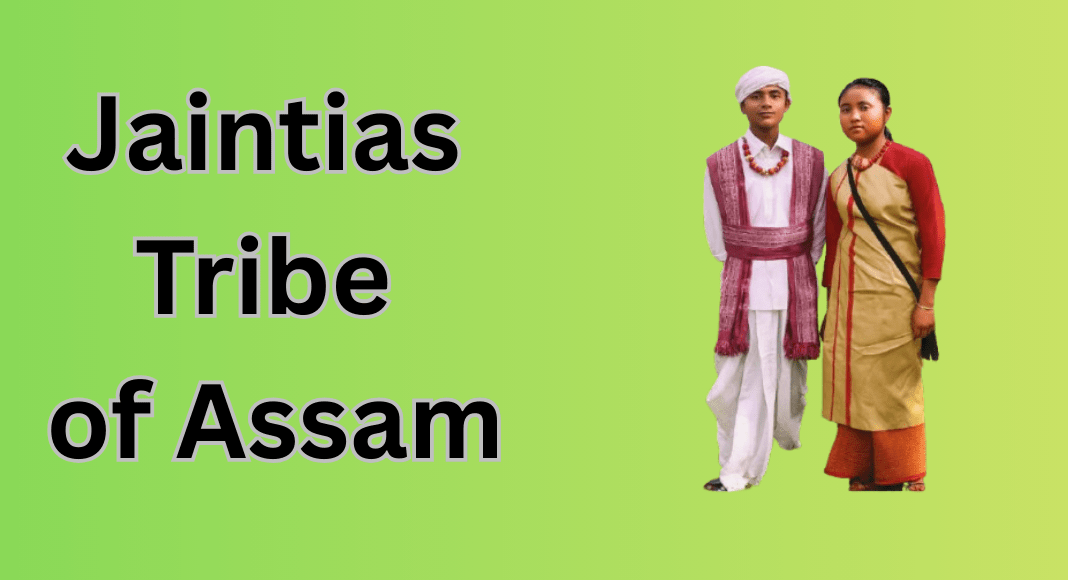
Jaintias Tribe of Assam: Culture, History & Heritage Explained

The Jaintias Tribe of Assam represents one of the most ancient, culturally rich, and historically fascinating ethnic communities of Northeast India. Although they are widely associated with the state of Meghalaya, the Jaintias have a long and deeply rooted connection with Assam. Their settlements in the hill regions of Karbi Anglong, North Cachar Hills (now Dima Hasao), and parts of the old Cachar district reveal a long history of movement, interaction, and shared heritage between the two neighbouring states.
Thank you for reading this post, don't forget to subscribe!The Jaintias, also known as Synteng or Pnars, are a Scheduled Tribe and form an essential part of Assam’s multi-ethnic social fabric. Their history spans ancient kingdoms, matrilineal traditions, migrations from Southeast Asia, and a unique cultural evolution over centuries. They follow customs that link them to both the Mon-Khmer linguistic traditions as well as the old mountain cultures of Eastern India.
Origin and Migration of the Jaintias Tribe
Understanding the origin of the Jaintias requires looking beyond written history, because systematic record-keeping in this region began only with the Ahom chronicles and even those accounts did not always focus on the hill tribes. As a result, the origins of the Jaintias must be reconstructed from legends, oral traditions, myths, and linguistic studies.
Connection with the Mon-Khmer People
Anthropologists such as Dr. Suniti Kumar Chatterjee and Sir Edward Gait agree that the Jaintias show clear cultural and linguistic similarities with the Mon-Khmer people of Southeast Asia particularly from the regions of Indo-China, Myanmar, and parts of Thailand. Their language belongs to the Austroasiatic family, which indicates that they were part of early human migrations into India coming from the East or Southeast.
Migration Route
Based on linguistic and physical anthropology, it is believed that:
- The Jaintias entered India through Myanmar.
- They settled for some time near the Kopili river.
- Later they moved to the Jaintia Hills region.
- Their settlements expanded into parts of Assam, especially:
- Karbi Anglong
- North Cachar Hills (Dima Hasao)
- Eastern border of old Cachar district
Their history also records that many areas now in Assam between Barak Valley and the Kalong river were once under the Jaintia Kingdom. This explains the presence of old Jaintia villages in present-day Assam.
Reference to “Stree Rajya”
Ancient Hindu texts such as the Puranas mention a “Stree Rajya” a kingdom ruled by women. Many scholars link this to the Jaintias because:
- They follow a matrilineal system.
- Women traditionally hold property and lineage rights.
- Two other matrilineal tribes the Khasi and the Garo live close to Jaintia areas.
Although it is difficult to say this reference is exclusively about the Jaintias, the matriarchal identity of the tribe makes the connection reasonable.
A Mongoloid Origin
Scholars widely agree that:
- The Jaintias are a Mongoloid people.
- They are descendants of early Indo-China migrants.
- Their isolation in the hills helped them preserve their identity.
Physically, the Jaintias are known to have:
- Fair complexion, especially among women
- Medium height
- Strong physical build
- Ability to perform hard manual labour
Racial Affinity and Nomenclature
Names of the Tribe
The Jaintias are known by different names:
- Jaintia – widely used in general and historical references
- Synteng – used in scholarly and linguistic discussions
- Pnars – the name commonly used in Meghalaya
- Jyntia – used by Colonel E.T. Dalton
All these terms refer to the same ethnic group.
Origin of the Name “Jaintia”
Dr. Suniti Kumar Chatterjee believed the name came from “Jain-tein”, which is synonymous with Synteng. Another theory states that Synteng comes from “Suteng” or “Sutunga”, which was believed to be the first royal dynasty of this tribe.
Regardless of the linguistic evolution, the terms Jaintia and Synteng today represent the same people.
Relation with the Khasis
All major scholars agree that:
- The Jaintias and Khasis share the same racial stock.
- Their languages belong to the same Mon-Khmer branch.
- They follow similar matrilineal family structures.
- Many of their cultural practices are shared or closely related.
This close affinity reflects their shared origins and long association.
A Glimpse Into Their History
The most detailed historical references to the Jaintias come from:
- Ahom Buranjis (royal chronicles)
- Copper plate inscriptions
- Coins
- Oral histories and legends
- Colonial accounts
Legend of Divine Origin

The Jaintia Buranji mentions a legend about the origin of the Jaintia kingdom:
- The kingdom was initially ruled by Brahmin kings.
- The last of them, Jayanta Roy, had no children.
- Through prayer, the goddess Gauri blessed him with a daughter, Jayanti.
- Jayanti was considered an incarnation of the goddess.
- The capital was named Jaintiapur, after her.
- Jayanti married Landhabar, son of the royal priest.
- Conflict later arose, and Landhabar left Jaintiapur to settle in Sutnga.
- There he married a mermaid-like divine being, sister of goddess Gauri.
- Their son, Bara Gossain or Bar Gohain Roy, later overthrew Jayanti and became king around 1250 AD.
Historical Kings of the Jaintia Kingdom
Sir Edward Gait lists several kings from 1500 AD onward:
| King | Period |
|---|---|
| Prabhat Ray | 1500–1516 |
| Majha Gosain | 1516–1532 |
| Burha Parbat Ray | 1532–1548 |
| Bar Gosain | 1548–1564 |
| Bijay Manik | 1564–1580 |
| Pratap Ray | 1580–1596 |
| Dhan Manik | 1596–1605 |
| Jasa Manik | 1605–1625 |
| Sundar Ray | 1625–1636 |
| Chota Parbat Ray | 1636–1647 |
| Jasamanta Ray | 1647–1660 |
| Ban Singh | 1660–1669 |
| Pratap Singh | 1669 |
| Lakshmi Singh | 1669–1697 |
| Ram Singh | 1697–1708 |
| Jay Narayan | 1708–1729 |
| Bar Gosain | 1729–1770 |
| Chatra Singh | 1770–1781 |
| Jatra Narayan | 1781–1786 |
| Bijay Narayan | 1786–1790 |
| Ram Singh II | 1790–1832 |
| Rajendra Singh | 1832–1835 |
Conflict With Neighboring Kingdoms
The Jaintia kings had repeated clashes with:
- The Kachari (Dimasa) kings
- The Koch dynasty
- The Ahom kings
Chilarai, the Koch general and brother of Naranarayan, once killed a Jaintia king. Dhan Manik, another Jaintia king, was forced to pay tribute to the Kacharis. Later, friendly relations were established through marriages between the Jaintia royal family and the Ahoms.
Annexation by the British
The last ruler, Rajendra Singh, was removed by the British in 1835. The kingdom was annexed primarily because the British objected to:
- Continued human sacrifice rituals
- Resistance to British authority
- Conflicts related to trade and taxation
Thus, nearly 800 years of Jaintia rule came to an end.
Demographic Characteristics in Assam
According to the 1971 Census, the combined population of Khasis and Jaintias in Assam was 6,487 (3,530 males and 2,957 females). Since these two tribes live adjacent to the Meghalaya border, it is estimated that a significant portion of this population were Jaintias.
Distribution in Assam
They are mainly found in:
- Karbi Anglong district
- Dima Hasao (North Cachar Hills)
- Cachar district (bordering Meghalaya)
Literacy
Their literacy rate in 1971 was only:
- 18.27% overall
- 20.65% for males
- 15.42% for females
This indicates low educational penetration among the tribe during that time. Improvements have occurred since then, but they still lag behind more developed communities.
Clan Structure (Kur)
The Jaintias have a well-defined clan system known as KUR, similar to the Karbi system where “Kur” also means clan.
Key features:
- Clans are exogamous marriage within the same clan is forbidden.
- Descent is traced through the mother.
- Each clan originates from female ancestors.
Four Main Ancestresses of Jowai
- Ka Bon
- Liban
- Ryngad
- Syngkon
- Litan
- Ka Tein
- Pakyntein
- Nikhla
- War
- Ka Wet
- Pariat
- Lywait
- Kynjing
- Catpoh
- Myreen
- Lanong
- Lakhiang
- Niangphoh
- Kima
- Siangbord
- Pyrdiang
- Ka Doh
- Langoh
- Nongbath
Other Ancestresses
- San Syngk — mother of eight clans: Shylla, Pariat, Pde, Blah, Hato, Dom, Slong, Thankiew
- Laloo — mother of twenty clans
Thus, at least 38 clans have been recorded, though more may exist.
Family Structure of Jaintias Tribe
The Jaintias follow a strict matrilineal family system known as Iung Bei, meaning “mother’s house”.
Features
- Lineage passes through women.
- Children belong to the mother’s family.
- The father has no ownership over the wife’s property.
- After marriage, the husband lives in the wife’s home.
- A son’s primary duty is towards his mother and her family, not his wife or children.
The mother’s authority is central and unquestioned in traditional Jaintia society.
Marriage Customs
Exogamy
Marriage within the same clan is prohibited.
Residence Pattern
After marriage:
- The husband must stay with his wife in her mother’s house.
- He becomes a member of her family, not his biological mother’s.
Inheritance
- Property passes only through daughters, not sons.
- Even if no daughters exist, sons cannot inherit.
Cultural Life of the Jaintias Tribe
Religion and Beliefs
Traditionally, the Jaintias practiced a form of animism, worshipping nature, ancestors, and local deities. Some important religious elements include:
- Worship of forest spirits
- Ritual ceremonies for agriculture
- Respect for ancestral stones (Megalithic tradition)
Festivals
- Behdienkhlam
- The most important festival
- Celebrated to chase away plague and evil spirits
- Includes dancing, music, wooden poles, and ritual offerings
- Lahoo Dance
- Performed by both men and women
- A celebration of community unity
- Chad Sukra
- Marks the beginning of the agricultural season
- Includes prayers for good harvest
Economic Life of Jaintias Tribe
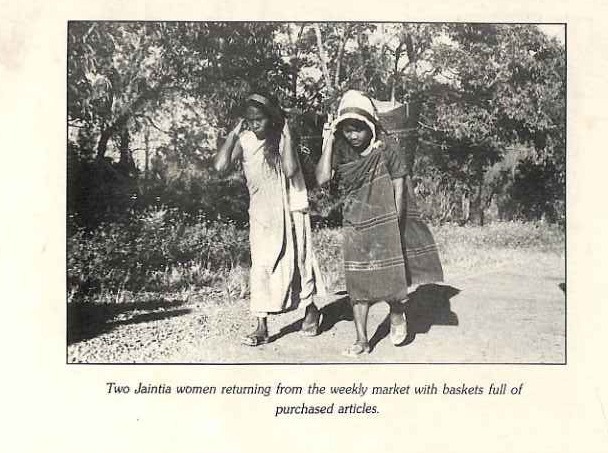
Traditionally, the Jaintias relied on:
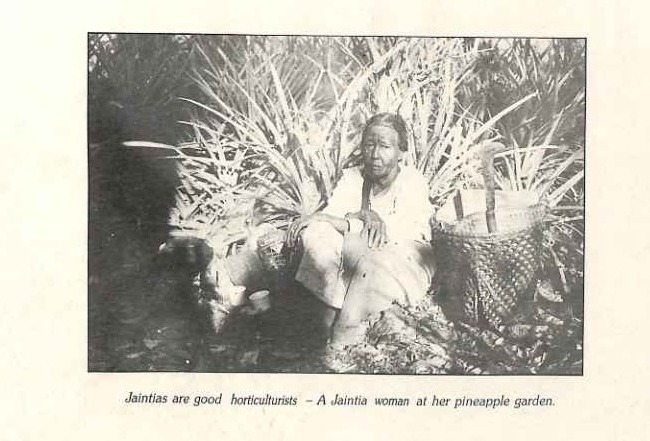
- Agriculture (paddy, millets, vegetables)
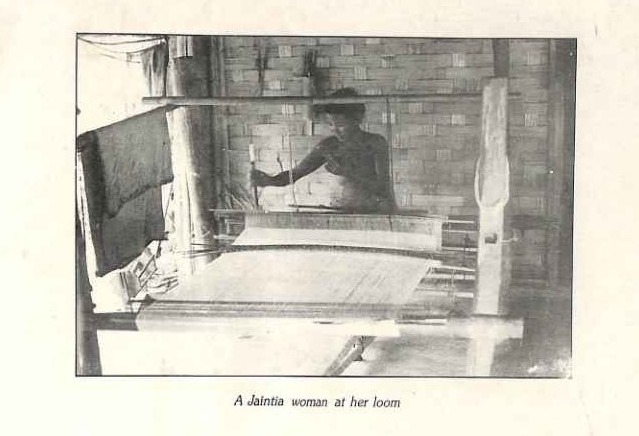
- Weaving
- Bamboo crafts
- Woodwork
- Pottery
- Animal husbandry
Women play a major role in agricultural and economic activities.
Language
The Jaintia language (Pnars) belongs to the Mon-Khmer branch of the Austroasiatic family. It contains:
- Ancient words not found in neighboring languages
- Close similarity with Khasi
- Soft sounds and rich oral traditions
Jaintias Tribe in Modern Assam
Today the Jaintias in Assam remain culturally active, preserving their:
- Matrilineal identity
- Clan traditions
- Festivals
- Language
- Marriage customs
They continue to contribute to the diversity of Assam’s hill districts.
Conclusion
The Jaintias Tribe of Assam are a testament to the deep cultural layers of Northeast India. Their matrilineal system, ancient kingdom, Mon-Khmer linguistic roots, unique clan structure, and rich traditions make them one of the most remarkable communities of this region.
Understanding them gives us a clearer picture of India’s ethnic diversity, the history of human migration, and the living heritage of indigenous peoples.
FAQs on the Jaintias Tribe of Assam
1. Who are the Jaintia people?
The Jaintias are an indigenous tribal community of Northeast India, mainly living in the Jaintia Hills of Meghalaya and parts of Assam. They have a unique matrilineal society and rich cultural traditions.
2. Where is the Jaintia Tribe found in Assam?
In Assam, the Jaintias mainly live in the Barak Valley region, especially in areas close to the Meghalaya border. Some small settlements also exist in the Dima Hasao district.
3. What is the Jaintia Tribe known for?
They are known for their matrilineal family system, traditional festivals like Behdienkhlam, beautiful handicrafts, sacred groves, and ancient heritage linked to the Sutnga and Jaintiapur kingdoms.
4. What language do the Jaintias speak?
They speak Pnar (also spelled Pnar/Jaintia) a branch of the Mon-Khmer language family. Many also speak Khasi, English, Bengali, and Assamese.
5. What is the religion of the Jaintia Tribe?
Traditionally, the Jaintias follow Niamtre, an indigenous faith based on ancestral worship, nature, and spiritual purity. Some Jaintias have also adopted Christianity over time.
6. What is the Behdienkhlam Festival?
Behdienkhlam is the most important Jaintia festival, celebrated to drive away diseases, evil forces, and misfortune. It includes rituals, dances, drumming, and symbolic wooden logs called dienkhlam.
7. What is special about Jaintia society?
Jaintias follow a strict matrilineal system where lineage, family property, and clan names pass through the mother. The youngest daughter (khadduh) inherits the family house.
8. Do Jaintias have their own traditional dress?
Yes. Women wear thoh saru, kyrshah, and layers of cloth, while men wear simple cotton garments and ornaments during festivals.
9. What are the main occupations of the Jaintias?
Agriculture, bamboo craft, blacksmith work, weaving, pottery, fishing, and small-scale trade are the main occupations. Many also work in education and government services today.
10. What foods are popular in Jaintia cuisine?
Jaintia cuisine includes jadoh (rice + meat), doh-khleh, tungrymbai (fermented soybean), smoked meat, bamboo shoot dishes, and rice beer (kiad).
11. What is the historical background of the Jaintias?
They were once the rulers of the Jaintia Kingdom, with their capital at Jaintiapur (now in Bangladesh). Their history goes back to ancient Austroasiatic tribes.
12. What makes Jaintia sacred groves unique?
These are protected forests where cutting trees or hunting is strictly forbidden. They preserve rare plants, herbs, and biodiversity.
13. What is the Jaintia clan system?
Clans (kur) are inherited from the mother. Marriage within the same clan is forbidden to maintain purity and lineage rules.
14. What types of houses do Jaintias traditionally build?
They build bamboo and wooden houses with raised floors, sloping roofs, and well-designed ventilation suited for heavy rainfall.
15. Are Jaintias only found in India?
No. A portion of the Jaintia population also lives in Bangladesh, especially in the Sylhet region, carrying forward similar traditions.