Khasis Tribe of Assam: Culture, Identity & Heritage

The Khasis Tribe of Assam represents one of the oldest and most culturally rich communities of Northeast India. Although the Khasis are mostly associated with Meghalaya especially the East and West Khasi Hills they have a significant and historically rooted presence in Assam, primarily in Karbi Anglong and Dima Hasao (North Cachar Hills). Their settlements extend beyond political borders, reaching into Tripura and even parts of Bangladesh such as Sylhet and Mymensingh.
Thank you for reading this post, don't forget to subscribe!Despite being numerically small in Assam, the Khasis hold a unique identity shaped by their Mon-Khmer linguistic heritage, matrilineal social system, ancient customs, and rich spiritual beliefs. Their traditions, mythology, kinship system, political structure, and economic life together present a distinct cultural world that continues to thrive even in modern times.
Origin, Racial Affinity & Migration of Khasis Tribe
The origin of the Khasis has fascinated anthropologists, linguists, and historians for decades. Multiple theories attempt to trace their roots:
1. Mon-Khmer Linguistic Link
Sir Edward Gait, a renowned historian, classified the Khasis (including Jaintias and Syntengs) as belonging to the Mon-Khmer linguistic family, a branch of the Austroasiatic group. This makes the Khasis unique, as they are the only Mon-Khmer speakers in India.
This linguistic connection suggests that the Khasis might have been part of an early wave of Mongoloid populations who migrated into Northeast India in ancient times.
2. Cultural Similarities with Ho-Munda Groups
Colonel Dalton proposed another theory linking the Khasis with the Hos of Singhbhum and the Mundas of Chota Nagpur.
His argument is based on funerary customs, such as:
- Preservation of the bones/ashes in stone cairns
- Erection of monoliths to commemorate ancestors
- Similar funeral rituals
These parallels raise the possibility of early cultural exchange or a distant common origin.
3. Common Cultural Source Theory
Barkataki further expanded on these ideas, suggesting that even if the Khasis and Ho-Mundas were not genetically related, they might have derived cultural traits from a common ancient source.
4. Mythological Origin
Traditional Khasi mythology narrates a beautiful story:
- God originally created 16 families.
- A golden ladder connected heaven and earth.
- 9 families stayed in heaven, while 7 families descended to earth.
- These 7 families settled in the region now known as the Khasi and Jaintia Hills.
Thus, the Khasis believe they descended directly from heavenly families, giving their homeland a sacred identity.
Racial and Migration Characteristics
Despite ritual similarities with central Indian tribes, linguistically and racially the Khasis remain distinct as Mongoloids. Scholars believe they migrated from Southeast Asia in the distant past and gradually settled permanently in the Khasi and Jaintia Hills, unlike some other Indo-Mongoloid tribes who continued migrating.
Demographic Characteristics of Khasis Tribe
The exact population of Khasis in Assam is difficult to determine because earlier census operations (like in 1971) categorized Khasis and Jaintias together. According to the 1971 Census:
- Total: 6,487
- Males: 3,530
- Females: 2,957
Their population has grown since then, but they still form a small community in Assam compared to Meghalaya.
Social Life of the Khasis Tribe
Khasi society is deeply structured, disciplined, and defined by a strong sense of family, clan, ritual, and responsibility.
1. Family: A Matrilineal System
The Khasis follow a strict matrilineal system.
Key features include:
- Inheritance passes through daughters, especially the youngest daughter (Ka Khadduh).
- The mother is the head of the household.
- Children belong to the mother’s clan.
- The maternal uncle acts as the guardian and plays ceremonial roles.
However, unlike the Jaintias, Khasi fathers have an important presence in family life. They share financial responsibility and participate in raising children.
2. Clan (Kur) System
A Khasi clan is called KUR, and it is always traced through the mother.
Important points:
- Clans are strictly exogamous marriage within the same clan is forbidden.
- A father’s clan, called KHA, is secondary but still important.
- When a Khasi man marries a non-Khasi woman, a new clan lineage is created for her.
- When a non-Khasi man marries a Khasi woman, their children automatically become part of the mother’s clan.
Clans serve as the main social units, often superseding individual families.
3. Marriage Customs
Marriage in Khasi society reflects both tradition and flexibility.
Key rules and customs include:
- Exogamy is strictly enforced.
- Violating clan exogamy once resulted in excommunication and loss of property.
- Cross-cousin marriage is allowed under limited circumstances.
- Levirate marriages (marrying a deceased brother’s wife or vice versa) are strictly forbidden.
- Women enjoy considerable freedom in choosing partners.
A unique custom:
- If a girl wishes to marry a boy who refuses, her family may compel the boy to agree.
After marriage:
- The husband lives in his mother-in-law’s house.
- Children inherit their mother’s clan name and title.
Child marriage is unknown. Divorce and widow remarriage are permitted.
4. Birth Rituals
Birth is a joyous occasion, irrespective of the baby’s gender.
Key beliefs include:
- The Khasis believe in rebirth, often within the same family.
- The maternal uncle performs the naming ceremony with rice beer rituals.
- Symbolic objects (bow and arrows for boys, knife and head strap for girls) are placed beside the newborn.
5. Death Rituals
Death rituals are elaborate and sacred.
Important practices:
- The dead are cremated.
- Bones are collected and stored in stone cairns or clan repositories.
- A man’s bones and his wife’s bones are never mixed because they belong to different clans.
- Offerings of food, betel nuts, and rice beer are made.
These rituals symbolize the continuation of the clan lineage.
Law of Inheritance
Khasi inheritance revolves around the youngest daughter, known as Ka Khadduh.
Her role:
- Custodian of family property
- Responsible for maintaining ancestral rituals
- Cannot sell property without consulting maternal uncles and elder brothers
If Ka Khadduh converts to another religion, she loses inheritance rights.
If she dies without daughters, inheritance passes to the next sister or the mother’s sister’s line.
Land System of Khasis Tribe
Khasi land is divided into three main categories:
1. Ri Raid Land (Community Land)
- Owned collectively by the community
- Individuals have usage and inheritance rights but cannot transfer it
2. Ri Kur Land (Clan Land)
- Owned by clans
- Members have full rights to use, inherit, and transfer (within clan customs)
3. Ri Kynti (Private Land)
- Belongs to individuals
- Can be sold or transferred freely within customary limits
In Jhum areas, land reverts to the community once abandoned.
Socio-Political Structure of Khasis Tribe
The Khasi political system is democratic and traditional.
It includes:
- Syiem – the traditional ruler
- Durbar – council of ministers and elders
- Mantries, Basans, Bakhraws, Lyngskors – administrative officials
Society is divided into:
- Ruling class: Syiems, Wahadadars, Sirdars, Lyngdohs
- Aristocratic class: Mantries, Basans, Lyngskors
- Common people
Although the Syiem system exists, its powers are now largely ceremonial due to the District Council system under the Sixth Schedule.
Surprisingly, despite their matrilineal society, women traditionally did not participate in political institutions.
Crimes and Punishment
Khasi customary laws were historically strict:
- Crimes like murder, adultery, incest, robbery, and arson were punished severely.
- Extreme punishment for theft involved sitting on a bamboo platform with burning chillies underneath.
- These harsh measures helped maintain a relatively crime-free society.
Khasi Villages and Housing
Khasi villages have distinct features:
- Villages are never built on hilltops considered taboo (Sang).
- Houses are built on slopes just below summits for protection.
- Houses traditionally used no nails, relying on indigenous joinery.
- No architectural distinctions between chiefs and commoners.
Religious Life of Khasis Tribe
Traditional Khasi religion is deeply spiritual and nature-based.
Beliefs Include:
- U Blei Nongthaw – Supreme Creator God
- Ka Blei Synshar – Female preserver goddess
- Numerous benevolent and malevolent spirits
- Ancestor worship
- Life after death, heaven, and rebirth
U Thlen – The Snake Deity
One of the most feared entities is U Thlen, a serpent spirit believed to grant wealth in exchange for human blood.
Families associated with U Thlen were traditionally avoided.
Christianity
Most Khasis in Assam today are Christians, but they still preserve many traditional rituals.
Economic Life of Khasis Tribe
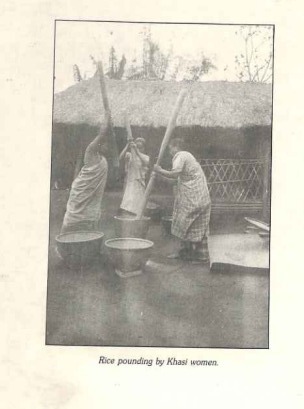
The Khasis have a diversified economy.
Agriculture
- Wet rice cultivation (without ploughs, using hoe and harrow)
- Terrace farming
- Jhum/shifting cultivation
- Horticulture: pineapples, oranges, bananas, pears, etc.
Occupations
- Beekeeping
- Bamboo crafts
- Blacksmith work
- Petty trade and carpentry
- Pig rearing and poultry
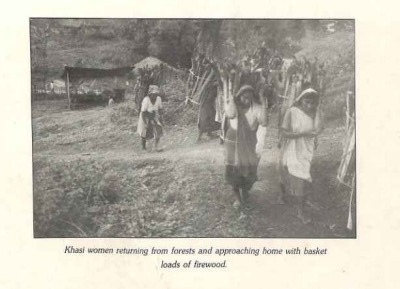
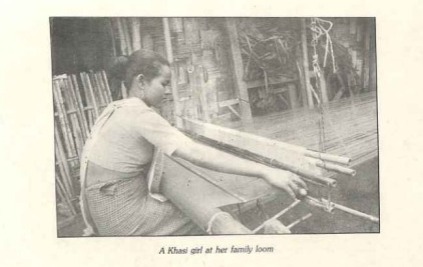
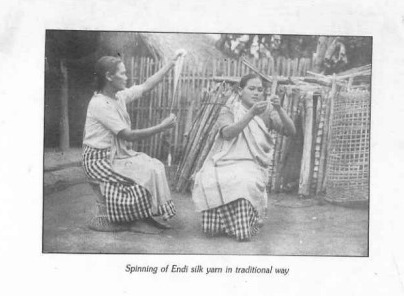
Unlike many tribes, Khasi women do not weave, depending on Assamese plains for clothing.
Food Habits
Khasi cuisine includes:
- Rice as staple
- Pork as a major delicacy
- Beef, chicken, mutton
- Dried fish
- Non-vegetarian food widely enjoyed
- Betel nut chewing is universal
- Drink rice beer, Khaweiang beer, and tea (with or without milk)
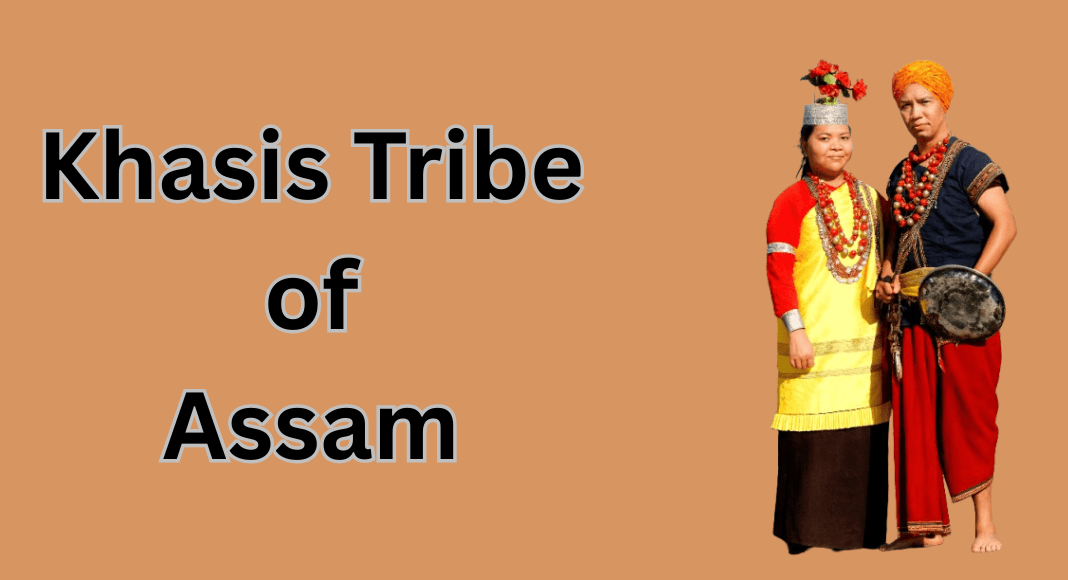
Dresses & Ornaments
Men
- Sleeveless fringed coat
- Dhotis
- Silk turbans (for wealthy individuals)
- Shawls
Women
- Ka Jympiew – waist garment
- Ka Jainsem – long silk cloth draped from shoulder to ankle
- Jainkup – winter cloak
- Head scarf for married women
- A shoulder bag containing betel nut essentials
Ornaments
- Gold and silver jewellery
- Coral bead necklaces
- Earrings (historically worn by both genders)
Role of Women in Khasi Society
Khasi women enjoy significant respect and economic rights.
Why Khasi women are culturally powerful:
- They hold inheritance rights
- They make family decisions
- They manage household wealth
- They maintain clan traditions
- They are cultural transmitters
This makes Khasi society a model of gender balance.
Modern Changes and Lifestyle Shifts
Like many indigenous communities, the Khasis tribe of Assam is going through social changes:
- Migration to urban areas
- Influence of Christianity
- Adoption of modern occupations
- Blending of traditional and modern attire
- Changes in traditional matrilineal roles
Yet, the community continues to preserve its core values.
Challenges Faced by the Khasi Tribe of Assam
Some concerns include:
- Loss of traditional lands
- Dilution of cultural practices
- Limited representation
- Language shift among youth
- Socio-economic differences
Despite challenges, many organizations and cultural groups are working to preserve Khasi identity.
Why Khasi History and Identity Matters for Assam & Northeast India
While Meghalaya remains the heartland of Khasi population, the existence of Khasi communities in Assam especially in hill districts like Karbi Anglong or North Cachar Hills adds to the ethnic and cultural mosaic of Assam.
For a state like Assam, which is home to a variety of tribal communities (Bodo-Kachari, Karbi, Deori, Dimasa, etc.), recognising, understanding and preserving the Khasi minority’s identity is important. Their presence reminds us of the region’s embedded cultural and linguistic diversity.
Furthermore, documenting Khasi traditions, social systems and ways of life especially as modernization brings change becomes crucial for cultural preservation, academic study, and for strengthening inter-tribal understanding in Assam and neighboring states.
Conclusion
The Khasis Tribe of Assam represents a vibrant thread in the cultural fabric of Northeast India. Though their largest population resides in Meghalaya, their presence in Assam particularly in Karbi Anglong and Dima Hasao continues to enrich the region’s ethnic diversity. Their unique matrilineal society, Mon-Khmer linguistic identity, clan-based structure, vibrant rituals, indigenous political systems, and deep connection with nature make them one of the most historically significant communities in India.
Despite modernization and religious conversions, the Khasis have successfully preserved their core traditions. Their customs surrounding marriage, inheritance, death rituals, and festivals continue to reflect their ancient worldview and spiritual wisdom. Today, the Khasis stand as a living example of cultural resilience balancing tradition and modernity while maintaining a strong sense of identity.