


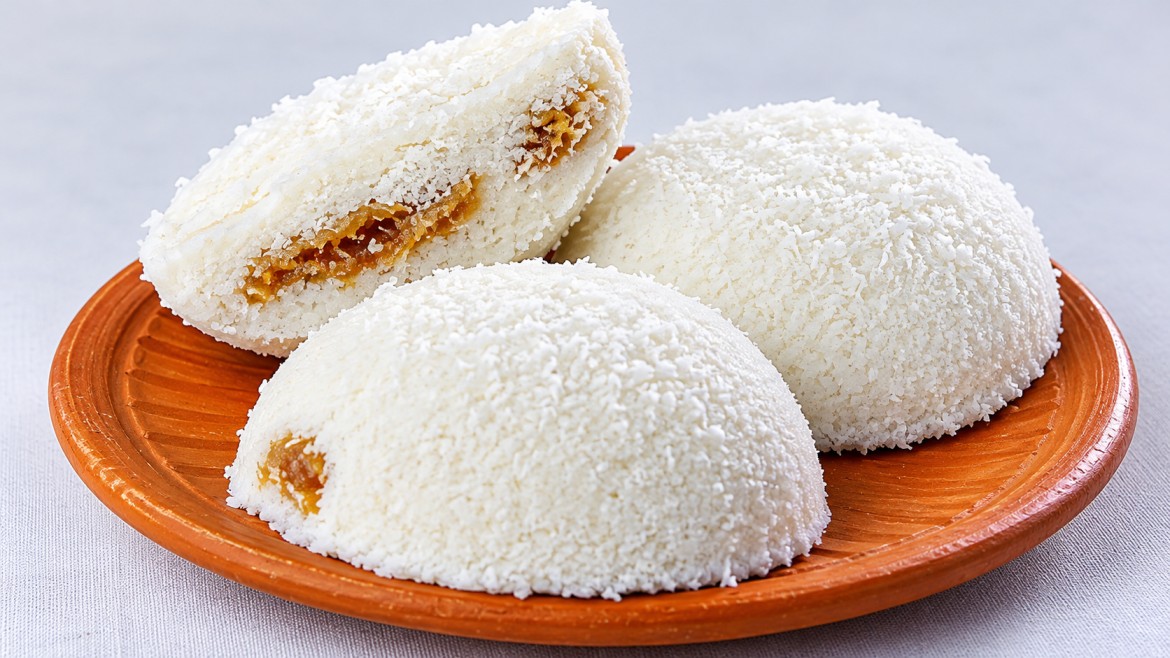
Tekeli Pitha: A Traditional Assamese Steamed Rice Cake

Tekeli Pitha is a traditional Assamese rice cake prepared by steaming a mixture of rice flour and different fillings over a kettle. It is especially popular during Magh Bihu, also known as Bhogali Bihu, the harvest festival of Assam. Made with simple ingredients such as rice flour, grated coconut, jaggery, chillies and herbs, Tekeli Pitha is a delicious part of Assamese food culture. While the sweet version is widely enjoyed, savoury Tekeli Pitha is also a wonderful option for people who prefer spicy and flavourful snacks.
The name Tekeli Pitha comes from the Assamese word tekeli, meaning a kettle. Traditionally, the pitha is prepared using the steam released from a kettle. The rice flour mixture is placed on the kettle lid with a filling in the centre and then covered with a damp cloth. As the water inside the kettle boils, steam cooks the pitha from below. This traditional cooking method gives it a soft, moist and slightly crumbly texture.

Tekeli Pitha and Assamese Food Culture
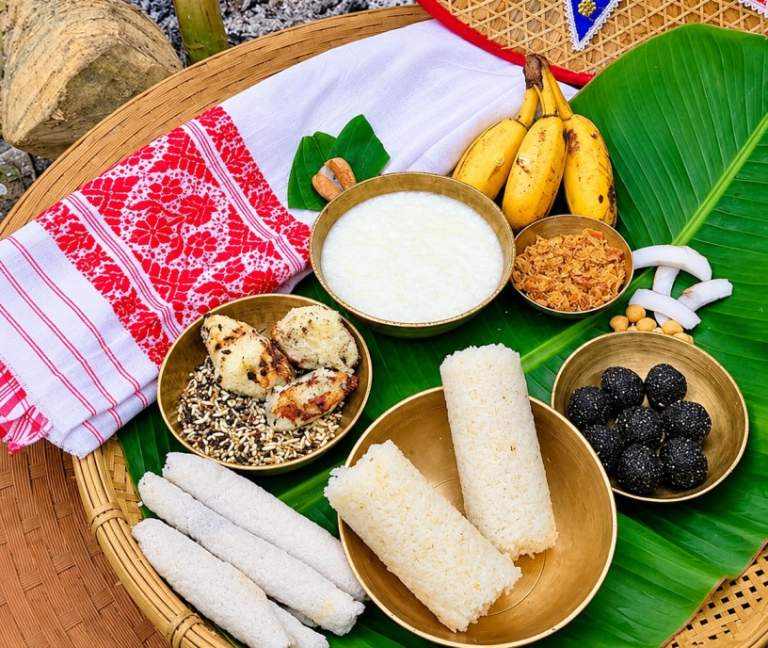
Assam celebrates Magh Bihu in January to mark the end of the harvest season. It is a festival of food, community gatherings and traditional celebrations. During this time, families prepare different kinds of pitha, larus and other dishes using freshly harvested rice, coconut, sesame seeds and jaggery.
Til Pitha and Ghila Pitha are among the well-known Assamese delicacies prepared during Bihu. Tekeli Pitha is another special preparation enjoyed in many parts of Assam. It is also sold at roadside tea stalls and small tea carts, where people enjoy it as a quick snack with a cup of tea.
Unlike many sweet pithas, Tekeli Pitha can be prepared in both sweet and savoury forms. The savoury version can include green chillies, curry leaves, coconut chutney, pickle and asafoetida. The sweet version can be filled with date palm jaggery and raisins. This variety makes Tekeli Pitha suitable for different tastes and occasions.
Types of Tekeli Pitha
Tekeli Pitha can be prepared with different fillings and flavours. The most common options include sweet coconut and jaggery fillings, as well as savoury fillings made with herbs, chillies and pickles.
Savoury curry leaf Tekeli Pitha: This version is flavoured with chopped green chillies, curry leaves and salt. A coconut chutney filling adds a rich, tangy and aromatic taste.
Pickle-flavoured Tekeli Pitha: This version uses a small amount of pickle and asafoetida. It has a spicy and tangy flavour and is a good choice for people who enjoy savoury snacks.
Sweet Tekeli Pitha: This version uses date palm jaggery, also known as Nolen Gur, and raisins as its filling. It has a natural sweetness and is suitable for people who prefer traditional sweet pithas.
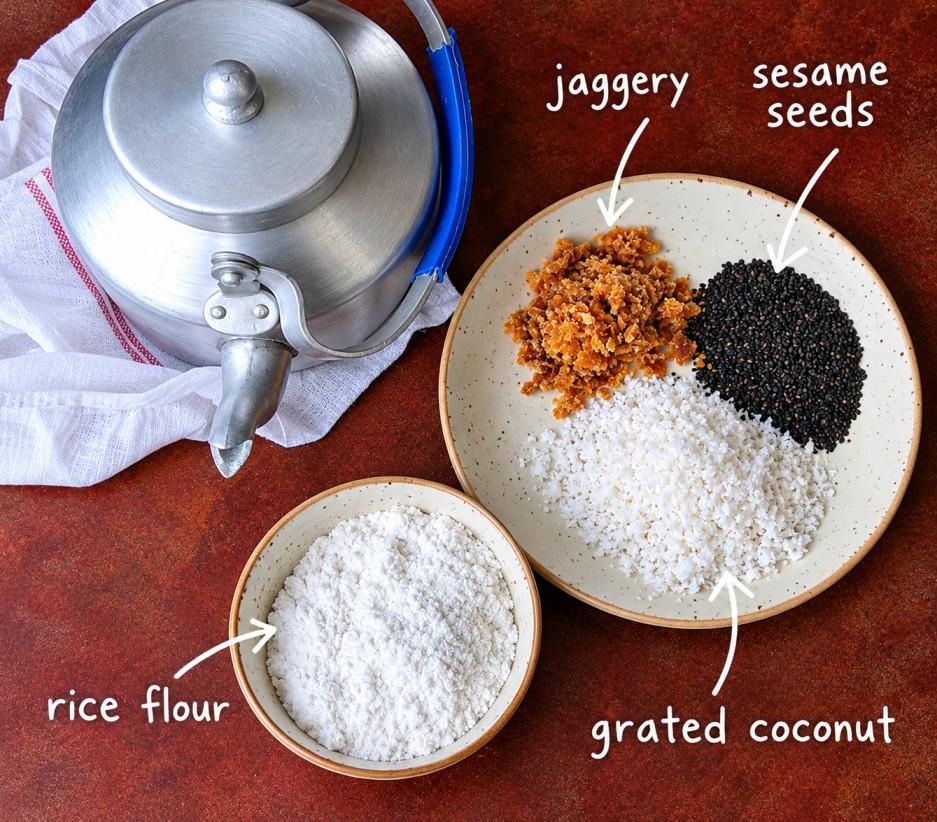
Ingredients for Tekeli Pitha
This recipe makes approximately 6–8 medium-sized pithas, depending on the size of the kettle lid and the amount of rice flour used.
Main ingredients
- Rice flour – 3 cups
- Freshly grated coconut – 1 cup
- Neutral cooking oil – ¼ cup, for greasing and brushing
- Water – as required
- Salt – ¼ teaspoon for each savoury portion, adjusted to taste
For the best texture, use freshly prepared rice flour made from rice that has been soaked, dried and ground. Joha rice or another short-grain rice can be used. The flour should be fine and dry before water is added.
Ingredients for curry leaf-flavoured savoury Tekeli Pitha
For the coconut chutney filling:
- Grated coconut – 1½ cups
- Tamarind pulp – 2 tablespoons
- Green chilli – 1
- Ginger – 1-inch piece
- Chopped green chillies – ¼ cup
- Curry leaves – 3–4 sprigs
- Dry red chilli – 1
- Neutral oil – ½ teaspoon
- Black mustard seeds – ½ teaspoon
- Salt – as required
These ingredients can be used to prepare a flavourful coconut chutney. The chutney should be thick rather than watery so that it stays inside the pitha during steaming.
Ingredients for pickle-flavoured savoury Tekeli Pitha
- Dry red chilli pickle – 1–2 teaspoons
- Asafoetida – ¼ teaspoon
- Rice flour – one portion from the main ingredients
- Grated coconut – as required for layering
- Salt – a small pinch, if needed
Choose a pickle with a thick consistency. Avoid adding too much oil or liquid from the pickle because excess moisture can affect the texture of the rice flour.
Ingredients for sweet Tekeli Pitha
- Crushed date palm jaggery (Nolen Gur) – ½ cup
- Raisins – ¼ cup
- Grated coconut – as required for layering
- Rice flour – one portion from the main ingredients
Date palm jaggery gives the sweet pitha a rich traditional flavour. If Nolen Gur is unavailable, another good-quality jaggery can be used, although the taste will be slightly different.
How to Prepare Tekeli Pitha
Step 1: Prepare the rice flour
If you are making rice flour at home, wash the rice properly and soak it in water. Drain the water and spread the rice on a clean cloth or tray. Allow it to dry completely before grinding it into a fine powder.
Sieve the flour to remove large particles. The flour should be dry and free from lumps. Divide the three cups of rice flour into three equal portions if you want to prepare curry leaf, pickle and sweet varieties together.
Step 2: Prepare the savoury flavour mixtures
Take the first portion of rice flour and add finely chopped green chillies, chopped curry leaves and about ¼ teaspoon of salt. Mix gently so that the ingredients are distributed evenly.
For the second portion, add asafoetida and a small amount of dry red chilli pickle. Mix it carefully. You can adjust the pickle according to your preferred level of spice. Keep the third portion plain, with only a small pinch of salt, for the sweet jaggery filling.
Step 3: Prepare the coconut chutney
For the curry leaf version, prepare a thick coconut chutney. Grind the grated coconut with tamarind pulp, ginger and one green chilli. Do not add too much water. The mixture should remain thick enough to be used as a filling.
Heat half a teaspoon of oil in a small pan. Add black mustard seeds and allow them to crackle. Add one dry red chilli and the curry leaves. Pour this tempering over the coconut mixture. Add chopped green chillies and salt, then mix everything well.
Keep the chutney aside. Allow it to cool before using it as a filling.
Step 4: Prepare the crumbly rice flour mixture
Sprinkle a little water over the first portion of rice flour. Mix it gently with your fingers. Continue adding water in small amounts until the flour becomes slightly moist and crumbly.
Do not knead the flour like regular dough. Tekeli Pitha needs a loose, breadcrumb-like mixture rather than a smooth, sticky dough.
To check the consistency, take a small amount of the mixture in your palm and press it gently with your thumb. It should hold together for a moment but break apart easily when you release the pressure. If it feels too dry, sprinkle a little more water. If it becomes sticky, add a small quantity of dry rice flour.
Repeat the same process for the other two portions.
Step 5: Prepare the kettle
Take a clean kettle and fill it with water up to approximately the level of its spout. Block the spout with a suitable heat-resistant plug designed for this purpose so that steam does not escape through it. Make sure the kettle is stable and suitable for stovetop use.
Place the kettle on the stove and bring the water to a boil. Steam will rise and reach the underside of the lid, cooking the pitha.
Handle the hot kettle and lid carefully. Use suitable heat-resistant equipment and never block a kettle’s pressure-relief mechanism or use an unsafe improvised plug. If your kettle is not designed for this cooking method, use a steamer with a suitable flat steaming plate instead.
Step 6: Grease the kettle lid
Take the kettle lid and brush a thin layer of neutral cooking oil over its underside or the surface on which the pitha will sit. This prevents the rice cake from sticking and makes it easier to remove after steaming.
Do not apply too much oil. A light coating is enough.
Step 7: Layer the rice flour and coconut filling
Take the first portion of the moist rice flour mixture and spread a thin, even layer over the greased lid. Do not press the flour firmly. Keep the mixture loose so that steam can pass through it.
Place a small amount of prepared coconut chutney in the centre. Cover the chutney with another thin layer of rice flour. Add some freshly grated coconut on top and finish with another layer of rice flour to cover the filling completely.
Make sure the filling does not reach the edges. Leave enough space around it so that the pitha holds its shape after steaming. Do not use too much chutney, as excess filling can make the pitha difficult to remove.
Step 8: Cover with a damp cloth
Take a clean muslin cloth or cheesecloth and wet it with water. Squeeze out the excess water so that the cloth remains damp but does not drip.
Carefully place the cloth over the layered rice flour mixture. It should cover the pitha and wrap around the lid securely. This helps hold the mixture in place during steaming.
Step 9: Steam the Tekeli Pitha
Place the prepared lid carefully on the boiling kettle. Allow the pitha to steam for approximately 7–10 minutes.
The cooking time may vary depending on the thickness of the rice flour layer, the size of the pitha and the strength of the steam. Avoid opening the lid too frequently because this can interrupt the cooking process.
Once the pitha is cooked, carefully remove the lid using heat-resistant gloves or a cloth. Keep your hands and face away from the steam to avoid burns.
Step 10: Remove and serve
Allow the lid to cool slightly before handling the pitha. Carefully remove the damp cloth and gently invert the lid onto a plate to release the pitha.
The finished Tekeli Pitha should be soft, moist and properly cooked. Serve it fresh and warm with Assamese tea. It can also be enjoyed as a light snack or as part of a traditional Bihu meal.
How to Make Pickle-Flavoured Tekeli Pitha
The pickle-flavoured version follows almost the same cooking process. Take the second portion of rice flour mixed with asafoetida and a little pickle. Sprinkle water gradually until it becomes crumbly.
Spread a layer of the mixture over the greased kettle lid. Add a small amount of dry red chilli pickle in the centre. Cover it with rice flour, add a little grated coconut and finish with another layer of rice flour.
Cover the mixture with a damp muslin cloth and steam it for 7–10 minutes. Remove it carefully once cooked. This version has a tangy and spicy taste that goes well with a cup of tea.
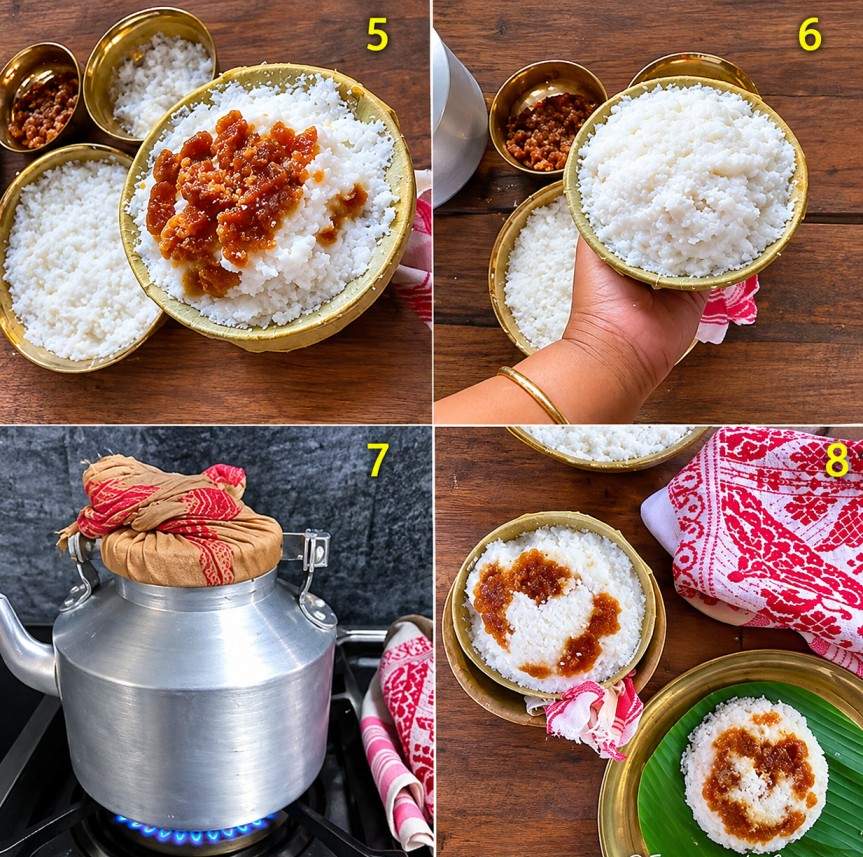
How to Make Sweet Tekeli Pitha with Nolen Gur
For the sweet version, use the third portion of rice flour. Prepare it with a small pinch of salt and enough water to make it crumbly.
Spread a layer of rice flour over the greased lid. Place a small amount of crushed Nolen Gur in the centre and add a few raisins. Cover the filling with another layer of rice flour and finish with grated coconut and a final layer of rice flour.
Keep the jaggery filling in the centre and avoid using too much. Excess jaggery may melt during steaming and cause the pitha to lose its shape. Cover it with a damp cloth and steam for 7–10 minutes. Remove it gently and serve warm.
Important Tips for Making Soft and Tasty Tekeli Pitha
- Use fine rice flour for a soft and even texture.
- Sprinkle water gradually instead of pouring it all at once.
- Never knead the rice flour mixture into a smooth dough.
- Keep the mixture loose and crumbly.
- Use a thick filling that does not contain excess water.
- Do not press the rice flour layers tightly on the kettle lid.
- Grease the lid lightly to prevent sticking.
- Use a damp, clean muslin cloth to hold the pitha together.
- Avoid overfilling the pitha with chutney, pickle or jaggery.
- Serve Tekeli Pitha fresh for the best taste and texture.
Serving Suggestions
Tekeli Pitha tastes best when served warm with a cup of Assam tea. The curry leaf and pickle versions are especially suitable for people who enjoy savoury snacks. They can also be served as part of a traditional Assamese breakfast or evening snack.
The sweet Nolen Gur version can be served after a meal or during Magh Bihu celebrations. A platter containing both sweet and savoury Tekeli Pitha is a lovely way to share the different flavours of Assamese cuisine with family and guests.
Frequently Asked Questions (FAQs)
1. What is Tekeli Pitha?
Tekeli Pitha is a traditional Assamese steamed rice cake prepared using rice flour and a filling. It is cooked with steam from a kettle, traditionally using the kettle lid as the cooking surface.
2. Why is it called Tekeli Pitha?
The word Tekeli means kettle in Assamese. The pitha gets its name from the traditional method of cooking it over a kettle.
3. When is Tekeli Pitha usually prepared?
Tekeli Pitha is commonly prepared during Magh Bihu, also known as Bhogali Bihu, in Assam. It is also enjoyed as a snack throughout the year in some areas.
4. Is Tekeli Pitha sweet or savoury?
Tekeli Pitha can be prepared in both sweet and savoury forms. The sweet version can contain jaggery and raisins, while savoury versions can include curry leaves, green chillies, coconut chutney, pickle and asafoetida.
5. Which rice is best for making Tekeli Pitha?
Joha rice or another short-grain rice can be used. The rice should be soaked, dried and ground into fine flour before preparing the pitha.