




AI-Planned Mars Drive: NASA’s Perseverance Rover Enters a New Era of Autonomous Exploration

AI-Planned Mars Drive has become a historic phrase in space exploration after NASA confirmed that its Perseverance rover successfully completed the first fully autonomous, artificial intelligence planned drives on another planet. This achievement marks a major step toward smarter and more independent robotic missions, where machines can analyse their surroundings, make decisions, and act with minimal help from humans on Earth.
Thank you for reading this post, don't forget to subscribe!The breakthrough shows how advanced AI systems can safely guide spacecraft across harsh and unpredictable environments. It also opens new possibilities for faster discoveries and more ambitious missions on Mars and beyond.
A Historic Moment on the Red Planet
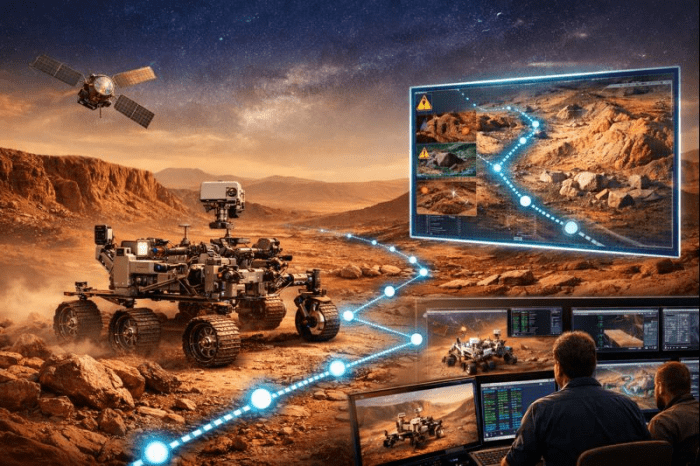
NASA announced that Perseverance carried out two autonomous drives on December 8 and December 10. During these tests, the rover did not rely on human engineers to choose each waypoint or driving path. Instead, onboard AI software independently studied images of the terrain and planned safe routes on its own.
This was the first time a rover on another planet had used artificial intelligence to fully design its driving route. Engineers at NASA’s Jet Propulsion Laboratory (JPL) described it as a milestone that proves AI can operate reliably in deep space.
Perseverance travelled 210 metres during the first AI-planned drive and 246 metres during the second. Both journeys were completed safely, without any human selecting the path in advance.
How the AI Thinks and Plans
The system behind the AI-Planned Mars Drive is a vision-enabled generative AI model. It has been trained using large collections of Mars mission data, including images and terrain information that human planners normally study.
The AI looks at high-resolution surface images, slope maps, and elevation models to understand what lies ahead. It identifies hazards such as steep slopes, loose sand, sharp rocks, and large boulders. At the same time, it searches for areas that are safe and scientifically interesting.
Using this information, the system creates a continuous driving route with precise waypoints. This allows Perseverance to move smoothly across the Martian surface while avoiding dangerous obstacles.
A key source of data is the HiRISE camera aboard the Mars Reconnaissance Orbiter, which provides detailed orbital images of Mars. These images help the AI understand the broader landscape before the rover even begins to move.
Careful Testing Before Real Use
Safety is a top priority for NASA, especially when introducing new technology. Before sending any AI-generated commands to Mars, engineers tested them using a digital twin of the Perseverance rover at JPL.
A digital twin is a virtual copy of the rover that behaves like the real one. Engineers ran the planned drives through this simulation to ensure the commands would work correctly with the rover’s flight software.
More than 500,000 telemetry variables were checked before the commands were approved. Only after passing all these tests were the instructions sent to Perseverance.
This careful process ensured that the rover could carry out the AI-planned drives without risk.
Why Autonomy Matters on Mars
Mars is about 225 million kilometres away from Earth on average. Because of this vast distance, radio signals can take between 5 and 20 minutes to travel one way. Real-time control of rovers is impossible.
Traditionally, human planners study images sent from Mars, design a route, and upload commands for the next day’s drive. This process is slow and limits how far a rover can travel.
With AI planning its own routes, Perseverance can make decisions much faster. This means it can cover more ground, explore tougher terrain, and spend more time doing science instead of waiting for instructions.
Boosting Scientific Discovery
Autonomous driving allows rovers to reach interesting geological features that might otherwise be too difficult or time-consuming to approach. Perseverance is exploring Jezero Crater, an area believed to once contain a lake and river delta.
By moving more efficiently, the rover can study a wider variety of rocks, search for signs of ancient life, and collect samples for future return to Earth.
AI autonomy also helps the rover react to unexpected situations, such as new obstacles or changing surface conditions.
A Step Toward Future Missions
NASA officials say responsible use of AI will be essential for future robotic and human missions. As missions travel farther from Earth, autonomy will become more important.
Technologies proven through the AI-Planned Mars Drive could one day guide rovers on the Moon, asteroids, or distant planets. They may also support astronauts by helping manage equipment, navigate terrain, and handle emergencies.
This achievement shows that artificial intelligence is no longer just a support tool but an active decision-maker in space exploration.

Looking Ahead
The success of Perseverance’s autonomous drives signals a new chapter in planetary exploration. With smarter machines that can think and act independently, humanity can explore more places, more safely, and more efficiently.
NASA plans to continue refining this technology and expanding its use, ensuring that future missions benefit from the growing partnership between human ingenuity and artificial intelligence.