
Ancient Egyptian Tool Discovery Reveals Early Engineering Skills

The Ancient Egyptian Tool Discovery of a small copper object is changing how historians view early technology in one of the world’s oldest civilisations. What was once thought to be a simple hand tool has now emerged as a possible sign of advanced mechanical knowledge that existed thousands of years earlier than previously believed. This rediscovery shows how even modest artefacts can reshape our understanding of history.
Thank you for reading this post, don't forget to subscribe!A Forgotten Artefact Gains New Attention
The object at the centre of this Ancient Egyptian Tool Discovery was excavated in Egypt more than a century ago. In the 1920s, archaeologists catalogued it as a basic copper awl, a pointed tool commonly used for piercing or marking materials. At the time, there was little reason to question this identification, and the artefact was stored away as just another example of everyday craftsmanship.
For decades, it attracted little interest. Like many small tools made from copper and organic materials, it lacked the visual impact of statues, temples, or jewellery. Yet its survival alone was unusual, especially because parts of it were wrapped in fragile leather, a material that rarely lasts for thousands of years.
Fresh Analysis with Modern Techniques
The renewed interest came when researchers decided to re-examine the object using modern microscopic methods. The study was led by Martin Odler from Newcastle University, who noticed details that earlier scholars could not easily observe.
Under magnification, the copper surface showed wear patterns that did not match simple pushing or piercing actions. Instead, the marks suggested repeated rotational movement. This was a crucial clue, as it hinted that the tool may have spun around its axis rather than being pressed straight into material.
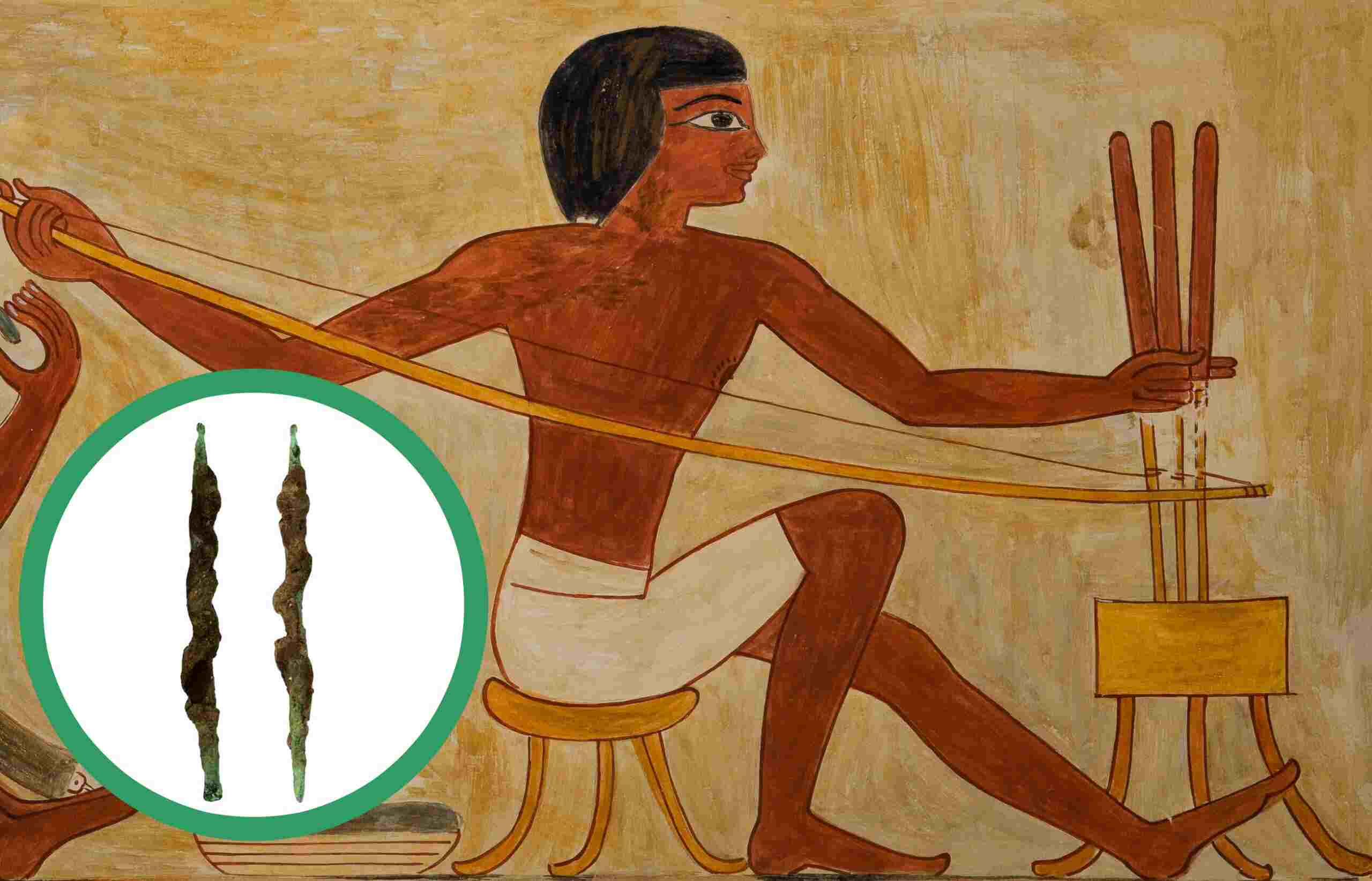
The leather component also proved important. Six coils of thin leather thong were still attached to the copper shaft. These coils appeared deliberately arranged, not decorative or accidental. Together, these features raised an intriguing possibility: the object may have been part of a bow drill.
From Simple Awl to Bow Drill
A bow drill is a tool that uses a bow and a cord to create continuous spinning motion. By wrapping a string around a shaft and moving the bow back and forth, the user can drill holes quickly and with greater control. This method reduces effort and allows for precision, especially when working with wood, stone, or beads.
If the copper object is indeed a bow drill component, it represents a major shift in interpretation. Previously, the earliest well-preserved evidence of such rotary drilling tools in Egypt dated to the New Kingdom period. This artefact, however, may be nearly 2,000 years older.
The original excavation of the tool was carried out by Guy Brunton, who described it as a leather-wrapped awl. At the time, the technology and comparative material needed to challenge that view were limited. Today, researchers can combine detailed microscopy with broader archaeological knowledge, allowing older finds to speak in new ways.
Why Rotary Drilling Matters
Rotary drilling was a key technology in the ancient world. It supported woodworking, bead production, furniture making, and many other crafts that were essential to daily life. These activities may seem small compared to pyramid building, but they formed the backbone of Egypt’s economy and culture.
Efficient drilling tools allowed artisans to work faster and with greater accuracy. They enabled the production of finely detailed objects, from wooden boxes to jewellery. Without such tools, many aspects of Egyptian material culture would not have been possible at the scale and quality seen in archaeological records.
This Ancient Egyptian Tool Discovery suggests that such mechanical knowledge may have developed gradually over a long period. Rather than appearing suddenly in later dynasties, advanced techniques may have evolved through experimentation by skilled craftspeople.
Rethinking Egyptian Engineering
The discovery also highlights a broader issue in archaeology: the survival of evidence. Large stone structures endure for millennia, but small tools and organic parts often decay. As a result, historians may underestimate the sophistication of early technologies simply because physical proof is scarce.
Re-examining museum collections is proving to be a powerful way to address this gap. Objects collected long ago were often studied with limited methods and assumptions. Modern science can reveal hidden details, offering fresh insights without the need for new excavations.
This case shows that innovation in Ancient Egypt was not limited to monumental architecture. It was also present in workshops, homes, and everyday tasks. The skills required to design and use a bow drill reflect careful observation, problem-solving, and an understanding of materials.

A New Chapter in Understanding Early Tools
As researchers continue to test and compare the artefact with other finds, the implications of this Ancient Egyptian Tool Discovery may grow even stronger. If confirmed beyond doubt, it could rewrite parts of the timeline of mechanical development in Egypt.
More importantly, it reminds us that history is not fixed. Even a small copper object, overlooked for generations, can challenge established ideas. By paying attention to the tools of ordinary life, scholars can build a richer and more balanced picture of how ancient societies worked, created, and innovated.
This rediscovered tool stands as a quiet but powerful symbol of human ingenuity, showing that the roots of engineering progress often lie in simple objects shaped by skilled hands thousands of years ago.