

China Fusion Magnet: World’s Largest Fusion Magnet

China Fusion Magnet has become one of the biggest breakthroughs in global energy research after China successfully completed the testing of the world’s largest fusion reactor superconducting magnet. The announcement was made after expert acceptance and full-parameter testing on 27 June 2026 at the Institute of Plasma Physics under the Chinese Academy of Sciences in Hefei, Anhui Province. Along with the giant toroidal field superconducting magnet, researchers also tested a high-temperature superconducting central solenoid coil, both of which are designed for future nuclear fusion reactors. The achievement represents another important step in China’s long-term goal of developing clean fusion energy and advancing its ambitious “Artificial Sun” programme.
Thank you for reading this post, don't forget to subscribe!China Achieves a Major Fusion Milestone
The successful testing of these advanced magnet systems highlights China’s rapid progress in nuclear fusion technology.
Scientists carried out detailed performance tests on two critical components used in fusion reactors. According to the research team, both systems achieved internationally leading performance levels during the testing process.
Fusion energy has become a major area of scientific research because it has the potential to produce enormous amounts of clean electricity without the long-lived radioactive waste associated with conventional nuclear fission reactors.
Countries around the world are investing heavily in fusion technology as they search for future energy solutions that are reliable, sustainable, and environmentally friendly.
The World’s Largest Fusion Magnet
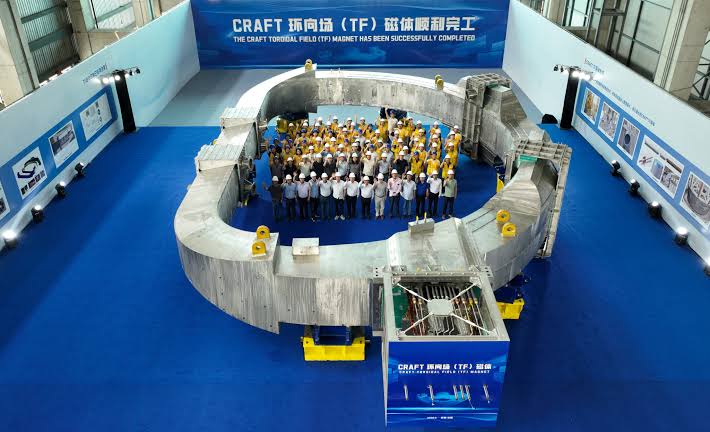
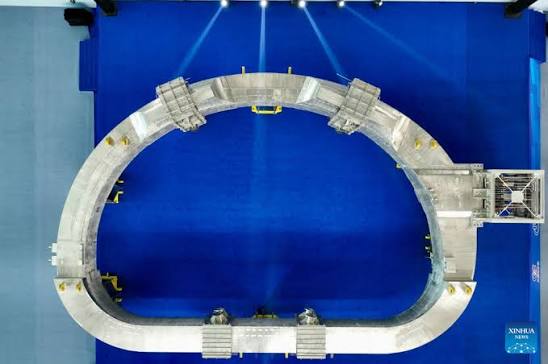
One of the most remarkable achievements is the development of the toroidal field superconducting magnet, which is now considered the largest fusion reactor superconducting magnet ever built.
Its impressive specifications include:
- Length: 21 metres
- Width: 12 metres
- Weight: 582 tonnes
The enormous size of the magnet reflects the engineering challenges involved in building future fusion power plants.
Unlike ordinary industrial magnets, superconducting magnets used in fusion research generate extremely powerful magnetic fields that can safely control superheated plasma inside a reactor.
Building such large and highly precise equipment requires advanced manufacturing technology and years of scientific research.
Why Fusion Reactors Need Powerful Magnets
Fusion reactors operate under extraordinary conditions.
Inside the reactor, scientists heat hydrogen fuel until it becomes plasma, an extremely hot state of matter where electrons separate from atomic nuclei.
The plasma inside a fusion reactor can reach temperatures of around 100 million degrees Celsius, making it impossible for any ordinary material to touch it directly.
Instead of physical walls, scientists use powerful magnetic fields to keep the plasma suspended safely inside a vacuum chamber.
The toroidal field superconducting magnet creates these magnetic fields, allowing the plasma to remain stable while fusion reactions take place.
Without these magnets, controlled nuclear fusion would not be possible.
What Is Nuclear Fusion?
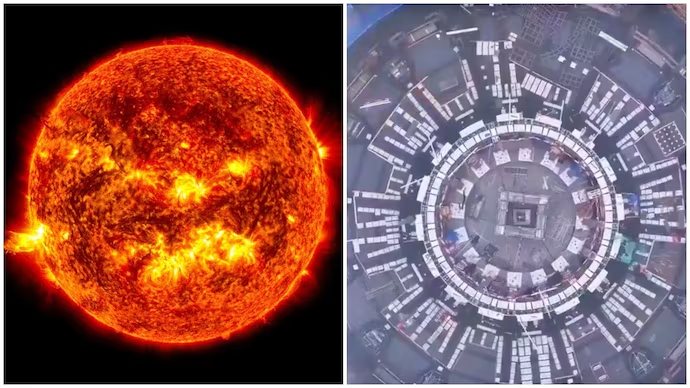
Nuclear fusion is the process in which two light atomic nuclei combine to form a heavier nucleus while releasing enormous amounts of energy.
This is the same process that powers:
- The Sun
- Other stars across the universe
Scientists have been trying for decades to recreate this natural process on Earth because fusion offers several important advantages.
Fusion energy has the potential to provide:
- Clean electricity
- Low carbon emissions
- Large fuel availability
- Long-term energy security
Although commercial fusion power plants have not yet been developed, research continues to move steadily forward.
Central Solenoid Plays a Vital Role
Along with the toroidal field magnet, Chinese scientists also tested a high-temperature superconducting central solenoid coil.
The central solenoid is sometimes called the heart of a tokamak reactor because it performs one of the most important functions in the fusion process.
Its main job is to generate and control the electric current flowing through the plasma.
This current helps:
- Ignite the fusion reaction
- Maintain plasma stability
- Control reactor operation
The successful testing of the central solenoid is therefore an important achievement for future fusion reactor development.
Understanding Tokamak Technology
The tested magnet systems are designed for use in a tokamak, the most widely used fusion reactor design in the world.
A tokamak uses a doughnut-shaped vacuum chamber surrounded by powerful magnetic coils.
The magnetic fields prevent the extremely hot plasma from touching the reactor walls.
Many of the world’s largest fusion research programmes, including ITER, use tokamak technology because it remains one of the most promising methods for achieving controlled nuclear fusion.
Scientists continue improving tokamak systems to make future fusion power generation practical and reliable.
Entirely Built Using Domestic Technology
One of the most significant aspects of the project is that both magnet systems were produced using a 100% domestic supply chain.
According to the project team, every stage of development included:
- Domestic raw materials
- Indigenous manufacturing
- Local fabrication processes
- Chinese engineering expertise
This achievement demonstrates China’s growing capability in advanced manufacturing and high-technology engineering.
Developing such specialised components entirely within the country also strengthens long-term technological independence.
Part of the CRAFT Project
The new magnet systems form part of the Comprehensive Research Facility for Fusion Technology (CRAFT).
CRAFT is a major scientific programme supporting China’s broader Artificial Sun initiative, which aims to develop practical fusion energy technologies.
The project provides researchers with advanced facilities for testing fusion equipment before it is used in future experimental reactors.
Large-scale research facilities such as CRAFT help scientists improve reactor safety, efficiency, and engineering performance while reducing technical risks.
Larger Than ITER Magnets
The newly tested toroidal field magnet is even larger than similar magnets being developed for ITER (International Thermonuclear Experimental Reactor), one of the world’s largest international fusion projects located in France.
According to project officials:
- The new magnet has 1.3 times the volume of comparable ITER magnets.
- It stores three times more magnetic energy than similar systems.
These improvements demonstrate the increasing scale of modern fusion engineering and the growing capabilities of advanced superconducting technologies.
China’s Long-Term Fusion Plans
China has announced its ambition to develop fusion-based electricity generation around 2030.
Although achieving commercial fusion power remains a major scientific challenge, continuous progress in superconducting magnets, plasma control systems, and reactor technology brings researchers closer to that goal.
Many countries, including China, the United States, Japan, South Korea, and members of the European Union, continue investing in fusion research because it could become one of the world’s most important clean energy sources in the future.
The successful testing of the China Fusion Magnet represents another major advance in global fusion research. By developing the world’s largest superconducting fusion magnet along with an advanced central solenoid coil, China has demonstrated significant progress in one of the most challenging areas of modern science and engineering. As research continues under the CRAFT programme and the country’s Artificial Sun initiative, these technologies are expected to play a key role in the future development of safe, sustainable, and large-scale fusion energy.