Coral Microatolls Reveal Early Indian Ocean Sea-Level Rise

Rising sea levels due to global warming have become one of the most pressing concerns for coastal and island nations. Among the most vulnerable ecosystems are coral reefs, which are highly sensitive to environmental changes. These vibrant marine structures not only support biodiversity but also protect shorelines from erosion and storm surges. However, with sea levels rising, corals face multiple threats—from reduced sunlight and bleaching to direct structural damage caused by shifting tides. A recent breakthrough study using coral microatolls has extended the record of sea-level changes in the central Indian Ocean by nearly a century. This research shows that sea-level rise began decades earlier than previously believed, reshaping our understanding of climate change and its impact on the ocean.
Thank you for reading this post, don't forget to subscribe!Sea-Level Rise and Coral Stress
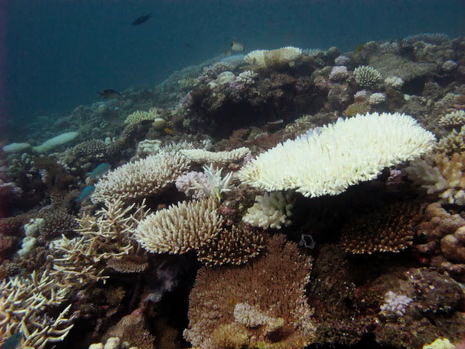
Sea-level rise poses significant challenges for coral reef ecosystems. As water levels increase, less sunlight penetrates the ocean surface, reducing the ability of corals to photosynthesize effectively. This weakens their overall health and resilience, leaving them vulnerable to bleaching events. Additionally, rising seas alter tidal patterns and contribute to coastal erosion, further stressing reef systems.
The Indian Ocean, in particular, has been warming at a rate faster than the global average. This accelerated warming amplifies the impacts of sea-level rise, putting ecosystems such as the Maldives, Lakshadweep, and the Chagos archipelago at greater risk. For local communities dependent on these reefs for fisheries, tourism, and coastal protection, the stakes could not be higher.
Historical Monitoring Efforts in Coral Microatolls Reveal Early Indian Ocean Sea-Level Rise
Long-term monitoring of sea-level changes in the Indian Ocean began relatively late, during the Tropical Ocean Global Atmosphere programme (1985–1994). Since then, data collection has continued under the Global Sea Level Observing System. India’s Ministry of Earth Sciences estimates that sea levels in the region have been rising at approximately 3.3 mm per year, which is above the global mean.
Despite these advances, significant data gaps remain—particularly in the central tropical Indian Ocean. Tide gauges, though reliable, are limited in coverage, and satellite observations only became available in the early 1990s. This lack of long-term historical data makes it difficult to understand when and how regional sea-level changes began, and what their broader climatic drivers might be.
Coral Microatolls as Natural Archives
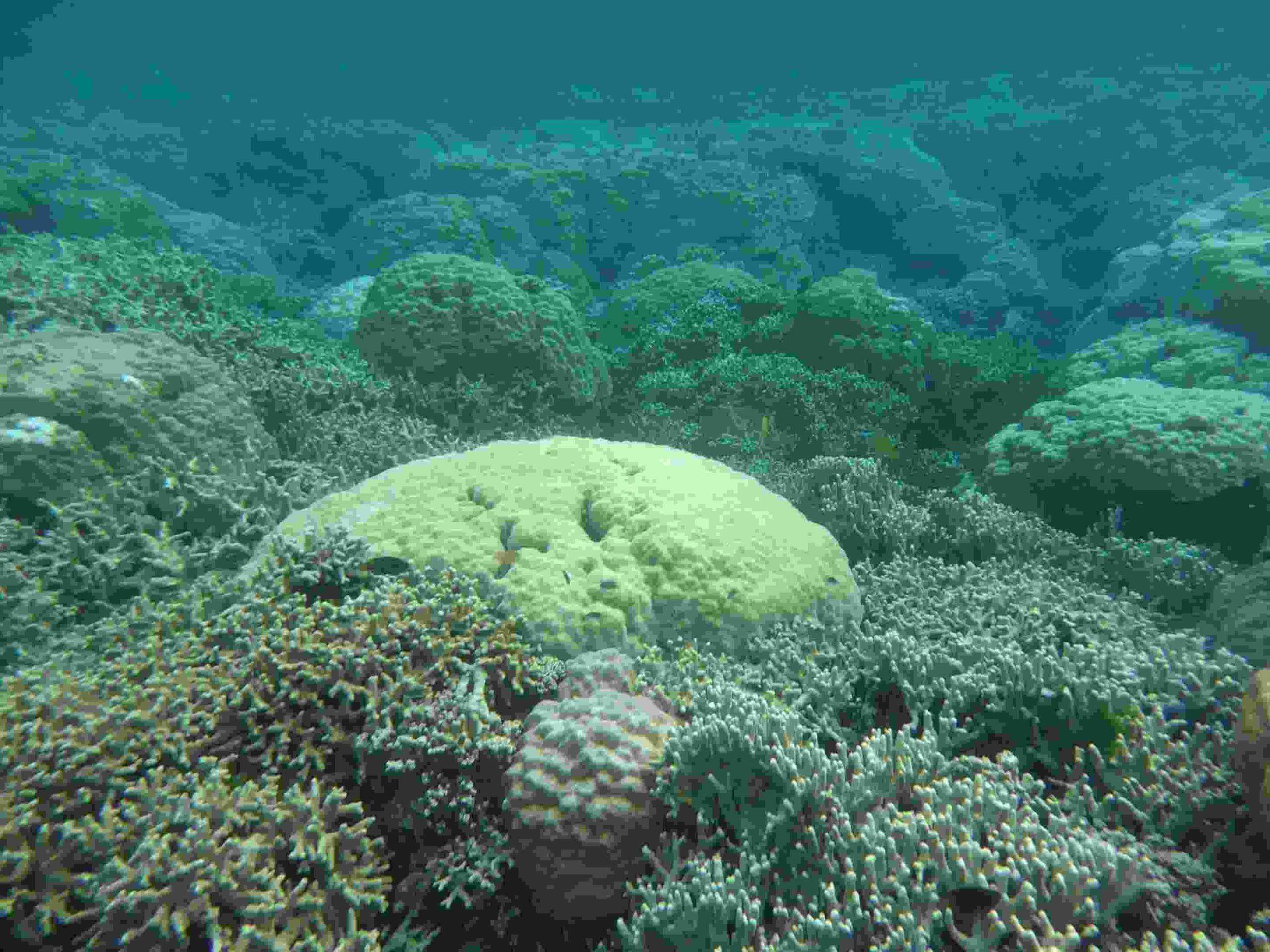
This is where coral microatolls prove invaluable. These unique coral formations grow outward rather than upward once they reach the low-tide water level, creating a flat, disc-like structure. The upper surface of the microatoll is shaped by the lowest sea level over time, effectively recording sea-level changes across decades or even centuries.
In the new study, researchers focused on a Porites microatoll located on the Mahutigalaa reef in the Maldives. By examining its growth patterns, scientists were able to reconstruct sea-level history spanning from 1930 to 2019—a record nearly a century long.
Methodology of the Study: Coral Microatolls Reveal Early Indian Ocean Sea-Level Rise
The research team surveyed both the outer edge and the upper surface elevation of the coral. They extracted a slab from the microatoll and used X-ray imaging to identify annual growth bands, much like tree rings in forests. Each band corresponded to a specific year, allowing for a precise reconstruction of coral growth in response to sea-level variations.
To refine the timeline, the team employed uranium-thorium dating, a radiometric method that accurately determines the age of calcium carbonate structures. This combination of physical surveying, growth band analysis, and radiometric dating provided one of the most detailed reconstructions of sea-level changes in the central Indian Ocean to date.
Findings on Sea-Level Rise
The results were striking. The study revealed that sea level in the region rose by approximately 0.3 metres (30 cm) over the past 90 years. What stood out most was the acceleration of this rise across different time periods:
- 1930–1959: 1–1.84 mm/year
- 1960–1992: 2.76–4.12 mm/year
- 1990–2019: 3.91–4.87 mm/year
These findings suggest that sea-level rise in the Indian Ocean began accelerating in the late 1950s, much earlier than previously thought. In regions such as the Maldives, Lakshadweep, and the Chagos archipelago, sea level has risen by 30–40 cm over the last half-century, confirming the heightened vulnerability of low-lying island nations.
Environmental and Climatic Signals
Beyond sea-level rise, the coral microatoll also recorded signals of major environmental events. Growth interruptions coincided with significant El Niño episodes and negative Indian Ocean Dipole events, both of which are known to cause coral bleaching and stress.
Interestingly, the coral also reflected the 18.6-year lunar nodal cycle, a natural rhythm that influences tides and sea levels. Since the Mahutigalaa reef is tectonically stable, researchers could confidently attribute the coral’s growth signals to actual sea-level variations rather than geological uplift or subsidence.
Significance and Future Role
This research highlights how coral microatolls can serve as natural archives of climate change, complementing tide gauges and satellite records. They are particularly valuable in filling historical data gaps for remote regions where modern monitoring tools are scarce.
Moreover, the findings reveal that sea-level rise is not uniform across the Indian Ocean. Regional patterns are shaped by complex interactions between oceanic and atmospheric systems, including changes in the Southern Hemisphere westerlies and shifts in the Intertropical Convergence Zone (ITCZ). Understanding these regional variations is essential for predicting local impacts and guiding adaptation strategies.
Looking ahead, coral microatolls are expected to play a greater role in climate science. By offering long-term perspectives, they can improve the accuracy of sea-level rise models, which in turn helps policymakers and coastal communities plan for adaptation. Whether it is building resilient infrastructure, protecting ecosystems, or preparing relocation strategies for vulnerable islands, reliable historical data remains the cornerstone of effective decision-making.
Conclusion
The discovery that sea-level rise in the central Indian Ocean began decades earlier than once thought is a wake-up call for climate researchers and policymakers alike. Coral microatolls reveal early Indian Ocean sea-level rise not only as a scientific breakthrough but also as a pressing reminder of the urgency to act. With rising seas threatening millions of lives and livelihoods across Asia and beyond, understanding the past becomes critical for preparing for the future.