Denmark Iron Age Temple Discovery Reshapes Early Northern European History

The discovery of the Denmark Iron Age Temple beneath quiet grasslands in central Denmark has opened a new chapter in the understanding of early northern European societies. What was once believed to be ordinary farmland near Hedegaard has now been revealed as a powerful centre of religion, politics, and trade dating back nearly 2,000 years. This remarkable find is changing how historians view the Iron Age in Scandinavia, showing that communities were far more organised and influential than previously thought.
Thank you for reading this post, don't forget to subscribe!A Hidden Settlement Beneath the Fields
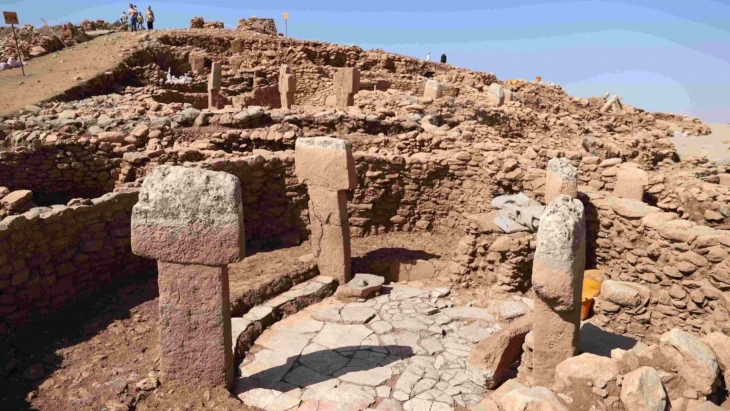
The site lies close to Hedegaard, near the small town of Ejstrupholm in central Jutland. For generations, the land was used for farming, with no visible signs of what lay below. That perception changed when archaeologists confirmed the presence of a large and complex settlement buried beneath the soil.
This settlement dates back to around the turn of the Common Era, roughly 0 AD. Instead of a simple village, researchers uncovered evidence of a carefully planned and fortified hub. Workshops, elite homes, defensive structures, and a central temple point to a community that held regional importance. The scale of construction suggests strong leadership and access to skilled labour, resources, and long-distance connections.
Rediscovery of a Forgotten Power Centre
The story of the site’s rediscovery began decades ago. In 1986, archaeologist Orla Madsen uncovered an unusually rich burial ground in the area. The graves contained weapons and high-quality goods, hinting that powerful individuals once lived there. Despite this promising start, excavations stopped in 1993, and the site faded from attention.
Interest returned in 2016 when researchers from Museum Midtjylland resumed studies of the area. However, it was not until 2023 that archaeologists fully understood the importance of the earlier burial finds. New surveys revealed that the graves were only one part of a much larger fortified settlement. This realisation transformed the site from a local curiosity into one of Denmark’s most significant archaeological discoveries in recent years.
The Heart of the Site: The Iron Age Temple
At the centre of the settlement stands the structure that has drawn the most attention: the Denmark Iron Age Temple. The temple is near-rectangular in shape and measures roughly 15 by 16 metres. Its design shows careful planning and strong construction methods, unusual for buildings of this period in the region.
A ring of sturdy wooden posts formed a colonnade around the main structure. Inside, deeply set posts supported walls made of planks lined with clay. This technique would have provided strength and insulation, suggesting the building was meant to last. The entrance faced south, leading into a space that appears to have been used for ceremonies rather than daily life.
One of the most striking features is a raised hearth measuring about two by two metres. The hearth was decorated with stamped and linear patterns, setting it apart from ordinary domestic fire pits. Archaeologists believe this hearth played a central role in rituals, possibly involving offerings, gatherings, or ceremonies linked to leadership and belief systems. Physical evidence of such formal religious architecture is rare in Denmark’s Iron Age, making this temple especially valuable for understanding early spiritual life.
Defence and Strategic Planning
The settlement was not only a religious centre but also a fortified one. Defensive palisades surrounded the area, showing that protection was a serious concern. Around 0 AD, the influence of the Roman Empire was expanding northward, reaching as far as the River Elbe. While the Romans never fully conquered Jutland, their presence likely affected local communities.
The design of Hedegaard’s defences suggests an awareness of Roman military practices. Strong palisades and organised layouts point to planning and coordination. This indicates that local leaders were not isolated but informed about events beyond their immediate surroundings. The settlement’s ability to defend itself also reinforces the idea that it was a centre worth protecting, holding political and economic importance.
Trade, Influence, and Daily Life
Beyond religion and defence, the site also reveals signs of active trade and production. Archaeologists identified workshops where crafts and goods were likely produced. These items may have been used locally or exchanged with neighbouring regions. The presence of elite residences suggests social hierarchy, with leaders living close to the temple and central areas of power.
Such organisation shows that the community combined spiritual authority, political leadership, and economic activity in one place. This challenges older views that Iron Age Scandinavian societies were small, scattered, and loosely organised. Instead, Hedegaard appears to have been a well-connected hub influencing a wider region.
A New View of Iron Age Denmark
The Denmark Iron Age Temple discovery has broad implications for how historians understand the past. The settlement’s size, layout, and preservation reveal a society capable of long-term planning and complex organisation. Religious practices were clearly structured, and power was concentrated rather than spread thinly across small groups.
Experts now see Hedegaard as one of the most important archaeological finds in Denmark in recent decades. The layers of remains offer a detailed picture of life, belief, and authority at a time often considered poorly understood. As research continues, the site is expected to provide even more insights into how early Scandinavian societies lived, ruled, and worshipped.
This discovery does more than uncover ancient buildings; it reshapes the story of northern Europe’s past. The Denmark Iron Age Temple stands as lasting proof that complex and influential centres existed in the region long before written history recorded them.