India Chabahar Port Role: A Strategic Link in Regional Connectivity and Global Geopolitics

India Chabahar Port Role has become a subject of renewed global focus as the US sanctions waiver protecting India’s operations at the Iranian port ended in September 2025. This development threatens India’s $120 million investment and exposes its operations to potential secondary sanctions under US law. Despite these challenges, Chabahar remains a cornerstone of India’s regional strategy serving as a gateway to Central Asia and Afghanistan while bypassing Pakistan. The port is not just a commercial project but a geopolitical statement reflecting India’s ambition to enhance connectivity and counterbalance China’s expanding influence through the Gwadar Port in Pakistan.
Thank you for reading this post, don't forget to subscribe!Geopolitical Importance of India Chabahar Port Role
The India Chabahar Port Role is deeply rooted in regional geopolitics. Chabahar, located on Iran’s southeastern coast along the Gulf of Oman, is the country’s only oceanic port. For India, it represents a lifeline to access Afghanistan and Central Asia without depending on routes through Pakistan. The port forms an integral part of the International North-South Transport Corridor (INSTC) a multi-modal network linking Mumbai to Russia via Iran and Azerbaijan.
Chabahar offers India a unique strategic advantage, especially considering its proximity to China’s Gwadar Port, which lies barely 170 kilometers away. Gwadar is developed and operated by Chinese interests under the China-Pakistan Economic Corridor (CPEC) a flagship project of Beijing’s Belt and Road Initiative (BRI). In contrast, Chabahar provides India and its allies with a counterweight to China’s growing presence in the Indian Ocean. The port also strengthens New Delhi’s partnerships with Iran, Afghanistan, and other Central Asian nations, supporting trade, energy cooperation, and cultural exchange.
Impact of US Sanctions on India Chabahar Port Role
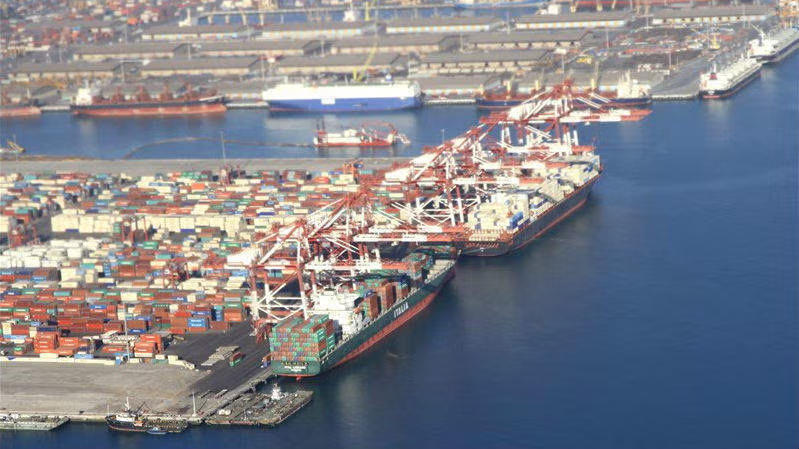
The India Chabahar Port Role faced a major setback following the expiration of the US sanctions waiver under the Iran Freedom and Counter-Proliferation Act (IFCA). Initially granted in 2018, the waiver allowed India to develop and operate the Shahid Beheshti Terminal at Chabahar without attracting punitive measures. Its revocation in 2025, however, now exposes India Ports Global Limited (IPGL) the Indian company managing the port to the risk of secondary sanctions.
This development has created uncertainty about India’s long-term involvement and investment protection. The United States’ decision comes at a time when India is seeking to diversify its energy sources and strengthen its economic ties with Iran. With Washington tightening its stance on Tehran, India faces the difficult task of balancing its strategic autonomy with the realities of international diplomacy. The move also complicates India’s connectivity projects, as Chabahar plays a vital role in ensuring supply chains and regional trade stability amid the volatile geopolitical climate.
Infrastructure and Operations: India Chabahar Port Role in Action
The India Chabahar Port Role extends beyond diplomacy it reflects tangible infrastructural cooperation. The port has a -16-metre draft, allowing it to handle vessels up to 120,000 deadweight tonnage (DWT), including container ships and passenger ferries. India has been instrumental in providing cargo-handling equipment, cranes, and other operational infrastructure at the Shahid Beheshti Terminal.
While the port remains functional, its scale is still modest compared to its potential. The surrounding area lacks major urban infrastructure, with limited transport connectivity and industrial activity. Despite these challenges, the port has already facilitated shipments of food grains and other essential goods to Afghanistan, showcasing its practical utility in humanitarian and trade missions. The Indian government has repeatedly reaffirmed its commitment to continue working on Chabahar, emphasizing its importance as a sustainable trade link that aligns with the “Act East” and “Connect Central Asia” policies.
Chabahar Free Zone and Economic Vision under India Chabahar Port Role
The India Chabahar Port Role also extends to economic development initiatives around the port. Adjacent to the terminal is the Chabahar Free Zone, envisioned as a vibrant hub for trade, logistics, and manufacturing. However, the zone is still in its infancy, lacking key facilities such as housing, schools, hospitals, and hotels. Authorities aim to attract Indian companies and private investors to establish industries, build infrastructure, and develop community spaces.
The vision includes setting up cultural and sports facilities, such as a cricket stadium being considered with assistance from the Board of Control for Cricket in India (BCCI). Such projects symbolize the growing India-Iran friendship and demonstrate how cultural diplomacy complements economic cooperation. The Free Zone’s strategic position allows it to serve as a gateway for goods moving between South Asia, Central Asia, and the Middle East, potentially transforming Chabahar into a regional trade powerhouse in the coming decades.
Strategic Challenges and Regional Dynamics Shaping India Chabahar Port Role
The India Chabahar Port Role is shaped by complex regional dynamics and competing global interests. The most significant challenge arises from the port’s proximity to Gwadar, which benefits from heavy Chinese investment and Pakistan’s strategic support. Gwadar’s integration into the Belt and Road Initiative gives Beijing a strong foothold in the Arabian Sea, while India’s Chabahar project serves as a strategic countermeasure.
However, India must navigate the dual pressures of maintaining relations with both Iran and the United States. Continued American sanctions complicate financing, insurance, and trade logistics. Additionally, Iran’s growing ties with China and Russia under frameworks like the Shanghai Cooperation Organisation (SCO) further alter the geopolitical balance.
Despite these challenges, India remains committed to Chabahar as part of its broader foreign policy vision. The port not only enhances connectivity and trade but also reinforces India’s position as a responsible regional power capable of pursuing independent strategic objectives. By ensuring that Chabahar remains operational, India sends a clear message of its determination to maintain regional stability, promote economic integration, and sustain long-term partnerships across Asia.