India-EFTA Trade Agreement 2025 Set to Transform Trade, Investment, and Job Growth

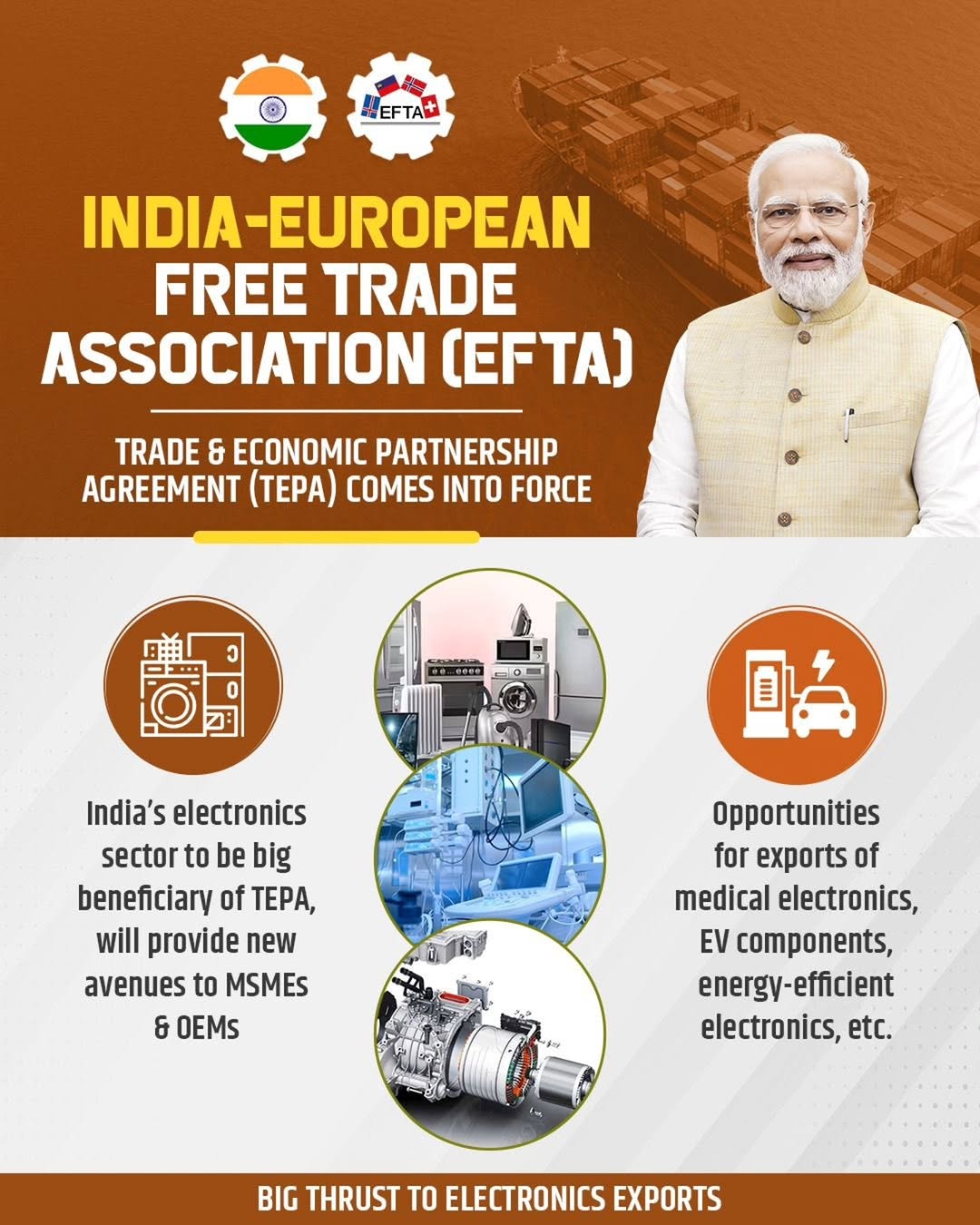
India and the European Free Trade Association (EFTA) will implement the Trade and Economic Partnership Agreement (TEPA) from 1 October 2025, marking a new era in India’s global trade relations. Signed in March 2024, this landmark deal represents India’s first Free Trade Agreement (FTA) with a group of highly developed European nations Switzerland, Norway, Iceland, and Liechtenstein. The India-EFTA Trade Agreement 2025 aims to expand trade, attract investments, and foster sustainable cooperation across multiple sectors.
Thank you for reading this post, don't forget to subscribe!Overview of TEPA
The India-EFTA Trade Agreement 2025 encompasses 14 comprehensive chapters covering goods, services, investment, intellectual property rights, and sustainable development. It offers mutual market access and introduces a framework for inclusive and transparent trade practices.
Under the agreement, EFTA will eliminate tariffs on 100% of non-agricultural products and most processed agricultural goods, providing Indian exporters a substantial competitive advantage in European markets. In return, India has liberalized 82.7% of its tariff lines, while safeguarding critical domestic sectors like pharmaceuticals, medical devices, dairy, and coal.
TEPA also emphasizes trade facilitation measures, including rules of origin, sanitary and phytosanitary (SPS) regulations, and technical barriers to trade (TBT). These mechanisms aim to streamline customs procedures, reduce compliance burdens, and enhance export efficiency for Indian industries.
Investment and Employment Commitments
A defining feature of the India-EFTA Trade Agreement 2025 is its strong focus on investment and job creation. The EFTA bloc has committed to channeling USD 100 billion in foreign direct investment (FDI) into India over the next 15 years. Unlike portfolio investments, these funds are directed toward long-term productive capital, including manufacturing, green infrastructure, and digital innovation.
This unprecedented commitment is expected to generate one million direct jobs in India, particularly benefiting the manufacturing, renewable energy, life sciences, and digital technology sectors.
To support this, the India-EFTA Desk, set up in 2025, will serve as a single-window investment facilitation platform. It will coordinate between investors and government agencies, ensuring smooth implementation of projects and promoting partnerships in high-growth industries such as clean energy, biotechnology, and advanced engineering.
Market Access for Goods
Under TEPA, EFTA countries have offered tariff concessions covering 92.2% of their tariff lines, accounting for 99.6% of India’s exports to the bloc. This extensive coverage opens vast new opportunities for Indian exporters in key industries like:
- Machinery and engineering goods
- Textiles and garments
- Processed foods and marine products
- Chemicals, coffee, tea, and agricultural commodities
By eliminating or reducing duties, the agreement strengthens India’s access to high-value European markets, especially Switzerland and Norway, which are known for their advanced economies and strong demand for premium imports.
At the same time, India has retained strategic safeguards for its vulnerable sectors, implementing phased tariff reductions to protect domestic industries and workers.

Services and Professional Mobility
The India-EFTA Trade Agreement 2025 provides significant liberalization in over 100 service sub-sectors, including information technology, professional services, education, and creative industries.
The inclusion of Mutual Recognition Agreements (MRAs) for professions such as nursing, chartered accountancy, and architecture is particularly impactful. These MRAs will allow Indian professionals to gain easier recognition of qualifications and work in EFTA member states, promoting mobility and skill exchange.
The agreement also enhances cooperation in digital trade and cross-border services, making it easier for Indian IT and business process outsourcing (BPO) firms to deliver digital solutions and establish commercial presence in Europe.
Intellectual Property Rights (IPR)
The IPR chapter of TEPA aligns with World Trade Organization (WTO) TRIPS standards, ensuring balanced protection for creators and innovators. Importantly, India’s longstanding concerns about generic medicines and patent evergreening have been carefully addressed, maintaining India’s ability to produce affordable medicines while upholding strong IP protection for investors.
This balanced approach supports both innovation and public health, encouraging technology transfer and research collaboration between Indian and European institutions.
Sustainable and Inclusive Development
Beyond trade and investment, the India-EFTA Trade Agreement 2025 emphasizes sustainability, environmental protection, and inclusive growth. It calls for promoting renewable energy partnerships, encouraging responsible corporate practices, and ensuring equitable opportunities for all participants in trade.
The agreement also includes provisions for vocational training, skill development, and technology exchange, helping strengthen India’s youth workforce and improve productivity across industries.
Sectoral Opportunities
Several sectors stand to gain from the tariff eliminations and improved access under TEPA:
- Agriculture: Exports like basmati rice, guar gum, and processed foods will enjoy reduced or zero tariffs.
- Marine and textile industries: Benefit from simplified standards and duty-free access.
- Engineering and electronics: Gain from investment inflows and enhanced market presence.
- Gems and jewellery: Continue to enjoy duty-free access, reinforcing India’s global leadership in the sector.
- Chemicals and allied industries: See tariff removals and more efficient regulatory processes.
These sectoral advantages will diversify India’s export basket and boost competitiveness in Europe’s high-income markets.
Strategic Safeguards and National Interest
While the agreement promotes liberalization, India has carefully designed strategic safeguards for sectors vital to national development and security. Sensitive industries such as pharmaceuticals, dairy, and coal will experience gradual tariff reductions, ensuring stability for domestic producers.
This calibrated approach aligns with the Make in India and Production Linked Incentive (PLI) schemes, which aim to bolster manufacturing and self-reliance.
Conclusion
The India-EFTA Trade Agreement 2025 is more than a trade pact it is a strategic partnership that combines market access with long-term investment and job creation. By connecting India’s dynamic economy with some of Europe’s most advanced nations, TEPA is set to reshape bilateral trade, enhance competitiveness, and drive sustainable economic growth in the coming decade.