Giant Fungus Species Arunachal Pradesh

A groundbreaking discovery has emerged from the dense forests of Arunachal Pradesh, where researchers from the Botanical Survey of India (BSI) have identified a remarkable new fungal species named Bridgeoporus kanadii. This newly discovered giant fungus species in Arunachal Pradesh stands out for its astonishing size with fruiting bodies measuring over three metres in radius large enough to support the weight of a person. The discovery sheds new light on the region’s biodiversity and highlights the ecological importance of fungi in maintaining forest balance and nutrient cycling.
Thank you for reading this post, don't forget to subscribe!Giant Fungus Species Arunachal Pradesh: Discovery and Naming
The discovery of Bridgeoporus kanadii took place during a monsoon mushroom survey conducted in the northeastern forests of India. The fungus was observed growing in clusters on the trunks of old fir trees, numbering around forty per cluster. Its exceptional size immediately drew the attention of the scientists, prompting further investigation.
The species was named in honour of Indian mycologist Dr. Kanad Das, who has made significant contributions to the study of macrofungi and fungal taxonomy in India. While the fungus was reportedly known to local forest dwellers, it was never harvested or used due to its inedibility and lack of commercial value. Despite its obscurity, this fungal species represents an important addition to the Bridgeoporus genus, which previously contained only a few known species globally.
The discovery underscores the rich fungal diversity hidden within the Eastern Himalayas, one of the world’s most biodiverse yet underexplored regions.
Giant Fungus Species Arunachal Pradesh: Physical Characteristics
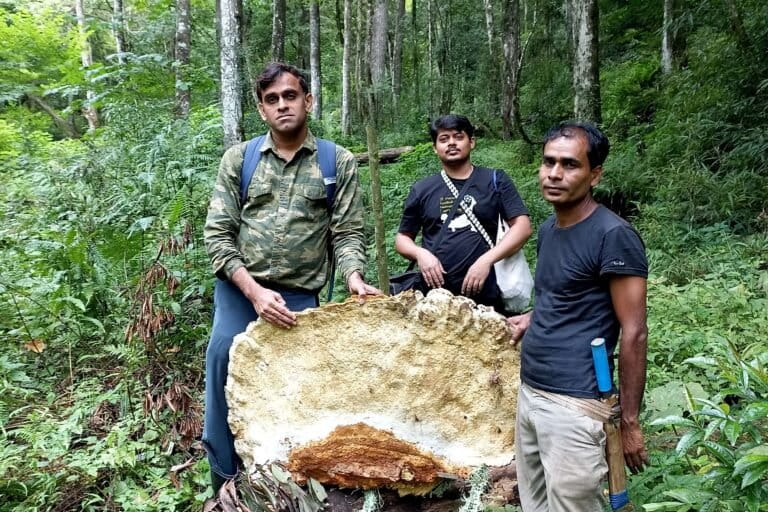
One of the most striking features of Bridgeoporus kanadii is its gigantic fruiting body. The largest specimen recorded by researchers had a radius exceeding three metres, making it significantly larger than its closest known relative, Bridgeoporus nobilissimus from North America, which grows up to 1.5 metres.
The fruiting body is thick, woody, and firmly attached to the tree trunk, forming a semi-circular structure. Researchers noted its distinct morphological features including colour variations from deep brown to reddish hues, layered textures, and a tough outer crust. Its internal tissue showed unique patterns under microscopic analysis, further confirming its taxonomic uniqueness.
Such physical adaptations likely help the fungus survive in the humid and dense forest environments of Arunachal Pradesh, where it decomposes fallen or decaying trees and contributes to the recycling of organic matter.
Giant Fungus Species Arunachal Pradesh: Scientific Analysis
Following field observations, scientists collected and preserved multiple specimens of Bridgeoporus kanadii for laboratory study. Using advanced methods, they examined its morphological traits such as size, shape, texture, and thickness. Microscopic examinations were carried out to study its spores and tissue structure.
The defining evidence came from DNA sequencing, which confirmed that the species is genetically distinct from other known Bridgeoporus fungi. Phylogenetic studies placed it firmly within the genus, though with enough genetic divergence to warrant classification as a new species.
Previously, the genus Bridgeoporus was known for only two species:
- Bridgeoporus nobilissimus, found in the Pacific Northwest of North America, and
- Bridgeoporus sinensis, reported from China but later reassigned to another genus.
The identification of Bridgeoporus kanadii now expands the genus’s distribution into South Asia, marking the first such discovery in India.
Giant Fungus Species Arunachal Pradesh: Ecological Role
Bridgeoporus species are known as wood-decaying or lignicolous fungi, meaning they thrive on decomposing wood. This process plays a crucial role in forest nutrient cycling. The newly identified B. kanadii was found primarily on dead or decaying fir trees, where it helps decompose complex plant materials like cellulose and lignin.
Through this decomposition process, the fungus releases essential nutrients such as nitrogen and phosphorus back into the soil. This nutrient recycling supports new plant growth and helps maintain the ecological balance of the forest.
Researchers note that B. kanadii acts as a biological recycler, turning dead organic material into fertile soil components. Such species are integral to carbon cycling, preventing the accumulation of undecomposed plant debris and supporting the growth of younger vegetation.
The study also suggests that the presence of such fungi can serve as bioindicators of forest health, offering insights into the ecological stability and biodiversity of the habitat.
Giant Fungus Species Arunachal Pradesh: Importance of Fungi in Ecosystems
The discovery of Bridgeoporus kanadii highlights the vital but often overlooked role of fungi in ecosystems. Fungi are not just decomposers they are key players in maintaining the planet’s life-support systems. Without their continuous activity, forests would be buried under layers of undecomposed organic matter, disrupting soil fertility and plant regeneration.
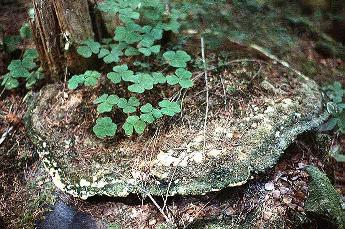
Beyond decomposition, fungi form symbiotic relationships with plant roots, aiding in water and nutrient absorption. They also influence soil structure, carbon storage, and even climate regulation. Unfortunately, fungal diversity remains one of the least studied aspects of biodiversity, especially in tropical and subtropical regions like Arunachal Pradesh.
The discovery of such a giant and ecologically significant fungus emphasizes the need for continued mycological exploration in India. Scientists believe that hundreds of fungal species in the Eastern Himalayas remain undescribed. By studying these species, researchers can uncover new insights into climate adaptation, biotechnology, and ecosystem restoration.
Giant Fungus Species Arunachal Pradesh: A New Symbol of Biodiversity
The identification of Bridgeoporus kanadii marks an exciting moment in India’s biological research. Its sheer size and ecological importance make it a symbol of nature’s complexity and the hidden wonders of Arunachal Pradesh’s forests. The discovery reinforces the state’s reputation as a biodiversity hotspot and underscores the necessity of preserving its pristine habitats from deforestation and human disturbance.
Researchers hope this finding will inspire more attention toward fungal conservation and the inclusion of fungi in broader biodiversity protection policies. The giant fungus species of Arunachal Pradesh stands as a reminder that even the smallest organisms or in this case, the largest fungus can play an enormous role in sustaining life on Earth.