India GDP Growth 2025: Low Inflation and Fiscal Challenges Ahead

Recent data on India GDP Growth 2025 reveals a complex economic scenario while inflation remains impressively low, the country is facing subdued nominal GDP growth. The Consumer Price Index (CPI) inflation stood at 2.07 per cent in August 2025, and the Wholesale Price Index (WPI) inflation was recorded at only 0.52 per cent year-on-year. Although this offers relief to consumers by keeping prices stable, it poses serious challenges for the government’s fiscal balance, revenue targets, and long-term growth planning.
Thank you for reading this post, don't forget to subscribe!India GDP Growth 2025: Current Inflation Scenario
Inflation rates in 2025 have remained exceptionally low, marking one of the calmest price environments in recent years. The CPI inflation averaged 2.4 per cent in the first five months of the fiscal year, down significantly from 4.6 per cent recorded in the previous year. Meanwhile, WPI inflation averaged merely 0.1 per cent, a sharp fall from 2.3 per cent in 2024-25.
A major contributor to this trend has been the reduction in Goods and Services Tax (GST) rates, which helped bring down retail prices across sectors such as food, energy, and manufacturing. Stable global oil prices and improved agricultural output have also played key roles in keeping inflation low.
However, such low inflation, while beneficial for households and consumers, often signals weak demand in the economy a factor that can weigh heavily on nominal GDP growth.
Nominal Growth and Its Importance
Nominal GDP growth is a crucial indicator for economic policy and fiscal planning, as it measures the total value of goods and services at current market prices. For the fiscal year 2025-26, the Union Budget projected India GDP Growth 2025 at a nominal rate of 10.1 per cent, targeting an output of ₹357 lakh crore.
In reality, the nominal GDP growth for the April–June 2025 quarter was recorded at just 8.8 per cent well below budget expectations. This slowdown is concerning, as nominal GDP directly affects the government’s ability to collect taxes and maintain fiscal discipline.
A slower nominal GDP implies that the base for calculating revenue and deficit targets shrinks, putting additional strain on government finances and debt ratios.
India GDP Growth 2025: Impact on Government Finances
The weak nominal growth trajectory has directly affected government revenue collection. Between April and July 2025, gross tax revenue rose by just 1 per cent year-on-year, while net tax revenue declined by 7.5 per cent. This shortfall creates fiscal stress, making it harder to achieve the targeted deficit levels set under the Union Budget.
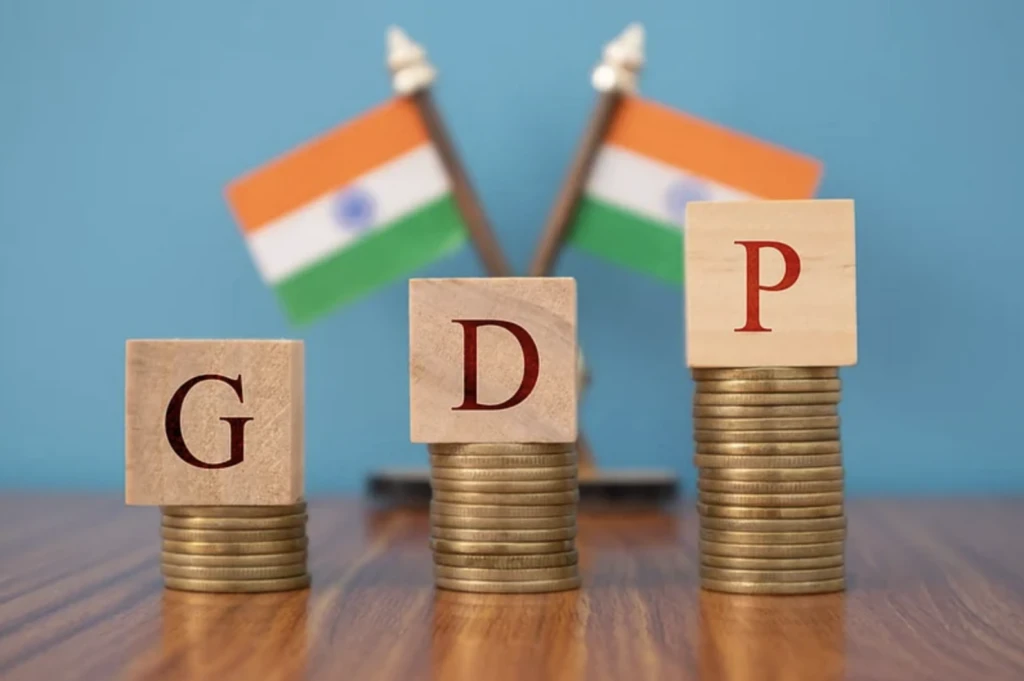
As a result, the government’s debt-to-GDP ratio could worsen if economic activity doesn’t pick up soon. A sustained period of weak nominal growth also limits the fiscal space available for infrastructure spending and welfare schemes both of which are critical to maintaining social and economic momentum.
India GDP Growth 2025: Reasons Behind Low Inflation
Understanding the causes behind the persistent low inflation offers insights into the broader economic environment. Economists attribute the trend to both supply-side and demand-side factors.
On the supply side, improved agricultural productivity and a stable global supply chain have reduced cost pressures. Domestically, the reduction in GST rates has effectively lowered the final prices of many essential goods and services.
On the demand side, however, the picture is less encouraging. Despite strong corporate profitability, sales growth has remained modest. Data shows that private manufacturing firms saw sales increase by 5.3 per cent, while profits jumped by nearly 28 per cent, mainly due to reduced input costs rather than higher demand.
Weak capital expenditure (capex) further highlights a cautious investment environment, as companies prefer to retain earnings rather than reinvest aggressively.
India GDP Growth 2025: Budget Assumptions vs Reality
Budget assumptions often overestimate economic momentum, and history supports this trend. Over the last thirteen years, India’s nominal GDP growth has fallen short of budget expectations nine times. Nonetheless, in three of the last four years, actual growth surpassed projections reflecting some resilience in post-pandemic recovery.
The revised GDP base for 2024-25 is pegged at ₹331 lakh crore, making the 2025-26 growth target of 8 per cent more achievable. Still, experts anticipate that India GDP Growth 2025 will remain below the 10.1 per cent budget forecast, mainly due to weaker demand and slower global trade recovery.
The mismatch between budget estimates and real outcomes poses challenges for fiscal planning, as any shortfall in nominal growth leads to underperformance in revenue and higher borrowing needs.
India GDP Growth 2025: Future Outlook and Fiscal Challenges
The economic outlook for 2025 requires careful management of the trade-off between low inflation and sustainable growth. On one hand, subdued inflation benefits households through stable purchasing power. On the other hand, it compresses nominal GDP, making fiscal management difficult.
If global commodity prices remain moderate and domestic demand continues to recover gradually, inflation may stay below 3 per cent for the remainder of the fiscal year. However, this will likely keep nominal GDP growth in the 8–9 per cent range lower than what policymakers need to comfortably meet fiscal deficit targets.
To strengthen India GDP Growth 2025, the government may focus on stimulating both private investment and household consumption. Measures such as targeted infrastructure spending, rural employment schemes, and tax incentives for manufacturing could help balance low inflation with higher real growth.
The Reserve Bank of India (RBI) also plays a critical role in maintaining this delicate equilibrium by ensuring liquidity support without stoking inflationary pressures. With the upcoming quarters likely to determine the broader fiscal trajectory, India’s economic policymakers must carefully navigate this phase of low inflation and moderate growth to sustain momentum in the years ahead.