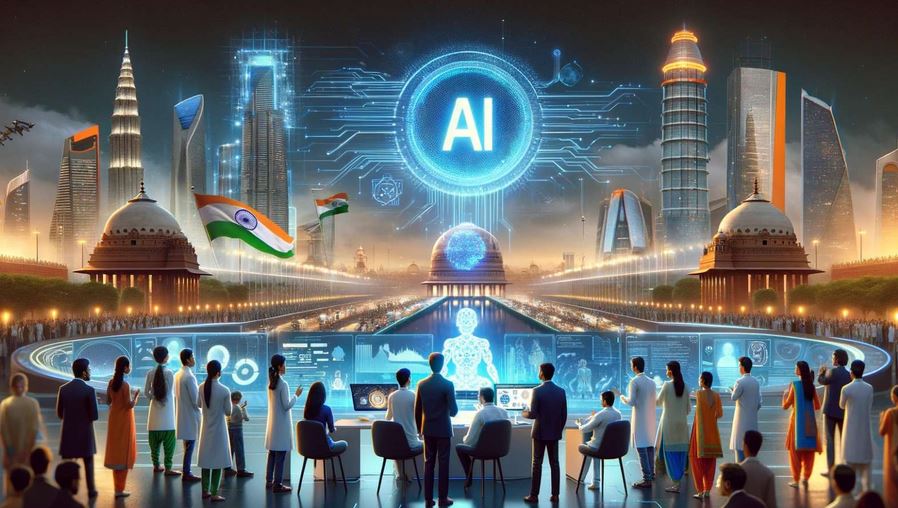
India Third in Global AI Competitiveness: A New Milestone in the World of Artificial Intelligence

India Third in Global AI Competitiveness is a headline that reflects a major shift in the global technology landscape. India has emerged as the world’s third most competitive country in artificial intelligence, ranking just behind the United States and China. This recognition comes from Stanford University’s Global AI Vibrancy Tool, a respected global benchmark that tracks how countries perform in the fast-growing AI sector.
Thank you for reading this post, don't forget to subscribe!For India, this ranking is more than just a number. It signals the country’s rising influence in one of the most important technologies shaping the future of economies, governance, and daily life.
What the Stanford AI Vibrancy Tool Measures
The Global AI Vibrancy Tool developed by Stanford University evaluates countries across a wide range of indicators. These include research and development, talent availability, investment levels, infrastructure, government policies, and public adoption of AI technologies.
The idea behind the tool is simple: AI leadership is not defined by one factor alone. Instead, it is built through a combination of skilled people, strong institutions, supportive policies, and real-world impact.
In the latest rankings, the United States secured the top position with a vibrancy score of 78.6, reflecting its strength across nearly all categories. China followed in second place with a score of 36.95, supported by large investments, strong infrastructure, and rapid adoption of AI in industry. India ranked third with a score of 21.59, placing it ahead of many advanced economies.
India Ahead of Several Advanced Economies
One of the most striking aspects of this ranking is the list of countries India has outperformed. Nations such as the United Kingdom, Japan, Germany, France, Canada, Singapore, and South Korea all ranked below India in overall AI competitiveness.
These countries have long been seen as global technology leaders. India’s position above them shows how quickly its AI ecosystem has grown in recent years. It also highlights how scale, talent, and innovation can sometimes outweigh traditional measures of economic strength.
The Power of India’s Talent Base
A key reason behind India’s strong performance is its vast pool of skilled professionals. The country is home to millions of engineers, data scientists, and software developers. According to the Stanford report, India ranks among the top three countries globally in AI talent.
This strength comes from decades of investment in technical education and a culture that values science and engineering. Indian universities and training institutes produce a large number of graduates every year, many of whom specialize in areas closely linked to artificial intelligence.
In addition, Indian professionals play a major role in global technology companies, research labs, and startups, both within the country and abroad. This global presence further strengthens India’s position in the AI ecosystem.
India Third in Global AI Competitiveness Supported by Growing Research and Innovation
India’s research output in artificial intelligence has grown steadily. Universities, public research institutions, and private companies are contributing more papers, patents, and practical applications related to AI.
At the same time, collaboration between academia and industry has improved. Startups often work closely with researchers to turn ideas into real products, while large technology firms invest in AI labs and innovation centers across Indian cities.
This steady increase in research activity has helped India score strongly in the research and development component of the AI Vibrancy Tool.
India Third in Global AI Competitiveness Driven by a Thriving Startup Ecosystem
Another major factor behind India’s ranking is its fast-growing startup ecosystem. India has become one of the world’s leading startup hubs, with thousands of young companies working on AI-based solutions.
These startups operate in areas such as healthcare, education, agriculture, finance, logistics, and governance. Many of them focus on solving local problems using AI, such as improving crop yields, detecting diseases early, or making digital services more accessible.
Investment in AI startups has also increased, with both domestic and international investors showing strong interest. This flow of capital has helped Indian companies scale their ideas and compete globally.
India’s Unique Position Among Income Groups
The Stanford report points out a clear link between national income levels and AI competitiveness. Most countries at the top of the rankings are high-income economies.
India stands out as the only lower-middle-income country to secure a top-three position. This makes its achievement even more significant. It shows that strong human capital, innovation, and strategic focus can help countries overcome income-related limitations.
India’s success also positions it as a bridge between advanced economies and emerging markets, offering a model for how AI can drive inclusive and innovation-led growth.
India Third in Global AI Competitiveness and Policy Support with Infrastructure Development
Government initiatives have played an important role in strengthening India’s AI landscape. Policies focused on digital transformation, data infrastructure, and innovation have created a supportive environment for AI development.
Investments in digital public infrastructure, such as digital identity systems and online platforms, have also created large datasets that can support AI applications. These efforts have helped improve India’s readiness for large-scale AI adoption.
India Third in Global AI Competitiveness: What This Means for the Global AI Landscape
The report also highlights a growing concern: the gap between countries with strong AI capabilities and those without could widen over time. Unequal access to AI technologies may deepen global inequality.
In this context, India’s rise is especially important. As a country with a large population and diverse challenges, India’s approach to AI can influence how the technology is used for development and public good. Its growing role adds a new voice to global discussions on responsible and inclusive AI.
India Third in Global AI Competitiveness and the Road Ahead in Artificial Intelligence
India’s position as the third most competitive country in AI reflects years of progress in talent development, research, startups, and policy support. While challenges remain, the ranking confirms that India is no longer just an emerging player but a central force in the global AI race.
As investments continue to grow and innovation spreads across sectors, India’s influence in artificial intelligence is likely to expand further, shaping both national growth and the future of AI worldwide.