

India-Vietnam Ties Gain Fresh Momentum

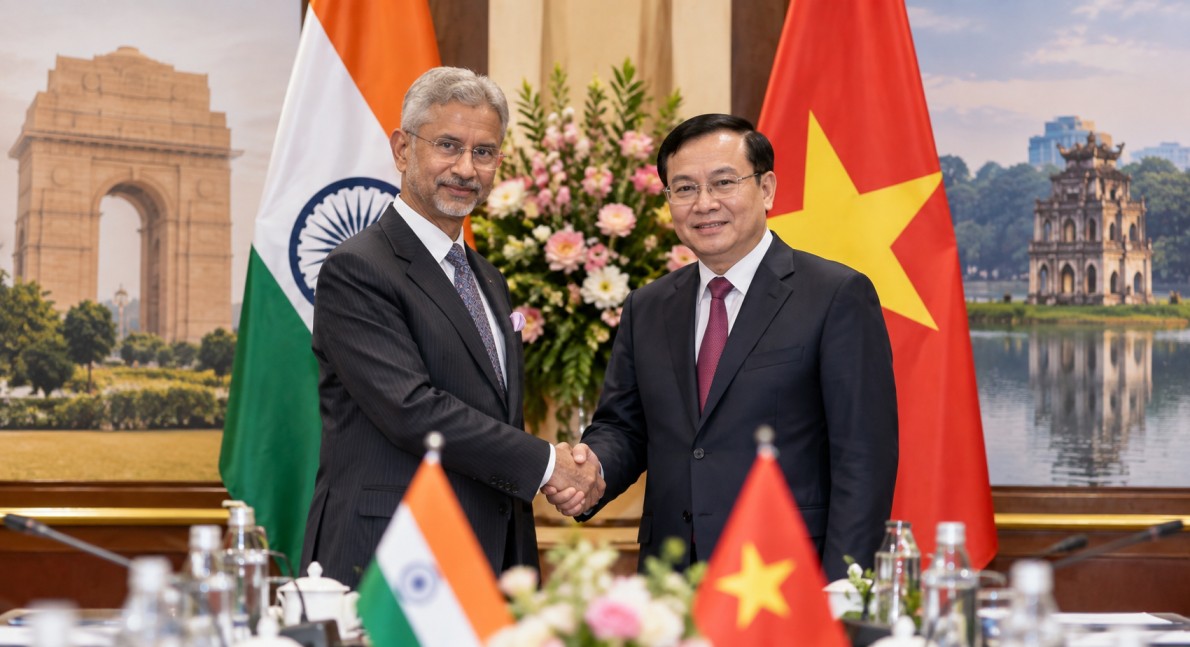
India-Vietnam Ties are gaining fresh momentum as External Affairs Minister Dr S Jaishankar described Vietnam as a key partner in India’s Act East Policy, Vision MAHASAGAR and its wider Indo-Pacific outlook. He made the remarks while co-chairing the 19th session of the India-Vietnam Joint Commission on Trade, Economic, Scientific and Technological Cooperation in New Delhi.
The meeting reviewed the progress of the bilateral relationship and discussed new areas where India and Vietnam can work together. Both sides also looked at regional and global developments and ways to strengthen cooperation through regional and multilateral platforms.

India-Vietnam Ties Under Enhanced Partnership
India-Vietnam Ties have expanded significantly in recent years. Jaishankar said the relationship has moved forward since the previous Joint Commission meeting three years ago.
The two countries now work under an Enhanced Comprehensive Strategic Partnership, which covers a wide range of areas, including defence, trade, technology, connectivity and people-to-people relations.
Jaishankar said the latest meeting provided an opportunity to review commitments already made by the two countries and turn political understanding into practical results that can benefit people and businesses.
Vietnam’s Role in India’s Act East Policy
Vietnam has an important place in India’s Act East Policy, which focuses on strengthening India’s economic, strategic and cultural engagement with Southeast Asia and the wider Indo-Pacific region.
India sees Vietnam as an important partner within its broader engagement with the Association of Southeast Asian Nations (ASEAN). The two countries also share long-standing civilisational and cultural links.
Jaishankar described Vietnam as a key pillar of India’s regional approach. The partnership has become increasingly important as India seeks stronger relations with Southeast Asian countries and greater cooperation across the Indo-Pacific.
Defence and Security Cooperation
Defence and security remain important parts of India-Vietnam Ties. During the Joint Commission meeting, the two sides discussed ways to deepen their existing defence cooperation.
One area identified for future work is the co-production of Indian defence equipment in Vietnam. Such cooperation could create opportunities for technology partnerships, manufacturing and industrial collaboration.
India and Vietnam have also maintained regular defence exchanges and cooperation as both countries seek to strengthen their security relationship in the wider Indo-Pacific.
Trade and Investment Expansion
Trade and investment were another major focus of the discussions in New Delhi. India and Vietnam agreed to explore ways to expand economic engagement and develop mutually beneficial supply chains.
The two sides discussed improving market access for Indian marine and agricultural products, as well as Indian pharmaceuticals.
Greater market access could help Indian companies reach Vietnamese consumers while also creating opportunities for Vietnamese businesses in the Indian market.
Both countries are also looking at investment opportunities in sectors where their economies can complement each other.
Connectivity Gets Greater Attention
Connectivity is emerging as another important area in India-Vietnam Ties. The two countries discussed financial, port and air connectivity as part of efforts to make trade and movement between the two countries easier.
Better connectivity can support business activity, tourism, supply chains and movement of goods. Port cooperation is particularly relevant because both India and Vietnam are major maritime countries with strong interests in secure and efficient sea routes.
Stronger connectivity could also support India’s wider engagement with Southeast Asian economies.
Cooperation in Nuclear Energy and Space
The latest meeting expanded the partnership beyond traditional areas by identifying opportunities in nuclear energy and space.
India and Vietnam are exploring new areas of technological cooperation as both countries develop their capabilities in advanced sectors.
Space cooperation could include areas such as satellite technology, scientific research and capacity building. Nuclear energy discussions also reflect the wider interest in clean and reliable energy technologies.
These emerging sectors could become important parts of India-Vietnam Ties as both countries look to develop more technology-focused partnerships.
India-Vietnam Cooperation in the Indo-Pacific
Regional security and developments in the Indo-Pacific were also discussed during the meeting.
India and Vietnam have common interests in maintaining a free, open and stable Indo-Pacific region. Vietnam has also been participating in India’s Indo-Pacific Oceans Initiative (IPOI).
The two countries reaffirmed their commitment to closer coordination in regional and international forums. Their cooperation comes as countries across the Indo-Pacific are placing greater attention on maritime security, connectivity, supply chains and economic resilience.
55 Years of Diplomatic Relations
India and Vietnam will mark 55 years of diplomatic relations in 2027. The two sides agreed to observe next year as the Year of India-Vietnam Friendship.
The anniversary is expected to provide opportunities for cultural programmes, diplomatic exchanges, business activities and people-to-people initiatives.
The milestone will also highlight the long history of relations between the two countries and their growing cooperation across new areas.
Focus on People-to-People Relations
People-to-people connections are another part of the India-Vietnam partnership. The two countries discussed capacity building and broader exchanges as areas for future cooperation.
Educational, cultural, professional and institutional exchanges can strengthen understanding between the two societies and support long-term relations.
The latest Joint Commission meeting showed that India-Vietnam Ties are expanding from established areas such as defence and trade into technology, space, nuclear energy and connectivity.