


Industry Definition: Supreme Court Revises Labour Law Test

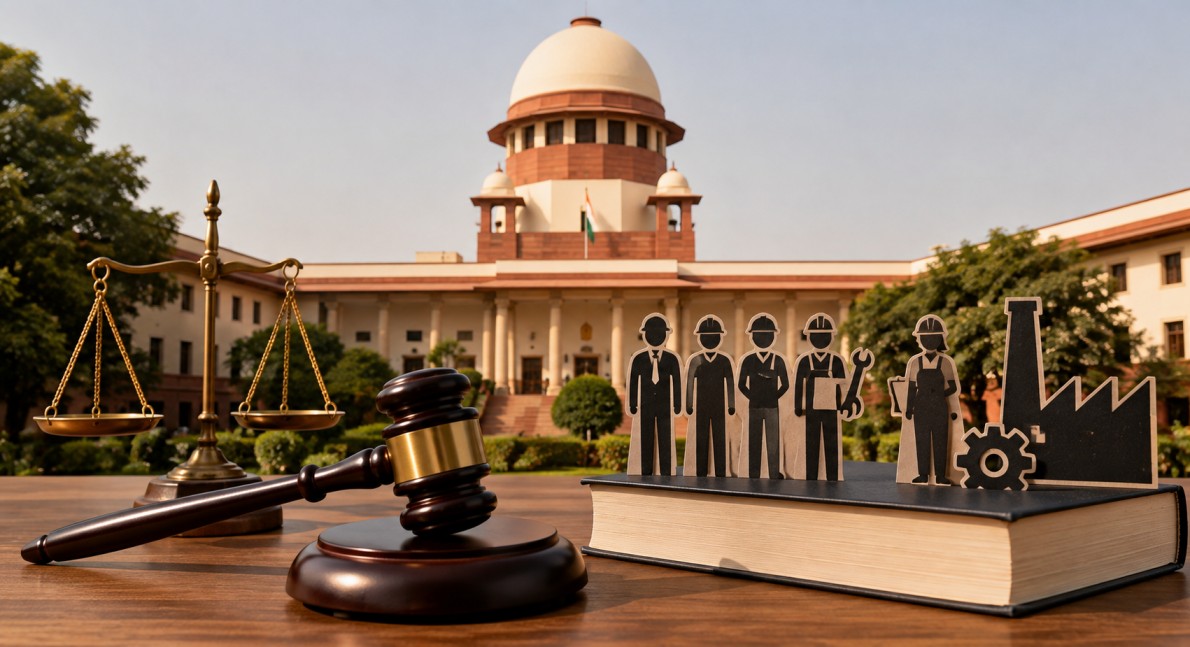
Industry Definition under India’s labour law has been revisited by the Supreme Court in a major nine-judge Constitution Bench judgment delivered on August 20, 2026. The Court examined the meaning of “industry” under Section 2(j) of the Industrial Disputes Act, 1947 and reconsidered the well-known framework laid down in the 1978 Bangalore Water Supply and Sewerage Board v. A. Rajappa case. By a 5:4 majority, the Court decided that parts of the earlier “triple test” require refinement, while making it clear that the revised approach will apply prospectively.
Why the Industry Definition Matters
The meaning of “industry” is important because it determines which activities and organisations can come within the scope of the Industrial Disputes Act, 1947. The definition can affect disputes involving employers and employees, including questions related to employment, service conditions and industrial relations.

Section 2(j) of the 1947 law used broad language to describe an industry. Over the years, the Supreme Court’s interpretation became an important part of labour law. The 1978 Bangalore Water Supply judgment gave the provision a wide meaning and introduced the famous triple test.
What Was the 1978 Triple Test?
The earlier framework generally looked at three main features. There had to be a systematic and organised activity, cooperation between employers and employees, and production or distribution of goods or services intended to satisfy human needs.
The 1978 judgment became a leading authority because it did not make the profit motive the central factor. This broad interpretation meant that the concept of an industry could extend beyond traditional factories and commercial businesses.
The judgment also created questions about organisations such as hospitals, educational institutions, research bodies and government-run activities. Over time, different cases created areas of uncertainty about how the broad test should be applied.
Supreme Court Refines the Earlier Test
The nine-judge Bench held by a 5:4 majority that the basic framework developed in Bangalore Water Supply had stood the test of time, but some parts of the triple test and related guidelines needed refinement. The Court therefore reformulated the approach rather than simply removing the earlier framework.
The ruling is significant because the 1978 judgment had remained an important reference point for almost five decades. The new decision attempts to provide greater clarity while recognising the long history of the earlier interpretation.
New Test Will Apply Prospectively
One of the most important parts of the judgment is its treatment of existing disputes. The Supreme Court said the revised interpretation will operate prospectively.
Pending cases under the Industrial Disputes Act, 1947 will continue to be decided using the triple test from the Bangalore Water Supply judgment. Cases and decisions that have already reached finality will also not be reopened simply because the Court has now refined the test.
This approach is intended to avoid uncertainty for disputes that are already before labour courts, tribunals or other authorities.
Industrial Relations Code Is Not Covered by the Ruling
The judgment also made an important distinction between the old Industrial Disputes Act and the newer Industrial Relations Code, 2020.
The Supreme Court clarified that its decision concerning Section 2(j) of the Industrial Disputes Act should not be treated as an interpretation of the definition of “industry” under the Industrial Relations Code. The Code came into effect on November 21, 2025, replacing the earlier legal framework in this area.
This means the meaning of “industry” under the new Code will have to be understood from the wording and structure of that legislation rather than automatically applying the interpretation developed under the old Act.
Case Behind the Constitution Bench
The matter came before the nine-judge Bench through State of Uttar Pradesh v. Jai Bir Singh. The dispute had been referred for reconsideration of the 1978 Bangalore Water Supply judgment.
The issue had a long judicial history. A five-judge Bench had referred the matter for reconsideration in 2005, and a seven-judge Bench later referred it to a nine-judge Constitution Bench in 2017 because the original Bangalore Water Supply ruling itself had been delivered by a seven-judge Bench.
The nine-judge Bench heard arguments in March 2026 and reserved its judgment on March 19. The final decision was delivered on August 20, 2026.
Four Judges Disagree With the Majority
The judgment was not unanimous. Four judges expressed disagreement with the majority’s approach on the merits.
Justice B.V. Nagarathna maintained that the earlier interpretation did not need to be changed. Justice Dipankar Datta, joined by Justice Ujjwal Bhuyan, considered the reference unnecessary and supported retaining the earlier framework. Justice Joymalya Bagchi also differed from the majority on the merits.
The differing opinions show the complexity of defining the scope of labour protections across different types of organisations and activities.
Impact on Labour Disputes
The ruling is likely to be important for future disputes involving the scope of the Industrial Disputes Act. It provides a distinction between disputes arising under the old law and matters governed by the newer Industrial Relations Code.
For pending matters under the 1947 Act, the established triple test remains relevant. For future cases governed by the new legal framework, courts will need to examine the provisions of the Industrial Relations Code independently.
The decision also highlights how labour law has developed alongside changes in India’s economy, workplaces and public institutions. The Supreme Court’s latest ruling attempts to balance legal continuity with the need to refine an interpretation that has been in use since 1978.