



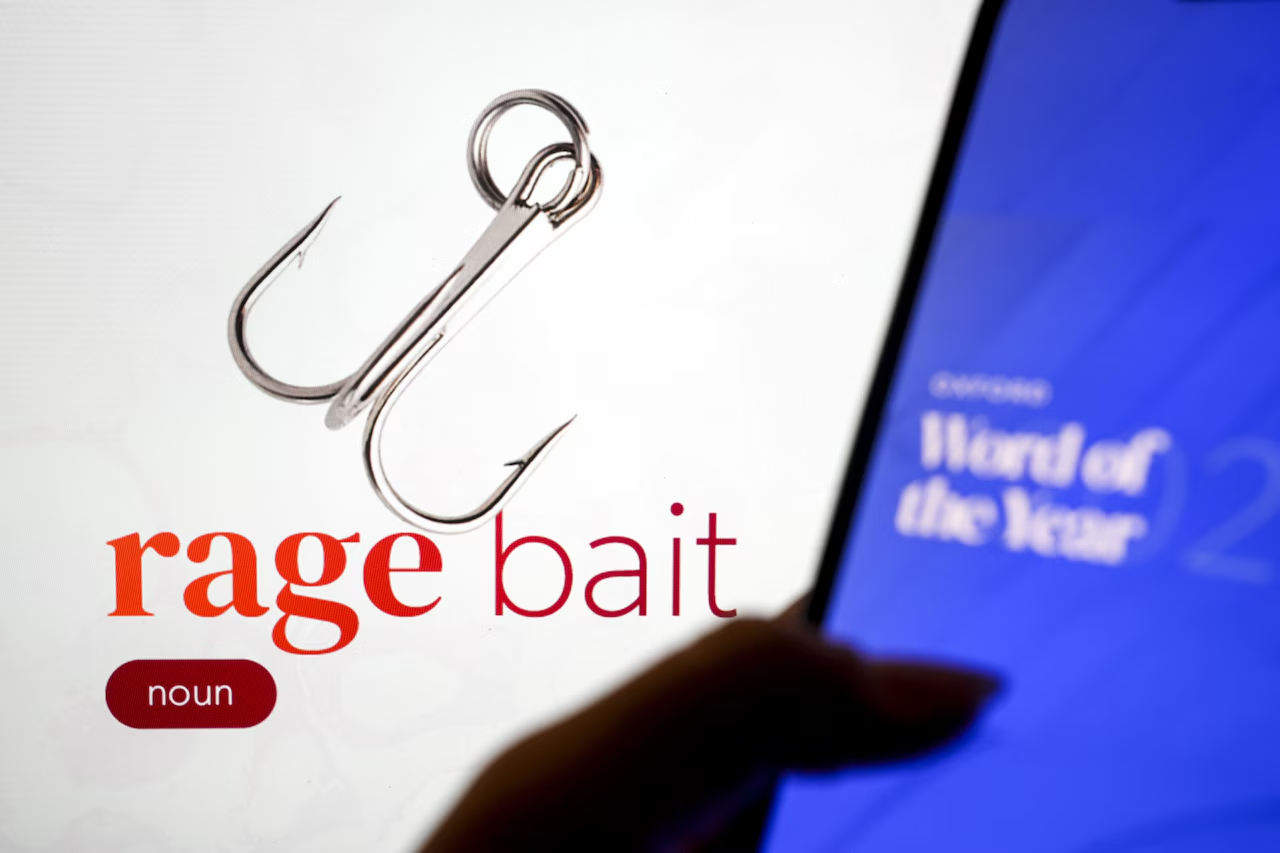
Rage Bait Word of the Year Announced by Oxford

Rage Bait Word of the Year has become a major global headline after Oxford University Press selected “rage bait” as its official Word of the Year for 2025. This decision reflects the changing nature of communication in the digital era, where provocative posts and emotionally charged content dominate social media feeds. The term captures a growing trend: content intentionally crafted to make people angry, frustrated or shocked. Oxford’s selection highlights how online reactions, digital design and user behaviour now play a major role in shaping language itself.
Rage Bait Word of the Year: Why This Term Was Chosen
The rise of “rage bait” shows how online engagement has shifted in recent years. People are spending more time on platforms where emotions especially anger drive interactions. “Rage bait” refers to content created specifically to evoke outrage. These posts are designed to irritate, provoke or cause disagreement so that users react quickly. The more reactions a post gets, the more it spreads, giving creators higher visibility.

Lexicographers at Oxford University Press studied how the term has become widespread in discussions about online culture, algorithm behaviour and digital communication. Because a large part of modern interaction happens on social media, words related to online emotions are becoming increasingly mainstream. The choice of “rage bait” as the Word of the Year signals how deeply negative online behaviour affects public conversation.
Rage Bait Word of the Year: Understanding the Term and Its Usage
“Rage bait” is now used across platforms such as Instagram, YouTube, X (formerly Twitter), TikTok and Facebook. It describes posts that deliberately provoke an emotional reaction. This content is often controversial, misleading or exaggerated. The goal is not to inform but to draw attention by sparking arguments. The more people argue or share their anger, the more the post spreads.
Digital experts explain that online users respond more strongly to content that triggers strong emotions. Anger, in particular, can lead to fast and intense reactions. This makes rage bait highly effective in a click-driven world. It encourages users to comment instantly, often without reading the full context. Over time, this behaviour creates an environment where negativity spreads quicker than balanced or thoughtful posts.
Rage Bait Word of the Year: How Social Media Algorithms Amplify It
One major reason for the rise of rage bait is the nature of social media algorithms. Platforms prioritise posts that generate high interaction. It does not matter whether the reaction is positive or negative as long as people are responding, the content is boosted.
This system encourages creators to produce material that will spark arguments or controversies. As a result, rage-inducing posts often appear at the top of users’ feeds. Some creators use this system to gain followers, while others unknowingly contribute to the cycle by amplifying disturbing or anger-filled content.
Digital analysts note that this loop can have long-lasting effects on public mood and online culture. People begin to expect strong emotional tones in online discussions, and neutral content gets overshadowed. Oxford’s selection of “rage bait” captures this major shift in digital communication.
Rage Bait Word of the Year: Other Shortlisted Expressions for 2025
Oxford University Press also revealed two other expressions that reached the final shortlist for 2025. Each one reflects deeper cultural movements connected to identity, self-image and personal development.
Aura Farming
“Aura farming” describes the act of curating a public image that creates an impression of coolness, mystery or charm. This term has grown popular on social media where people carefully plan photos, posts and captions to create a desirable aura. It reflects modern concerns with self-presentation and how online impressions influence real-world perception.
Biohack
“Biohack” refers to unconventional methods aimed at improving physical or mental performance. This includes activities like cold exposure, experimental diets, wearable tech, micro-dosing and other self-optimisation practices. The term represents a growing cultural interest in hacking the human body for better health, productivity or lifestyle outcomes.
Both shortlisted terms show how people today are thinking more deeply about identity, health, and personal expression especially in a digital world where self-image is constantly broadcasted.
Rage Bait Word of the Year: Oxford’s Role in Observing Language Change
Oxford University Press selects a Word of the Year to highlight how language evolves with society. Their choice often mirrors cultural movements, technological shifts and social changes. By tracking emerging terms, they document how people communicate in different contexts online spaces, workplaces, entertainment, news and everyday life.

This year’s selection focuses on digital behaviour, showing how modern language emerges directly from the internet. Terms like “rage bait” reveal how technology affects not only communication but also emotions. Oxford’s research teams analyze millions of real-world language examples to understand how frequently new words appear and how they influence public conversation.
Their work provides a record of linguistic changes happening in real time. It also helps researchers, educators, students and language enthusiasts understand how vocabulary reflects the world around them. Words such as “podcast,” “emoji,” and “goblin mode” were previous selections that captured important cultural moments. “Rage bait,” in contrast, reflects rising concern over how digital platforms shape public interactions.
Rage Bait Word of the Year: A Reflection of Today’s Digital Culture
The announcement of “rage bait” as the Word of the Year sparks conversations about how people interact online. It draws attention to how quickly anger spreads, how creators use emotional triggers, and how social media algorithms shape what people see. Many users feel that online spaces have become more dramatic, emotional and reactive over the years. This choice encourages people to pause and think about how they respond to content and how they participate in digital discussions.
As online behaviour continues to evolve, new terms will reflect future changes. But for 2025, “rage bait” stands out as a clear symbol of how digital environments influence modern communication, cultural trends and emotional responses.