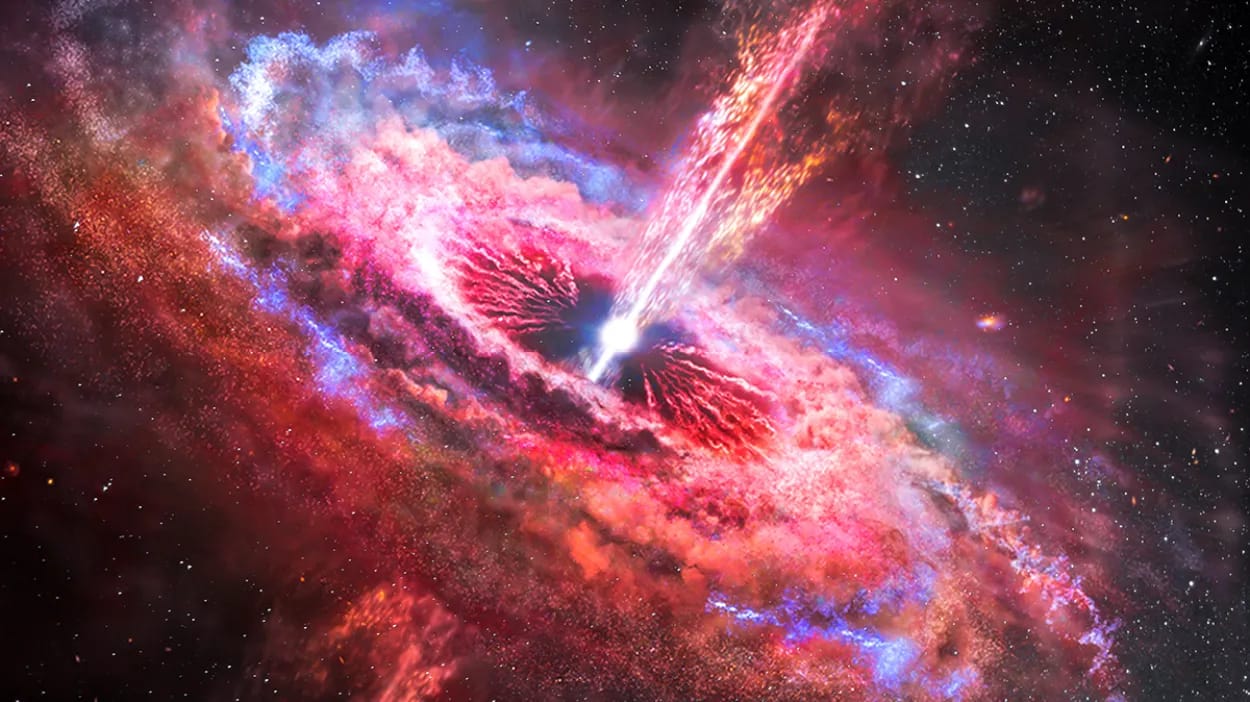
S301 Fastest Star in the Milky Way

S301 Fastest Star is the latest major discovery in astronomy, with scientists identifying the object as the fastest-moving star known to be travelling on a securely measured orbit around the supermassive black hole at the centre of the Milky Way. The finding was announced on August 19, 2026, in a study published in Nature.
Thank you for reading this post, don't forget to subscribe!S301 reaches a remarkable speed of around 25,000 kilometres per second, or about 15,500 miles per second. This is roughly 8% of the speed of light, making the star an important object for studying extreme gravity and the behaviour of stars close to a supermassive black hole.
S301 Moves Around Sagittarius A*
S301 follows a highly stretched, or elliptical, orbit around Sagittarius A*, the supermassive black hole located at the centre of our galaxy.
Sagittarius A* has an estimated mass of about 4.3 million times that of the Sun. Its enormous gravitational pull affects the movement of stars and other objects in the region around it.
S301 completes one full orbit around Sagittarius A* in approximately 8.7 years. At its closest point, the star comes within about 12 astronomical units of the black hole.
One astronomical unit is the average distance between Earth and the Sun, equal to approximately 149.6 million kilometres. Therefore, 12 astronomical units represent roughly 1.8 billion kilometres.
Although this distance may appear extremely large on a human scale, it is relatively close when compared with the enormous size of the region surrounding a supermassive black hole.
A Star Travelling at Extreme Speed
The most striking feature of the S301 Fastest Star discovery is its extraordinary velocity. At around 25,000 kilometres per second, S301 travels nearly 8% as fast as light.
The speed becomes particularly important when the star approaches Sagittarius A*. The immense gravitational field of the black hole accelerates the star as it moves along its highly elliptical orbit.
Studying such objects gives scientists an opportunity to observe how gravity behaves under extreme conditions. The motion of stars close to Sagittarius A* can provide information about the environment surrounding the Milky Way’s central black hole.
Observations Made Using Very Large Telescope Interferometer
Scientists identified S301 using observations from the European Southern Observatory’s Very Large Telescope Interferometer (VLTI) at the Paranal Observatory in Chile.
Researchers also examined archival observations of the star dating back to 2017. By combining observations made over several years, the team was able to track S301’s movement and determine its orbital path.
Long-term observations are important for stars near Sagittarius A* because their positions and speeds change rapidly as they travel around the black hole.
The international research team was led by K. Abd El Dayem of the Paris Observatory. Researchers including Felix Mang and Stefan Gillessen of the Max Planck Institute for Extraterrestrial Physics also contributed to the study.
Why S301 Matters to Astronomy
The discovery is important because stars moving at such high speeds provide natural laboratories for testing theories of gravity.
Near a supermassive black hole, gravitational effects can become much stronger than those experienced in ordinary regions of space. Precise measurements of stellar orbits can therefore help scientists understand how massive objects influence space and time.
Observations of stars near Sagittarius A* have already played an important role in modern astronomy. Researchers have used their movements to study the mass of the black hole and investigate relativistic effects.
S301 adds another valuable object to this group of extreme stars.
Earlier Fast-Star Record
Before the latest measurements, another star known as S4714 had been reported as one of the fastest stars near Sagittarius A*. In 2020, researchers estimated that S4714 could reach a speed of around 24,000 kilometres per second.
However, later measurements by the GRAVITY collaboration did not reproduce the earlier result. This created uncertainty over whether S4714 held the record for the fastest securely measured star.
The new observations of S301 provide a stronger measurement of a star travelling at extreme speed on a confirmed orbit around Sagittarius A*.

Exploring the Milky Way’s Centre
The centre of the Milky Way remains one of the most closely studied regions of our galaxy. Sagittarius A* is surrounded by numerous stars, gas clouds and other objects moving under its powerful gravitational influence.
Modern instruments such as the Very Large Telescope Interferometer allow astronomers to measure these objects with extremely high precision.
The S301 Fastest Star discovery adds to a growing body of research into the unusual environment around Sagittarius A*. Its 8.7-year orbit and extraordinary speed provide scientists with another opportunity to examine how stars behave when travelling through the intense gravitational environment of a supermassive black hole.
The continuing study of S301 and other nearby stars could provide further information about Sagittarius A*, extreme stellar motion and the effects of gravity at the heart of the Milky Way.