Tobacco Excise Duty: New Fiscal Measures to Reshape Taxation on Sin Goods

Tobacco Excise Duty is set to take centre stage in India’s taxation landscape from February 1, as the government rolls out a new system of fiscal levies on tobacco products and pan masala. This change signals an important shift away from the earlier compensation cess regime under the Goods and Services Tax (GST) and introduces product-specific levies that will operate outside the GST framework. The move has implications not only for pricing and consumption but also for public revenue, health policy, and the future structure of indirect taxation in the country.
Thank you for reading this post, don't forget to subscribe!The government has formally notified February 1 as the date when these new levies will come into effect. From this day onward, tobacco products and pan masala will be taxed under a revised structure that combines GST with additional duties and cesses. This marks the end of the compensation cess that was earlier imposed to make up for states’ revenue losses after GST was introduced.
Tobacco Excise Duty and a Shift Away from the Compensation Cess Regime
When GST was implemented, a compensation cess was levied on certain goods such as tobacco, cigarettes, and pan masala. The purpose of this cess was to compensate states for potential revenue losses arising from the transition to GST. Over time, however, the need for a more stable and product-focused taxation approach has gained ground.
With the new notification, the compensation cess on tobacco products and pan masala will no longer apply. Instead, the government has opted for a system where these products attract additional excise duty or a special cess, separate from GST. This change allows the central government to directly impose and manage these levies without linking them to the GST compensation mechanism.
Tobacco Excise Duty and New Levies Effective From February 1
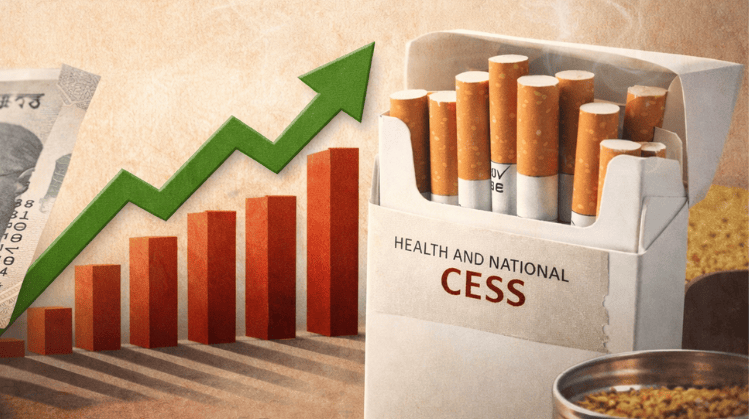
Under the revised framework, tobacco and its related products will attract an additional excise duty, while pan masala will be subject to a newly introduced Health and National Security Cess. These levies will be charged over and above the applicable GST rates, making the overall tax burden on these products higher and more clearly defined.
The additional excise duty on tobacco products revives a traditional form of taxation that existed before GST, but in a more targeted manner. For pan masala, the Health and National Security Cess is a new concept, designed to serve specific policy goals beyond general revenue collection.
Both these levies will operate outside the GST system. This means they will not be shared with states in the same way GST revenues are, and they will not be adjustable against input tax credits. The structure gives the central government greater control over how the revenue is collected and used.
Tobacco Excise Duty and Revised GST Rates on Tobacco and Related Products
Alongside the new levies, the government has also clarified the GST rates applicable to various tobacco products from February 1. Pan masala, cigarettes, tobacco, and similar products will attract a GST rate of 40 per cent. This uniform rate reflects the government’s view of these items as harmful or “sin goods” that should be discouraged through higher taxation.
Biris, however, will continue to be taxed at a lower GST rate of 18 per cent. This distinction is significant. Biris are widely consumed by lower-income groups and are often produced in small-scale or unorganised settings. By keeping the GST rate lower for biris, the government appears to be balancing public health concerns with socio-economic realities, including livelihoods linked to the biri industry.
Health and National Security Cess: Purpose and Scope
The Health and National Security Cess introduced on pan masala is a notable feature of the new system. Unlike GST, which goes into a general revenue pool shared between the Centre and the states, this cess is designed to generate funds for specific purposes.
As the name suggests, the cess is aimed at supporting public health initiatives and national security-related priorities. Pan masala consumption has long been associated with serious health risks, including oral cancer and other diseases. By imposing a dedicated cess, the government is signalling its intent to link taxation more closely with health outcomes.
At the same time, the reference to national security indicates a broader policy approach, where revenues from certain products are earmarked to support critical national needs. While the exact allocation of funds may be determined later, the structure itself highlights a more purpose-driven form of taxation.
Additional Excise Duty on Tobacco Products
For tobacco and its derivatives, the government has chosen to impose an additional excise duty instead of a cess. This duty will apply over and above the 40 per cent GST rate on products such as cigarettes and chewing tobacco.
Excise duty has historically been an effective tool for regulating tobacco consumption. By adjusting duty rates, the government can influence retail prices and, in turn, consumption patterns. The return of excise duty in this context allows for more flexibility in policy-making, especially when compared to the relatively rigid GST framework.
Tobacco Excise Duty: Legislative Backing and Policy Direction
The legal basis for these new levies was approved by Parliament in December, when two Bills were passed to authorise the imposition of the Health and National Security Cess on pan masala and the additional excise duty on tobacco products. This legislative approval ensures that the new taxation measures are firmly grounded in law and can be implemented without ambiguity.
From a policy perspective, the changes reflect the government’s broader objectives. On one hand, there is a clear intent to discourage the consumption of harmful products through higher and more targeted taxes. On the other hand, there is a need to ensure steady and predictable revenue flows, especially as the compensation cess mechanism linked to GST has run its course.

Tobacco Excise Duty and What the New Structure Means Going Forward
The introduction of a revised Tobacco Excise Duty framework marks a significant moment in India’s approach to taxing sin goods. By moving away from the compensation cess and introducing product-specific levies outside GST, the government has created a system that is more direct, flexible, and aligned with public policy goals.
Consumers are likely to see higher prices for tobacco products and pan masala, while manufacturers will need to adapt to a more complex tax structure. For policymakers, the new system offers greater control over both revenue and health outcomes, setting the stage for a more focused approach to regulating harmful consumption in the years ahead.