


Fundamental Rights: Meaning, Features, and Right to Equality & Freedom (Part 1)

Fundamental Rights are the basic rights given to every citizen and, in some cases, every person living in India by the Constitution. These rights protect the freedom, equality, and dignity of people. They also prevent the misuse of power by the government and ensure justice for everyone.
Thank you for reading this post, don't forget to subscribe!These rights are written in Part III of the Constitution of India (Articles 12 to 35). They are called the backbone of Indian democracy because they guarantee equal treatment and protect the basic freedoms of individuals.
The Constitution originally provided seven Fundamental Rights, but after the 44th Constitutional Amendment Act, 1978, the Right to Property was removed from the list of Fundamental Rights. It is now a legal right under Article 300A.
What Are Fundamental Rights?
Fundamental Rights are constitutional guarantees that help every person live with freedom, equality, and dignity. If these rights are violated, a person can directly approach the courts for justice.
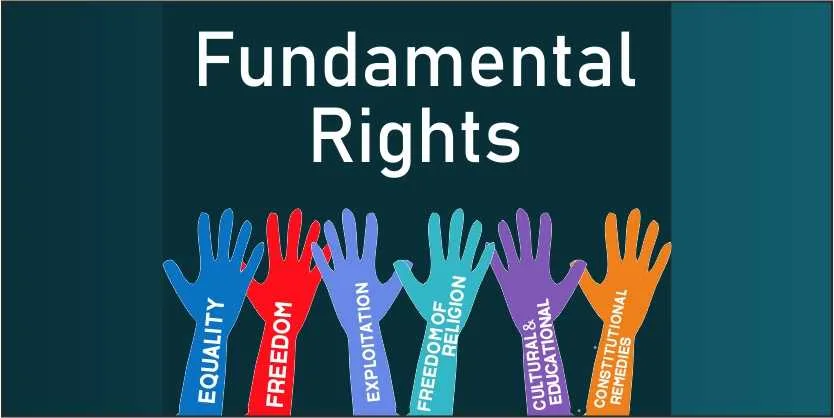
The Constitution provides six Fundamental Rights:
| Fundamental Right | Articles |
|---|---|
| Right to Equality | Articles 14–18 |
| Right to Freedom | Articles 19–22 |
| Right Against Exploitation | Articles 23–24 |
| Right to Freedom of Religion | Articles 25–28 |
| Cultural and Educational Rights | Articles 29–30 |
| Right to Constitutional Remedies | Article 32 |
These rights are considered essential for maintaining democracy and protecting citizens from unfair treatment.
Why Is Part III Called the Magna Carta of India?
Part III of the Constitution is often called the Magna Carta of India.
The term Magna Carta refers to a famous charter signed by King John of England in 1215. It was one of the earliest documents that limited the powers of the ruler and protected the rights of people.
Similarly, Part III protects the rights of people in India and ensures that the government follows constitutional limits.
Article 13: Laws Against Fundamental Rights
Article 13 is one of the most important provisions in the Constitution.
It states that any law that violates or takes away Fundamental Rights becomes void to the extent of the violation.
This means:
- Parliament and State Legislatures cannot make laws against Fundamental Rights.
- Courts have the power to strike down unconstitutional laws.
The Supreme Court (Article 32) and High Courts (Article 226) can protect these rights.
In the famous Kesavananda Bharati Case (1973), the Supreme Court ruled that even a Constitutional Amendment can be challenged if it destroys the Basic Structure of the Constitution, including Fundamental Rights.
Writs for Protecting Fundamental Rights
When someone’s Fundamental Rights are violated, the courts can issue special legal orders known as Writs.
The Supreme Court and High Courts can issue five types of writs:
- Habeas Corpus
- Mandamus
- Prohibition
- Certiorari
- Quo Warranto
These writs help citizens receive quick legal protection against illegal actions by authorities.
Main Features of Fundamental Rights
Fundamental Rights have several important features that make them unique.
1. Protected by the Constitution
Unlike ordinary legal rights, Fundamental Rights are guaranteed by the Constitution.
They cannot be easily removed by ordinary laws.
2. Available to Citizens and Non-Citizens
Some Fundamental Rights are available only to Indian citizens.
Others are available to every person living in India, including foreigners (except enemy aliens).
3. They Are Not Absolute
Fundamental Rights are not unlimited.
The government can impose reasonable restrictions in the interest of:
- National security
- Public order
- Morality
- Friendly relations with foreign countries
Courts decide whether these restrictions are reasonable.
4. They Can Be Enforced in Court
If someone’s Fundamental Rights are violated, they can directly approach:
- Supreme Court under Article 32
- High Court under Article 226
This makes these rights legally enforceable.
5. Rights Can Be Suspended During Emergency
During a National Emergency, certain Fundamental Rights may be suspended.
However:
- Articles 20 and 21 cannot be suspended.
- Article 19 can be suspended only during war or external aggression.
6. Special Restrictions for Armed Forces
Under Article 33, Parliament may restrict certain Fundamental Rights of:
- Armed Forces
- Police
- Intelligence agencies
- Paramilitary forces
This helps maintain discipline and national security.
Fundamental Rights Available to Everyone
The following rights are available to both citizens and foreigners (except enemy aliens):
- Equality before law
- Protection of life and personal liberty
- Protection against arbitrary punishment
- Right to elementary education
- Protection against human trafficking
- Freedom of religion
- Protection against child labour
- Freedom to manage religious affairs
Fundamental Rights Available Only to Citizens
Some rights are reserved only for Indian citizens.
These include:
- Protection against discrimination
- Equality in public employment
- Six freedoms under Article 19
- Cultural and educational rights of minorities
- Right of minorities to establish educational institutions
Right to Equality (Articles 14–18)
The Right to Equality ensures that every person is treated equally before the law.
It removes discrimination and promotes equal opportunities.

Article 14: Equality Before Law
Article 14 states that every person is equal before the law.
No one is above the law, regardless of:
- Wealth
- Religion
- Caste
- Gender
- Position
This right applies to:
- Citizens
- Foreigners
- Companies
- Registered societies
- Other legal persons
Exceptions
Some constitutional authorities enjoy limited legal protection.
These include:
- President of India
- Governors
- Members of Parliament for speeches inside Parliament
- Members of State Legislatures
- Foreign ambassadors and diplomats
These protections help them perform official duties independently.
Article 15: Prohibition of Discrimination
Article 15 prohibits discrimination against any citizen based only on:
- Religion
- Race
- Caste
- Sex
- Place of birth
Special Provisions Allowed
The Constitution allows special benefits for:
- Women
- Children
- Socially and educationally backward classes
- Scheduled Castes (SC)
- Scheduled Tribes (ST)
Examples include:
- Reservation
- Scholarships
- Free education
- Welfare schemes
Article 16: Equality in Public Employment
Article 16 guarantees equal opportunity in government jobs.
Every citizen has an equal chance to apply for public employment.
Exceptions
Reservation can be provided for:
- Backward classes
- SCs
- STs
- Economically weaker sections (according to law)
Religious institutions may also require employees to belong to a particular religion.
Article 17: Abolition of Untouchability
Article 17 completely abolishes untouchability.
Practising untouchability in any form is a punishable offence.
Examples include:
- Denying entry into temples
- Refusing admission to schools
- Preventing access to hotels or public places
- Insulting someone because of caste
This article promotes equality and social justice.
Article 18: Abolition of Titles
Article 18 abolishes titles that create social inequality.
The State cannot grant titles such as:
- Raja
- Nawab
- Rai Bahadur
However, military and academic distinctions such as:
- Doctor (academic)
- Major
- Colonel
are allowed.
Indian citizens cannot accept titles from foreign governments without permission.
Right to Freedom (Articles 19–22)
The Right to Freedom protects the personal liberty of citizens.
It allows people to express themselves, move freely, and choose their profession.
Article 19: Six Fundamental Freedoms
Article 19 gives six important freedoms to Indian citizens.
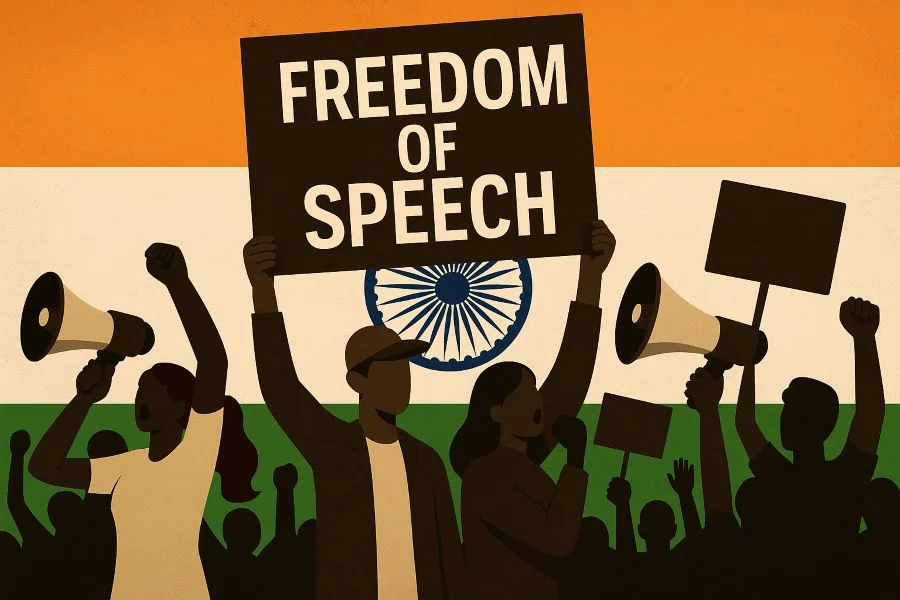
1. Freedom of Speech and Expression
Citizens can:
- Speak freely
- Write
- Express opinions peacefully
Reasonable restrictions may apply for security, public order, or morality.
2. Freedom of Peaceful Assembly
Citizens can gather peacefully without weapons.
This includes:
- Public meetings
- Demonstrations
- Peaceful processions
Violent or unlawful gatherings are not protected.
3. Freedom to Form Associations
People can create:
- Political parties
- Trade unions
- Clubs
- Companies
- Cooperative societies
They also have the freedom not to join any association.
4. Freedom to Move Throughout India
Citizens can travel freely anywhere within India.
Certain tribal or protected areas may have restrictions to preserve local culture and traditions.
5. Freedom to Live Anywhere in India
Citizens can live and settle in any part of the country.
Restrictions may apply in some protected tribal regions.
6. Freedom to Choose a Profession
Every citizen can:
- Start a business
- Choose an occupation
- Practice a profession
However, illegal or harmful businesses are not protected.
Article 20: Protection in Criminal Cases
Article 20 protects every person against unfair punishment.
It provides three important safeguards:
- No punishment under a law made after the offence.
- No person can be punished twice for the same offence.
- No accused person can be forced to testify against themselves.
These protections apply to citizens and foreigners.
Article 21: Protection of Life and Personal Liberty
Article 21 is one of the most important Fundamental Rights.
It states that no person can be deprived of life or personal liberty except according to the law.
The Supreme Court has expanded this article to include many rights, such as:
- Right to live with dignity
- Right to privacy
- Right to clean environment
- Right to legal aid
- Right to health
- Right to livelihood
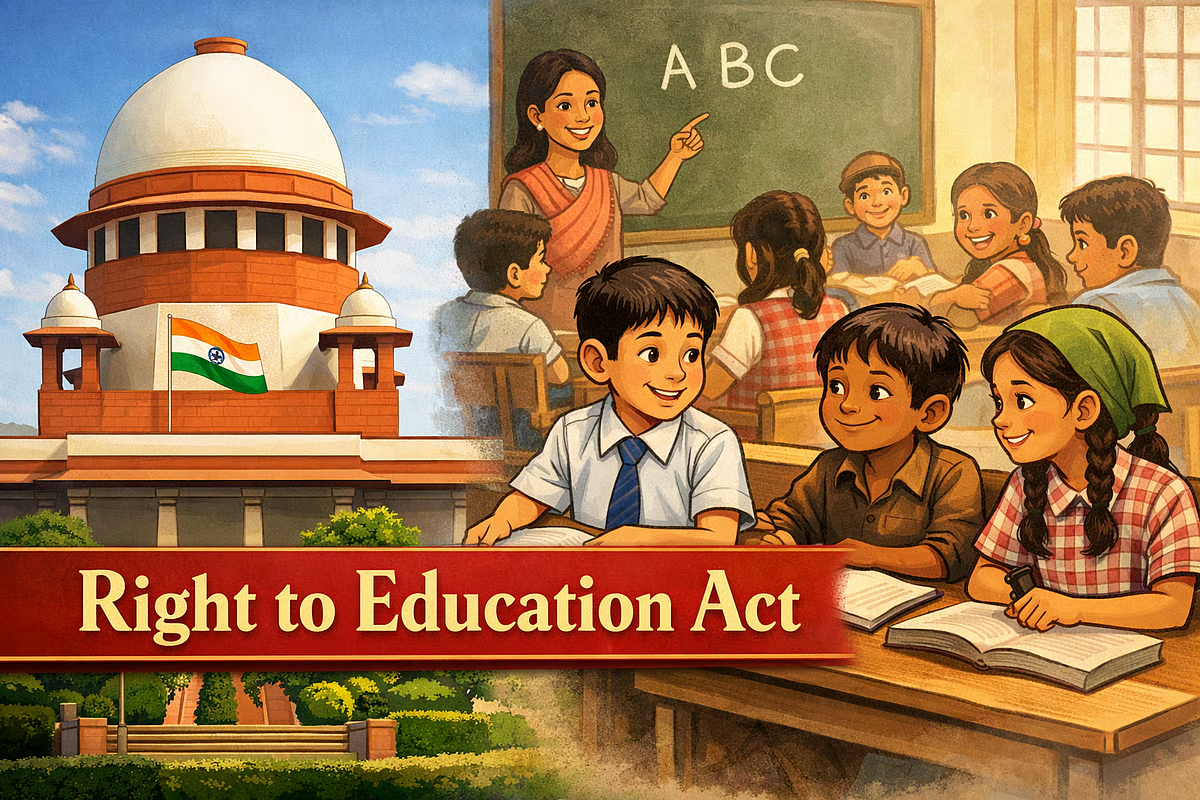
Article 21A: Right to Education
Article 21A makes education a Fundamental Right.
The government must provide:
- Free education
- Compulsory education
to children between 6 and 14 years of age.
This article was added by the 86th Constitutional Amendment Act, 2002.
Article 22: Protection Against Arrest and Detention
Article 22 protects people who are arrested.
A person has the right to:
- Know the reason for arrest.
- Consult a lawyer.
- Be produced before a magistrate within 24 hours.
- Avoid illegal detention.
The Constitution also allows preventive detention under certain conditions for national security and public safety. However, safeguards such as review by an advisory board and communication of the grounds of detention are provided to prevent misuse.
Frequently Asked Questions (FAQs)
1. What are Fundamental Rights?
Fundamental Rights are basic constitutional rights that protect the freedom, equality, and dignity of people in India.
2. How many Fundamental Rights are there in India?
There are six Fundamental Rights under Part III of the Constitution.
3. Which Articles deal with Fundamental Rights?
Fundamental Rights are covered under Articles 12 to 35 of the Constitution.
4. Which Fundamental Right was removed?
The Right to Property was removed as a Fundamental Right by the 44th Constitutional Amendment in 1978 and is now a legal right under Article 300A.
5. Which Article is called the Heart and Soul of the Constitution?
Article 32 is known as the “Heart and Soul of the Constitution” because it allows people to approach the Supreme Court when their Fundamental Rights are violated.
6. What are the six freedoms under Article 19?
They are freedom of speech and expression, peaceful assembly, forming associations, movement, residence, and profession.
7. Can Fundamental Rights be suspended?
Yes, some Fundamental Rights can be suspended during a National Emergency. However, Articles 20 and 21 cannot be suspended.
8. Which Fundamental Right provides free education?
Article 21A guarantees free and compulsory education for children aged 6 to 14 years.