


Ocean Currents: Types, Causes and Effects

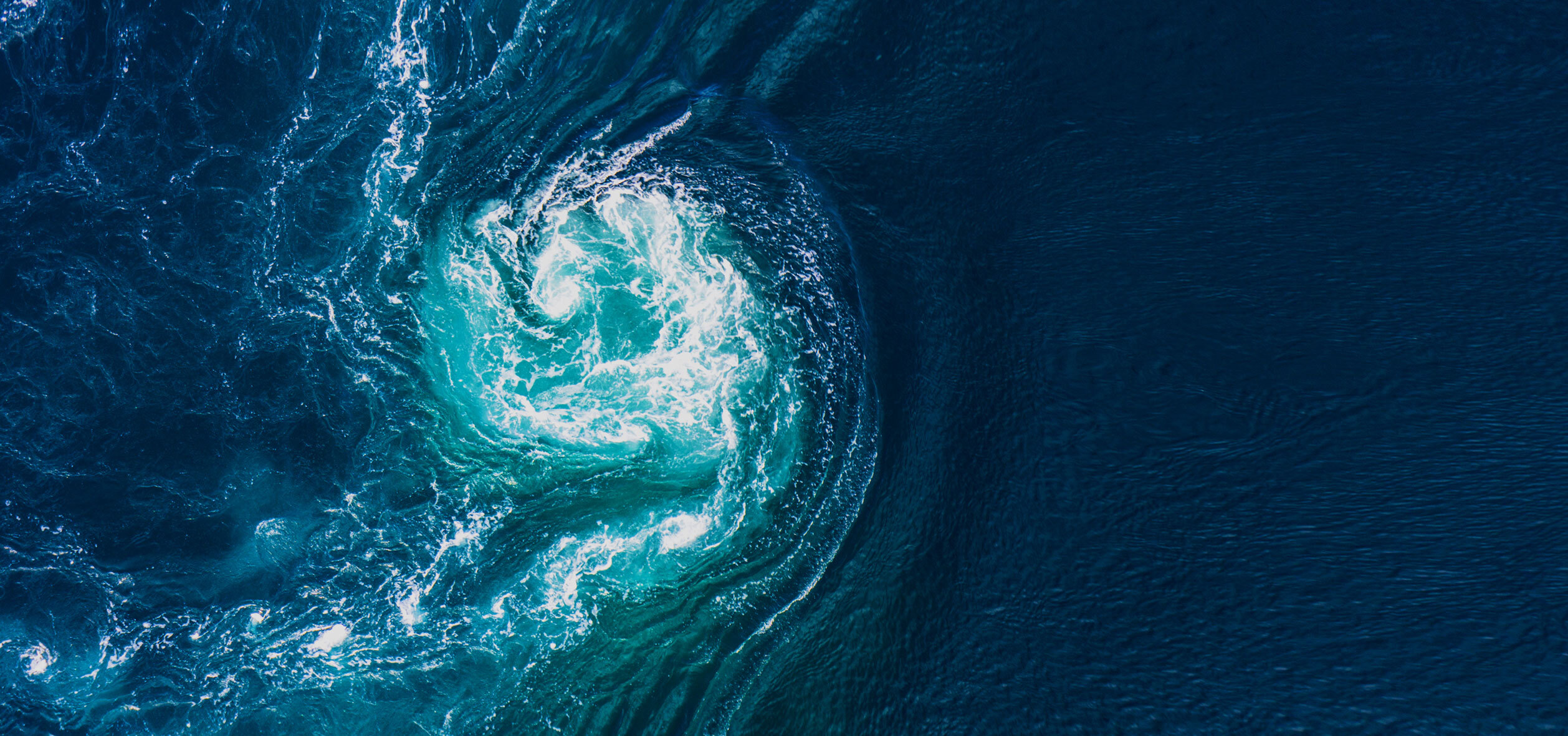
Ocean currents are the continuous movement of seawater in a fixed direction. They act like large rivers flowing inside the oceans and play a major role in shaping climate, weather, and marine life.
Thank you for reading this post, don't forget to subscribe!Ocean water moves in two ways: horizontal movement (currents) and vertical movement (upwelling and downwelling). These movements are controlled by different natural forces.
Ocean currents are very important for students preparing for geography, environment, and competitive exams because they connect oceans, climate, and human activities.
What are Ocean Currents?
Ocean currents are the steady and predictable flow of ocean water across the Earth. They are caused by wind, temperature differences, salinity, and Earth’s rotation.
These currents move huge amounts of water from one place to another. They help distribute heat, nutrients, and gases across the globe.
Ocean currents can be compared to rivers in the ocean because they follow fixed paths and directions.
Types of Ocean Currents
Ocean currents can be classified in different ways. The two main classifications are based on depth and temperature.
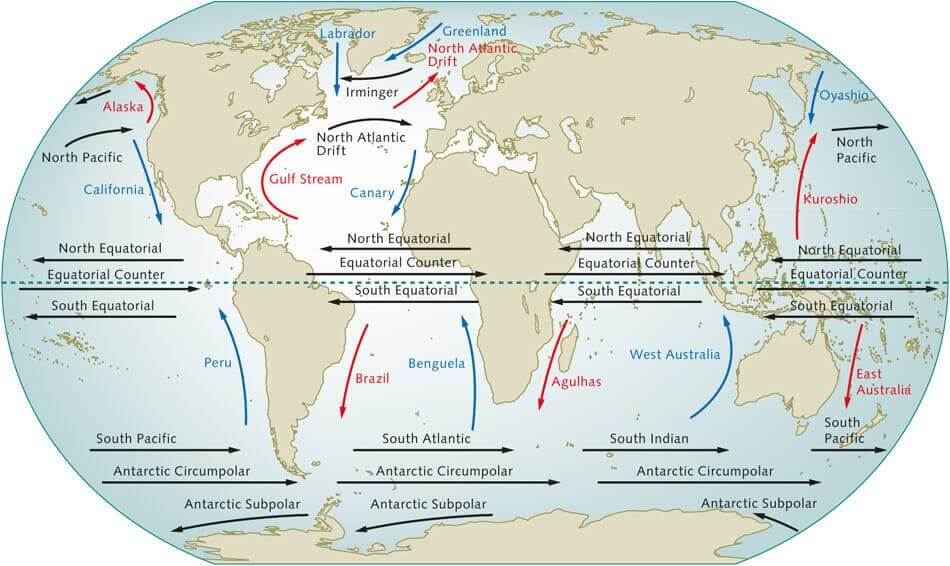
1. Based on Depth
Surface Currents
- Surface currents flow in the upper layer of the ocean, up to about 400 meters. They are mainly driven by winds and solar energy.
- These currents move warm water from the equator towards the poles. This helps in controlling global temperature.
- Examples include the Gulf Stream, Kuroshio Current, and Agulhas Current.
Deep Water Currents
- Deep ocean currents move below the surface and are controlled by density differences. These differences occur due to changes in temperature and salinity.
- Cold and dense water sinks near the poles and flows towards the equator. This creates a global circulation system called the thermohaline circulation.
- Examples include North Atlantic Deep Water and Antarctic Bottom Water.
2. Based on Temperature
Warm Currents
- Warm currents carry warm water from tropical regions to colder areas. They usually flow along the eastern coasts of continents.
- These currents increase the temperature of coastal regions and bring rainfall. They make climates milder and more comfortable.
- Examples include the Gulf Stream and Antilles Current.
Cold Currents
- Cold currents carry cold water from polar regions to warmer areas. They are mostly found along western coasts of continents.
- These currents cool nearby land areas and reduce rainfall. They often create dry and desert-like conditions.
- Examples include the California Current and Oyashio Current.
Factors Responsible for Ocean Currents
Ocean currents are formed due to several forces. These forces can be divided into primary and secondary factors.
Primary Forces
1. Insolation (Sun’s Heat)
The sun heats the Earth unevenly, causing differences in water temperature. Warm water expands and creates slight height differences in ocean levels.
This leads to movement of water from high level to low level areas.
2. Wind (Atmospheric Circulation)
Winds push the surface water of oceans and create currents. The direction of currents usually follows the direction of wind.
For example, monsoon winds in the Indian Ocean change the direction of currents seasonally.
3. Gravity
Gravity pulls water downward and helps maintain the flow of currents. It also influences tides and overall water movement.
4. Coriolis Effect
Due to Earth’s rotation, moving water gets deflected. In the Northern Hemisphere, it moves to the right, and in the Southern Hemisphere, to the left.
This creates circular patterns of currents known as gyres.
Secondary Forces
1. Temperature Differences
Cold water is denser than warm water. So, it sinks and moves below the surface.
Warm water rises and moves along the surface, creating circulation.
2. Salinity Differences
Water with higher salt content is heavier and sinks. Lower salinity water rises.
This difference creates vertical currents and deep ocean circulation.
Key Characteristics of Ocean Currents
Ocean currents have some common features that help us understand their behavior.
Direction of Movement
In the Northern Hemisphere, currents move in a clockwise direction. In the Southern Hemisphere, they move anticlockwise.
However, the Indian Ocean shows seasonal reversal due to monsoon winds.
Movement of Warm and Cold Currents
Warm currents move towards colder regions, while cold currents move towards warmer regions.
This exchange helps balance the Earth’s temperature.
Convergence and Divergence
Convergence happens when two currents meet. This creates nutrient-rich zones.
Divergence occurs when currents split and move in different directions, spreading heat and nutrients.
Coastal Influence
Coastlines affect the direction of currents. Land barriers can change their path and speed.
This is why currents behave differently near continents.
Subsurface Currents
Not all currents flow on the surface. Some move deep inside oceans due to density differences.
These hidden currents are very important for global water circulation.
Impact of Ocean Currents
Ocean currents have a strong impact on climate, environment, and human activities.
1. Climate Control
Ocean currents help distribute heat from the equator to the poles. This keeps the Earth’s temperature balanced.
Warm currents make regions warmer, while cold currents cool them down.
2. Desert Formation
Cold currents reduce moisture in the air. This leads to dry conditions and desert formation.
For example, the Humboldt Current helps form the Atacama Desert.
3. Rainfall Patterns
Warm currents increase evaporation and bring rainfall. Coastal regions near warm currents receive heavy rain.
Cold currents reduce rainfall and create dry climates.
4. Fishing Grounds
Areas where warm and cold currents meet are rich in nutrients. These areas support plankton growth.
Plankton attracts fish, making these regions ideal for fishing.
5. Fog and Drizzle
When warm and cold currents meet, fog forms. This affects visibility and weather conditions.
Such areas are often risky for ships due to low visibility.
6. Tropical Cyclones
Warm ocean water provides energy for cyclones. Regions with warm currents are more prone to storms.
The Indian and Atlantic Oceans are highly affected by this.
7. Navigation
Ocean currents help ships travel faster and save fuel. Sailors use currents to plan routes.
Understanding currents is very important for global trade and shipping.
Major Ocean Currents of the World

Pacific Ocean Currents
- Antarctic Circumpolar Current (ACC)
Also called West Wind Drift, it flows around Antarctica from west to east. It connects the Atlantic, Pacific, and Indian Oceans.
It carries cold water and is the largest ocean current on Earth. It plays an important role in global circulation. - Humboldt (Peruvian) Current
This cold current flows along the west coast of South America from Chile to Peru. It is low in salinity and rich in nutrients.
It supports one of the world’s richest fishing zones due to strong marine ecosystems. - California Current
This is a cold current flowing southward along the west coast of North America. It is part of the North Pacific Gyre.
It creates strong upwelling, bringing nutrients to the surface and supporting marine life. - Kuroshio Current
Also known as the Japan Current or Black Current, it is a warm current. It flows along Japan’s coast.
It increases temperature in nearby areas and helps regulate Japan’s climate. - North Pacific Current
It is formed by the meeting of Kuroshio and Oyashio currents. It flows eastward across the North Pacific Ocean.
It helps in distributing heat and nutrients across the ocean. - Alaskan Current
This current flows northward along the coast of Alaska. It is a branch of the North Pacific circulation.
It helps maintain relatively warmer conditions in coastal Alaska. - East Australian Current
This warm current flows along the east coast of Australia. It carries tropical marine life to cooler regions.
It plays an important role in marine biodiversity and climate regulation. - Oyashio (Kurile) Current
This is a cold, nutrient-rich current coming from the Arctic region. It flows southward via the Bering Sea.
It meets the Kuroshio Current and forms rich fishing grounds.
Atlantic Ocean Currents
- Canary Current
This is a cold current flowing along the northwest coast of Africa. It has low salinity and cooling effects.
It influences climate and contributes to dry conditions in nearby regions. - Benguela Current
This cold current flows along the southwest coast of Africa. It is part of the South Atlantic Gyre.
It is rich in nutrients and supports excellent fishing zones due to upwelling. - Falkland (Malvinas) Current
This is a cold current flowing along the southeastern coast of South America. It originates from Antarctic waters.
It meets the warm Brazil Current and creates a temperate climate zone. - Florida Current
This current flows from the Gulf of Mexico along Florida’s coast. It is a strong and warm current.
It later becomes part of the Gulf Stream system in the North Atlantic. - Gulf Stream
This is a major warm current flowing from the Gulf of Mexico towards Europe. It is driven mainly by winds.
It makes Western Europe warmer and splits into different branches like North Atlantic Drift. - Norwegian Current
This current flows towards the Arctic region. It is a continuation of the North Atlantic Drift.
It brings warm water and helps keep northern Europe relatively mild. - Brazilian Current
This warm current flows along the coast of Brazil in the South Atlantic Ocean.
It meets the cold Falkland Current and creates a balanced climate in the region. - Labrador Current
This is a cold current flowing from the Arctic towards the south.
It meets the warm Gulf Stream and forms one of the richest fishing grounds.
Indian Ocean Currents
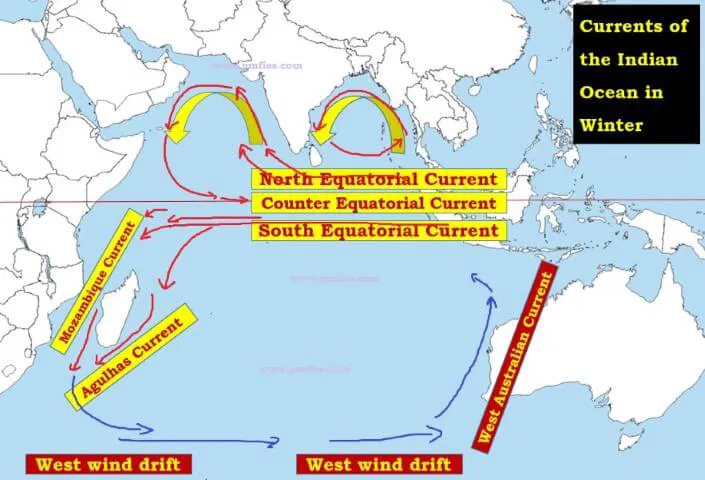
- Northeast Monsoon Current
This current flows southwest and west across the equator during winter monsoon.
It is influenced by seasonal wind patterns in the Indian Ocean. - Somali Current
This current flows along the coast of East Africa and changes direction with monsoon winds.
It creates strong upwelling and supports marine productivity. - Western Australian Current
This is a cold current flowing along the west coast of Australia. It is part of the Antarctic circulation.
It is seasonal, being stronger in summer and weaker in winter. - Mozambique Current
This is a warm current flowing in the Mozambique Channel between Madagascar and Africa.
It connects with the Agulhas Current and supports heat transfer. - Agulhas Current
This is a strong warm current flowing along the southeast coast of Africa.
It is one of the fastest ocean currents and plays a key role in ocean circulation. - Southwest Monsoon Current
This current flows eastward during the southwest monsoon season.
It spreads across the Arabian Sea and Bay of Bengal.
Equatorial Current System
- North and South Equatorial Currents
These currents flow from east to west in all major oceans. They are driven by trade winds.
They cover large ocean areas and are important for global water movement. - Equatorial Counter Current
This current flows from west to east between the equatorial currents.
It balances the water movement and helps maintain ocean circulation.
Conclusion
Ocean currents are one of the most important parts of physical geography. They control climate, support marine life, and influence human activities like fishing and navigation.
Understanding ocean currents helps us understand global climate systems and environmental changes. They are also very important for competitive exams and real-world applications.
FAQs
1. What are ocean currents?
Ocean currents are the continuous movement of seawater in a fixed direction. They act like rivers in the ocean and help in heat distribution.
2. What are the main types of ocean currents?
Ocean currents are mainly of two types: surface currents and deep water currents. They are also classified as warm and cold currents.
3. What causes ocean currents?
Ocean currents are caused by wind, temperature differences, salinity, gravity, and the Coriolis effect due to Earth’s rotation.
4. Why are ocean currents important?
They help control climate, support fishing, influence rainfall, and assist in navigation. They are also important for marine ecosystems.
5. What is the difference between warm and cold currents?
Warm currents carry warm water to cold regions, while cold currents carry cold water to warmer regions. They affect climate differently.
6. How do ocean currents affect climate?
Ocean currents distribute heat across the Earth. Warm currents increase temperature, while cold currents lower it in coastal areas.