



Quasi Judicial Bodies: Meaning, Features, Powers, Importance and Challenges

Quasi Judicial Bodies are an important part of India’s administrative and legal system. These bodies help solve disputes quickly without following the lengthy process of regular courts. As the number of legal cases in India continues to grow, quasi judicial bodies play a major role in providing faster, cheaper, and specialized justice.
Thank you for reading this post, don't forget to subscribe!Although these bodies are not regular courts, they have powers similar to courts in certain matters. They hear cases, examine evidence, pass judgments, and impose penalties within their area of authority. Their decisions can also be challenged in higher courts if required.
In recent years, quasi judicial bodies have become even more important because they deal with specialized areas such as taxation, consumer protection, environmental issues, elections, telecommunications, human rights, and information rights.
What are Quasi Judicial Bodies?
Quasi Judicial Bodies are organizations that have some powers similar to courts of law. They are created by Parliament or state legislatures to solve disputes in specific fields.
The word “quasi” means “almost” or “partly.” Therefore, a quasi judicial body is not a full court but performs several judicial functions.
These bodies hear complaints, collect evidence, examine witnesses, interpret laws, and deliver decisions within their assigned jurisdiction.
Unlike civil or criminal courts, they deal only with matters related to their specialized field.
Why are Quasi Judicial Bodies Needed?
India has one of the largest judicial systems in the world. However, regular courts face a huge backlog of pending cases.
Quasi judicial bodies help by:
- Reducing the burden on courts.
- Providing faster justice.
- Using subject experts for decision-making.
- Offering low-cost dispute resolution.
- Making justice more accessible to ordinary citizens.
Without these institutions, many technical disputes would remain unresolved for years.
Main Features of Quasi Judicial Bodies
1. Specialized Jurisdiction
Every quasi judicial body deals with a particular subject.
For example:
- Consumer disputes
- Tax matters
- Environmental protection
- Election disputes
- Human rights
- Telecom disputes
2. Court-like Powers
Although they are not regular courts, these bodies can:
- Conduct hearings
- Summon witnesses
- Ask for documents
- Examine evidence
- Pass legally valid orders
3. Expert Members
Instead of only judges, these bodies often include experts from fields such as:
- Law
- Economics
- Finance
- Environment
- Technology
- Administration
This helps them understand technical issues better.
4. Faster Decision Making
Their procedures are simpler than ordinary courts.
This allows disputes to be resolved more quickly.
5. Less Expensive
The cost of approaching these bodies is generally much lower than filing cases in traditional courts.
6. Judicial Review
Their decisions are not final in every situation.
Higher courts such as High Courts and the Supreme Court can review their decisions if required.
Powers of Quasi Judicial Bodies
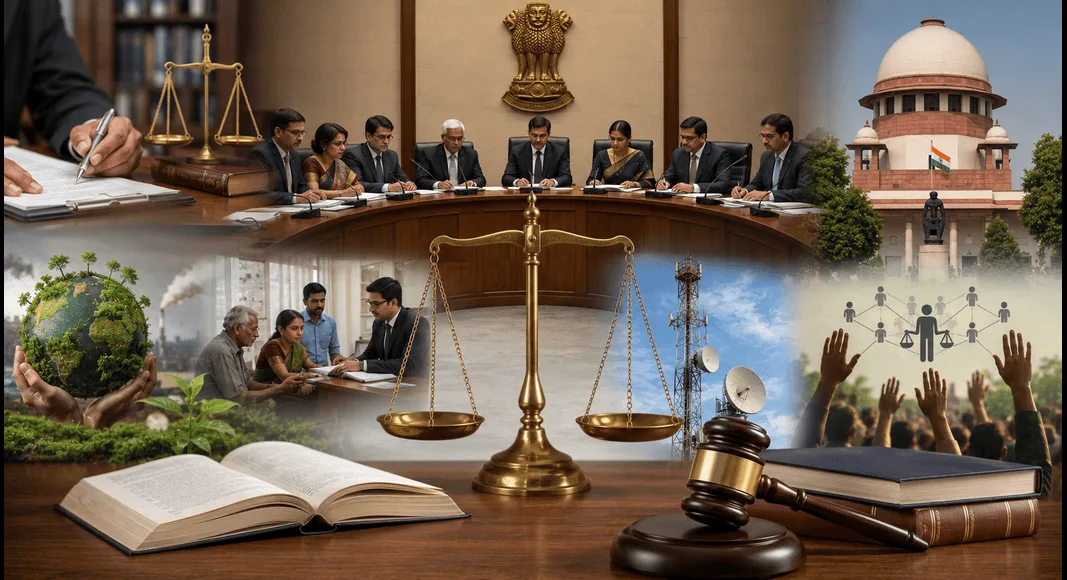
Quasi judicial bodies have several important powers within their area of jurisdiction.
Conduct Hearings
They hear both parties before giving any decision.
Examine Evidence
They study documents, records, reports, and witness statements.
Determine Facts
They decide what actually happened after examining all available evidence.
Apply Existing Laws
Instead of creating new laws, they interpret and apply existing laws to specific cases.
Pass Orders
They can direct individuals, companies, or government agencies to take certain actions.
Impose Penalties
Many quasi judicial bodies have the authority to impose fines, compensation, or other penalties for violations.
Enforce Decisions
Their orders are legally binding and must be followed unless overturned by a higher court.
Importance of Quasi Judicial Bodies
Speedy Justice
One of their biggest advantages is quick disposal of cases.
Specialized procedures reduce unnecessary delays.
Reducing Court Burden
Lakhs of cases are pending in Indian courts.
Quasi judicial bodies help reduce this burden by handling technical disputes separately.
Expert Decisions
Complex issues involving finance, taxation, environment, and technology require expert knowledge.
These bodies combine legal understanding with technical expertise.
Easy Access to Justice
Their procedures are simple and affordable.
Common people can approach them without facing complicated court procedures.
Better Governance
They improve transparency, accountability, and administrative efficiency by resolving disputes fairly.
Public Confidence
When disputes are resolved quickly and fairly, people develop greater trust in government institutions.
Major Quasi Judicial Bodies in India
1. Election Commission of India (ECI)
The Election Commission performs several quasi judicial functions.
Its important powers include:
- Settling disputes between rival groups of recognized political parties.
- Deciding election symbol disputes.
- Disqualifying candidates who fail to submit election expense reports according to law.
These powers help maintain fairness in the electoral system.
2. Income Tax Appellate Tribunal (ITAT)
The ITAT deals with disputes related to income tax.
Its functions include:
- Hearing appeals against tax authorities.
- Deciding disputes between taxpayers and the Income Tax Department.
- Ensuring fair interpretation of tax laws.
It plays an important role in India’s taxation system.
3. Telecom Disputes Settlement and Appellate Tribunal (TDSAT)
TDSAT resolves disputes involving:
- Telecom companies
- Service providers
- Government authorities
- Consumers
Its jurisdiction has also expanded to include broadcasting, airport tariff matters, and certain cyber-related issues.
4. National Human Rights Commission (NHRC)
The NHRC protects human rights in India.

Its powers include:
- Investigating human rights violations.
- Summoning witnesses.
- Calling for official records.
- Recommending compensation to victims.
- Suggesting action against guilty officials.
Although its recommendations are generally advisory, they carry significant importance.
5. Central Information Commission (CIC)
The CIC was established under the Right to Information Act, 2005.
It acts as the highest appellate authority for RTI-related complaints.
Its objectives include:
- Promoting transparency.
- Ensuring citizens receive information.
- Holding public authorities accountable.
6. Consumer Commissions
Consumer commissions help protect consumer rights.
They hear complaints regarding:
- Defective products
- Poor services
- Unfair trade practices
- Excessive pricing
Consumers receive quick and affordable justice through these commissions.
7. National Green Tribunal (NGT)
The National Green Tribunal specializes in environmental disputes.
It deals with:
- Pollution
- Forest conservation
- Environmental compensation
- Protection of natural resources
The NGT has significantly improved environmental governance in India.
Difference Between Judicial and Quasi Judicial Bodies
Although both aim to deliver justice, they differ in several ways.
| Judicial Bodies | Quasi Judicial Bodies |
|---|---|
| Regular courts established under the Constitution | Specialized tribunals or authorities |
| Independent from the executive | Greater administrative control |
| Hear civil and criminal cases | Hear only specific subject-related disputes |
| Judges conduct proceedings | Experts and judicial members conduct proceedings |
| Can create legal precedents | Apply existing laws only |
| More formal procedures | Simpler and flexible procedures |
| Usually take more time | Faster disposal of cases |
Challenges Faced by Quasi Judicial Bodies
Despite their importance, these institutions face several problems.
Shortage of Staff
Many tribunals have vacant positions.
Lack of members causes delays in hearing cases.
Large Number of Pending Cases
As awareness increases, more people approach these bodies.
Some tribunals now face heavy workloads.
Frequent Appeals
Many decisions are challenged before High Courts and the Supreme Court.
This sometimes delays final justice.
Lack of Uniform Procedures
Different tribunals follow different procedures.
This creates inconsistency in decision-making.
Infrastructure Problems
Several quasi judicial bodies lack proper offices, digital systems, and modern facilities.
Political or Administrative Influence
Since many members are appointed by the government, concerns are sometimes raised about their independence.
False Complaints
Easy access encourages some people to file baseless or unnecessary cases.
This wastes valuable time and resources.
Government Initiatives to Improve Quasi Judicial Bodies
The government has introduced several reforms over the years.
Some important initiatives include:
- Digital filing of cases.
- Online hearings using video conferencing.
- Better case management systems.
- Appointment of additional members.
- Tribunal reforms for improving efficiency.
- Simplification of procedures.
- Greater transparency through technology.
These reforms aim to provide faster and more effective justice.
Way Forward
Several steps can further strengthen quasi judicial bodies.
- Fill vacant posts quickly.
- Recruit more qualified experts.
- Improve digital infrastructure.
- Standardize procedures across tribunals.
- Introduce strict penalties for false complaints.
- Strengthen coordination among different tribunals.
- Increase public awareness about their functions.
- Ensure greater independence in appointments.
- Conduct regular performance reviews.
- Promote online dispute resolution wherever possible.
These measures can improve both efficiency and public confidence.
Conclusion
Quasi Judicial Bodies have become an essential part of India’s justice delivery system. They bridge the gap between administrative agencies and regular courts by providing specialized, affordable, and speedy justice. These institutions help reduce the burden on the judiciary while ensuring that technical disputes are handled by experts.
Bodies such as the Election Commission of India, Income Tax Appellate Tribunal, National Green Tribunal, National Human Rights Commission, Telecom Disputes Settlement and Appellate Tribunal, and Central Information Commission have greatly improved governance and protected the rights of citizens.
However, challenges such as staff shortages, infrastructure gaps, delayed appointments, and inconsistent procedures still affect their efficiency. Strengthening these institutions through reforms, better staffing, digital technology, and greater independence will make them more effective. As India continues to modernize its legal and administrative systems, quasi judicial bodies will play an even greater role in ensuring justice, accountability, transparency, and good governance.
FAQs
1. What are Quasi Judicial Bodies?
Quasi Judicial Bodies are authorities that have powers similar to courts and resolve disputes in specific areas such as taxation, environment, elections, and consumer rights.
2. Why are Quasi Judicial Bodies important?
They provide faster, affordable, and expert-based justice while reducing the burden on regular courts.
3. Are Quasi Judicial Bodies the same as courts?
No. They are not regular courts but have limited judicial powers to decide cases within their specific jurisdiction.
4. Can the decisions of Quasi Judicial Bodies be challenged?
Yes. Their decisions can usually be challenged before High Courts or the Supreme Court through judicial review.
5. What powers do Quasi Judicial Bodies have?
They can conduct hearings, examine evidence, summon witnesses, issue orders, impose penalties, and enforce their decisions.
6. Name some important Quasi Judicial Bodies in India.
Some major examples are the Election Commission of India (ECI), Income Tax Appellate Tribunal (ITAT), National Green Tribunal (NGT), National Human Rights Commission (NHRC), Central Information Commission (CIC), and Telecom Disputes Settlement & Appellate Tribunal (TDSAT).
7. How do Quasi Judicial Bodies reduce the burden on courts?
They handle specialized disputes separately, allowing regular courts to focus on civil and criminal cases.
8. What is the difference between judicial and quasi judicial bodies?
Judicial bodies are regular courts with broad jurisdiction, while quasi judicial bodies deal only with specific subjects and follow comparatively simpler procedures.
9. What are the major challenges faced by Quasi Judicial Bodies?
They face staff shortages, case backlogs, lack of uniform procedures, infrastructure issues, and frequent appeals in higher courts.
10. Which competitive exams include questions on Quasi Judicial Bodies?
This topic is important for UPSC, State PSC, SSC, Banking, UGC NET, Judiciary, and other government examinations.