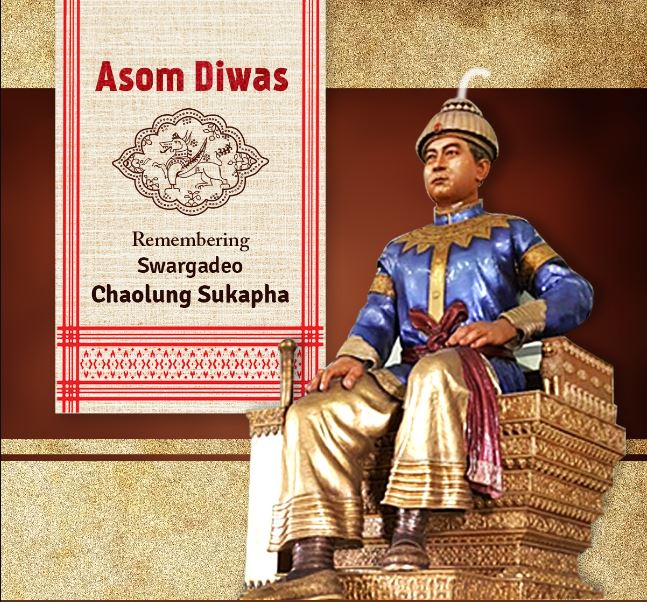
Asom Divas, or Assam Day: Celebrating the Legacy of Sukaphaa and the Ahom Kingdom

Asom Divas, or Assam Day, is a special day for the people of Assam, celebrated every year on December 2. This day commemorates the arrival of Sukaphaa, the first Ahom king, into the Brahmaputra valley and the establishment of the Ahom kingdom in 1228 CE. Sukaphaa, also known as Siu-Ka-Pha, was not just a conqueror but a visionary leader whose actions shaped the history, culture, and identity of Assam. His legacy is celebrated in Assam not only as a historical event but also as a symbol of unity, peace, and cultural integration.
Thank you for reading this post, don't forget to subscribe!The Early Life and Ancestry of Sukaphaa
Sukaphaa was born as a prince in the Tai state of Mong Mao, which is in present-day Dehong Dai and Jingpo Autonomous Prefecture, China. He belonged to the Su/Tsu (Tiger) clan of the Mao-Shan sub-tribe. His father, Chao Chang-Nyeu, was a prince from Mong-Ri Mong-Ram, and his mother, Nang-Mong Blak-Kham-Sen, was the daughter of a local chief. According to Ahom tradition, Sukaphaa was a descendant of the divine god Khunlung, who ruled Mong-Ri-Mong-Ram. His ancestry was considered noble and even divine. Legend says he brought with him sacred items like a diamond, a divine tusked elephant, a divine chicken, a pair of drums, an embroidered cloth, and a divine sword called Hengdan. These items symbolized his royal authority and divine mission.
Sukaphaa’s early life was spent under the guidance of his maternal grandparents, and he was nominated to succeed the ruler of Mong Mao. However, a late-born son in the royal family ended Sukaphaa’s claim to the throne. Following the advice of his grandmother “no two tigers live in the same jungle, no two kings sit on the same throne” Sukaphaa decided to leave Mong Mao in 1215 CE to seek new lands where he could establish his own kingdom.
Journey from Mong Mao to Assam
Sukaphaa’s journey into Assam was long and challenging, spanning over a decade. He was accompanied by three queens, two sons, a daughter, chiefs from five other dependent Mongs, priests, soldiers, and several commoners, totaling around 9,000 people. His caravan included 300 horses and two elephants, and heavy arms were transported separately. Sukaphaa followed a known route from Yunnan to Assam, passing through Myitkyina, Mogaung, and the upper Irrawaddy River valley.
In 1227, he reached Nangyang lake and subdued the local Naga tribes, establishing a small settlement called a Mong. After leaving a representative to guard the passage, he crossed the Patkai hills at Pangsau Pass and finally reached Namrup in the Brahmaputra valley in December 1228. This year is considered the foundation year of the Ahom kingdom.
Sukaphaa in Assam: A Leader of Integration
Unlike many conquerors, Sukaphaa did not enter Assam with the intention of raiding or dominating the local people. He came with a vision to establish a society based on agriculture, cooperation, and integration. He adopted a diplomatic approach, inviting local tribes to join him and building relationships based on mutual respect. He learned the local languages, honored their religious practices, married local women, and lived a simple life as a cultivator alongside the people.
Through this approach, Sukaphaa successfully integrated the diverse ethnic groups of Assam into his kingdom. This process, later called Ahomisation, involved locals adopting Ahom methods of wet rice cultivation, administrative practices, and social structures. In return, they were accepted as part of the Ahom community, creating a culturally unified society in the Brahmaputra valley.
Sukaphaa encouraged marriages between his soldiers and local women, fostering bonds of kinship and friendship. This helped in building trust and loyalty, and strengthened the social fabric of the emerging Ahom kingdom. The local Borahi and Moran people referred to his followers as “Ha-Cham,” which eventually developed into the words “Ahom” and “Assam.”
Establishment of the Ahom Kingdom
Over the years, Sukaphaa moved through different regions of Assam, leaving representatives in each place to govern newly settled areas. His journey included establishing provinces along rivers and fertile plains, which were suitable for rice cultivation. Some key settlements included Lakhen Telsa, Tipam, Mungklang (Abhoipur), Habung (Dhemaji), Ligirigaon (Song-Tak), and Simaluguri (Tun Nyeu).
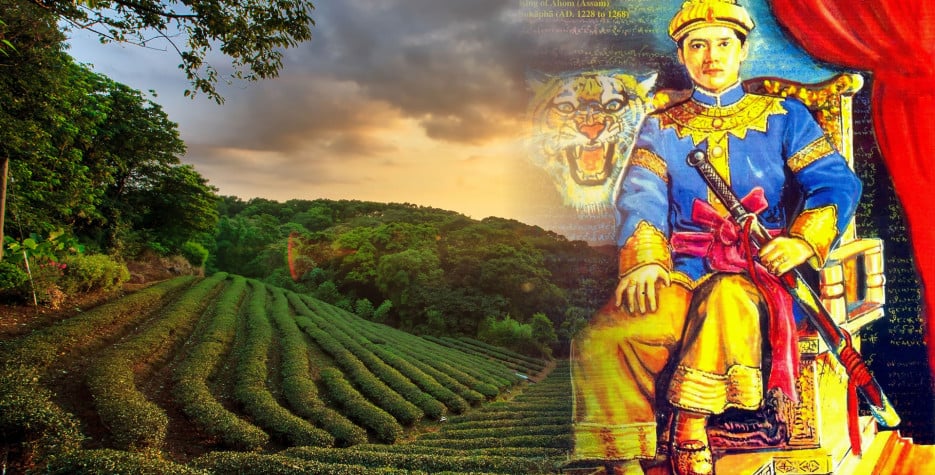
In 1253, Sukaphaa established his capital at Charaideo near present-day Sibsagar. Although the capital of the Ahom kingdom changed over time, Charaideo remained the symbolic heart of Ahom power. The kingdom prospered under Sukaphaa’s leadership, expanding gradually with new settlements and integrating various local tribes.
To ensure food security and economic stability, Sukaphaa established three large farms for sali rice cultivation, called Barakhowakhat, Engerakhat, and Gachikalakhat. These initiatives laid the foundation for the agricultural prosperity of the region, a tradition that continued under subsequent Ahom kings.
Death and Legacy of Sukaphaa
Sukaphaa passed away in 1268 CE. At the time of his death, his kingdom was bounded by the Brahmaputra River in the west, the Disang River in the north, the Dikhow River in the south, and the Naga Hills in the east. His death marked the end of an era but the beginning of a lasting legacy. The Ahom kingdom he established endured for nearly six centuries, leaving a profound impact on the cultural, political, and social life of Assam.
Sukaphaa’s policies of integration, diplomacy, and peaceful coexistence ensured that Assam remained a land of cultural harmony and ethnic unity. He was revered not only as a king but also as a visionary leader who respected local traditions and encouraged collaboration among different communities.
Celebrating Asom Divas, or Assam Day
Since 1996, December 2 has been celebrated as Sukaphaa Divas, or Asom Divas (Assam Day), to honor the arrival of Sukaphaa in Assam and the foundation of the Ahom kingdom. On this day, the state government awards prominent personalities who have contributed to the development and unity of Assam. The day is marked with cultural programs, seminars, and events that celebrate the history and heritage of the state.
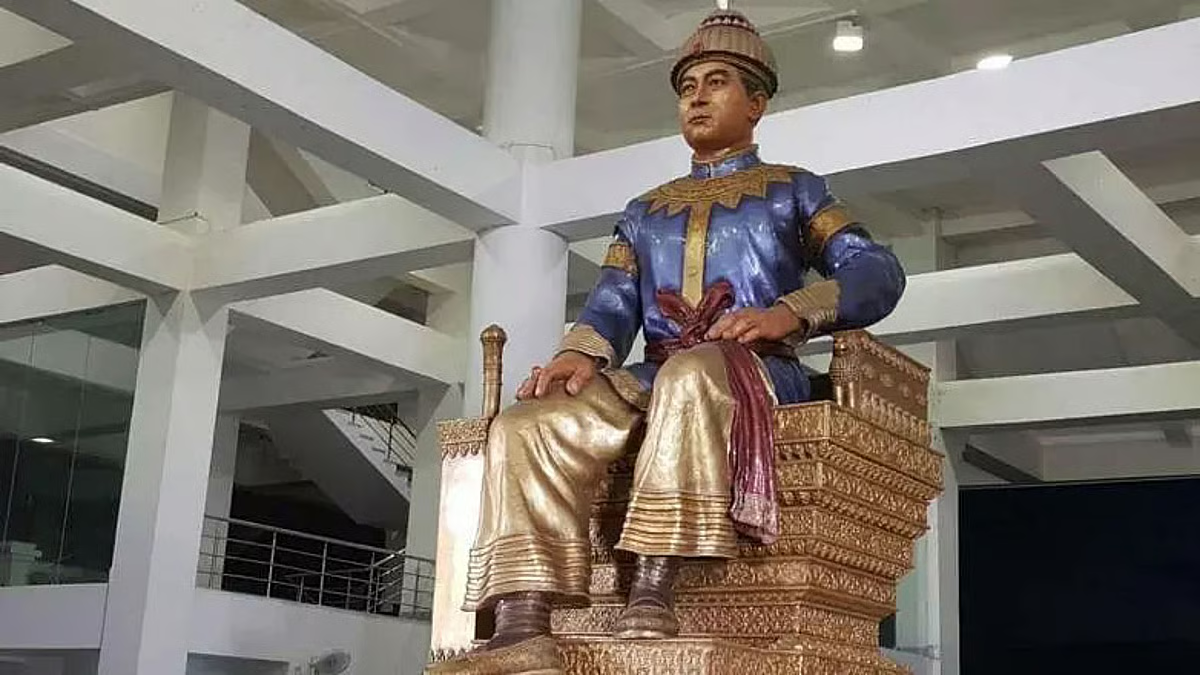
Several monuments and memorials in Assam pay tribute to Sukaphaa’s life and achievements. The Su-Ka-Pha Samanway Kshetra in Jorhat was inaugurated on December 2, 2015, as a center for commemorating his contributions. In February 2021, a 100-feet-long statue of Chaolung Siu Ka Pha was unveiled in Nazira, symbolizing his towering presence in Assam’s history, though it stirred controversy for its unusual facial design. Other memorials include Sukaphaa Bhawan at Khanapara, Guwahati, and at Borbaruah, Dibrugarh. The RV Sukapha, a cruise on the Brahmaputra, has been named in his honor, reflecting his enduring connection with the river valley he once ruled.
Sukaphaa’s Enduring Influence on Assam
The influence of Sukaphaa on Assam extends far beyond political history. His introduction of wet rice cultivation, statecraft, and integration policies shaped the economic, social, and cultural development of the region. The Ahom kingdom became a model of governance that balanced the authority of the monarchy with the inclusion of local communities.

His approach to leadership emphasized respect for diversity, which remains a core value in Assam today. By treating locals as friends and partners rather than subjects, Sukaphaa fostered a sense of belonging and unity that is remembered and celebrated on Asom Divas.
The Ahom kingdom, founded by Sukaphaa, survived for nearly 600 years, successfully resisting invasions and maintaining political stability in the region. The administrative and cultural systems he introduced were adapted and refined by successive kings, ensuring the survival and prosperity of Assam throughout the medieval period.
Conclusion
Asom Divas, or Assam Day, is not just a celebration of history but a tribute to the spirit of unity, cultural harmony, and visionary leadership exemplified by Sukaphaa. From his early life in Mong Mao to the establishment of the Ahom kingdom in Assam, Sukaphaa’s journey reflects resilience, diplomacy, and foresight. His ability to integrate diverse communities and cultivate a prosperous society laid the foundation of modern Assam.
Every year, on December 2, people of Assam remember Sukaphaa’s contributions, celebrate the state’s rich cultural heritage, and reaffirm their commitment to unity and progress. Asom Divas serves as a reminder that leadership, respect for diversity, and a spirit of cooperation can transform societies and leave a lasting legacy for future generations.
FAQs (Frequently Asked Questions)
Q1: What is Asom Divas or Assam Day?
A: Asom Divas, or Assam Day, is celebrated on December 2 every year to commemorate the arrival of Sukaphaa, the first Ahom king, in Assam and the establishment of the Ahom kingdom.
Q2: Who was Sukaphaa?
A: Sukaphaa, also known as Siu-Ka-Pha, was the first Ahom king who founded the Ahom kingdom in Assam in 1228 CE. He was a prince from Mong Mao in present-day China.
Q3: When did Sukaphaa arrive in Assam?
A: Sukaphaa arrived in Assam in December 1228 CE after a long journey from Mong Mao across the Patkai Hills.
Q4: What was Sukaphaa’s approach to ruling Assam?
A: Sukaphaa integrated local tribes peacefully, respected their culture, married locally, and promoted agriculture, especially wet rice cultivation. He treated locals as equals and built a harmonious society.
Q5: What is the significance of Charaideo in Assam history?
A: Charaideo, near present-day Sibsagar, was the capital city established by Sukaphaa and remained the symbolic center of the Ahom kingdom. It also houses the famous Ahom Maidams (royal burial mounds).
Q6: How is Asom Divas celebrated today?
A: The day is celebrated with cultural programs, awards by the state government, exhibitions, seminars, and remembrance of Sukaphaa’s legacy and the history of the Ahom kingdom.
Q7: What is Su-Ka-Pha Samanway Kshetra?
A: Su-Ka-Pha Samanway Kshetra, located in Jorhat, Assam, is a memorial inaugurated in 2015 to honor Sukaphaa and his contributions to Assam.
Q8: Why is Sukaphaa important in Assam’s history?
A: Sukaphaa is considered the architect of Assam as he unified various ethnic groups, established governance, agriculture, and cultural integration that shaped Assam’s identity for centuries.