


The Mishing Tribe of Assam: A Vibrant Riverine Community

The Mishing Tribe of Assam, also known as the Miris, represents one of the most colorful and resilient indigenous groups in Northeast India. As the second largest scheduled tribe in the plains of Assam, the Mishing people have carved out a unique identity amidst the lush riverine landscapes of districts like Lakhimpur, Dibrugarh, Sibsagar, Jorhat, and Sonitpur. Despite centuries of integration with the broader Assamese society, the Mishing Tribe of Assam has preserved its traditional socio-cultural practices, blending ancient hill origins with adaptive plains living. This article delves deep into their history, lifestyle, economy, social structures, and evolving traditions, offering a window into a community that thrives on harmony with nature and communal bonds.
Thank you for reading this post, don't forget to subscribe!Origins and Migration: From Hills to Plains
The story of the Mishing Tribe of Assam begins in the misty hills of what is now Arunachal Pradesh, specifically the Abor, Miri, and Mishmi ranges. Originally a hill tribe, the Mishings migrated to the Assam plains before the Ahom kings’ reign, settling along the Brahmaputra and Subansiri rivers. The exact timeline and reasons for this migration remain subjects of scholarly debate, as the tribe lacks written historical records. Instead, their history is woven into oral legends and folk tales that paint vivid pictures of their past.
One such legend recounts the tale of Moying, a skilled wrestler from the Minyong clan, who married the beautiful Turi from Damra village after defeating rivals in a wrestling contest—a common custom to prove valor. Jealous youths from Damra plotted revenge, tricking Moying into a feast where they bound him, sealed him in a bamboo container, and cast him into a river. Heartbroken, Turi took her own life. This tragedy sparked retaliation from Moying’s village, leading to a cycle of violence. Outnumbered, the Moyings fled downstream, seeking refuge under the protection of Dine Mirem, a respected headman who blocked the pursuing Damras. Thus, the Moyings descended to the plains, establishing permanent settlements. Even today, the Mishing Tribe of Assam evokes their hill origins in nostalgic folk songs, like: “Adi Lokke Kang Kandak / Baggum Sinloode Okumso Kang Kandak / Brahmaputra Abude Einolemsine Diuryadeng / Ngke Mennam Oimebui,” which compares the beauty of hill woods and the Brahmaputra to a beloved’s charm.
Scholars link the Mishing Tribe of Assam to the Adi tribes of Arunachal Pradesh, including Minyongs, Pasis, and Padams, who share the worship of Donyi (Sun) and Polo (Moon) as principal deities. Both groups identify as descendants of “Awa Tani,” meaning “man,” and claim heavenly origins, descending via a golden ladder from Regi Regam (heaven). Another genealogical legend traces their lineage from primordial elements: from a liquid substance emerged herbs, then Dyuli, Lyut, Tyea, Yepe, and Pedo, branching into gods, birds, humans, and finally the Mishing (Kärsing) and non-Mishing (Kärtäng).
Historical accounts, such as those in B.C. Allen’s Assam District Gazetteers, suggest the Mishings accompanied the Chutiyas in conquering Lakhimpur, retreating to hills after Ahom defeats in the 16th century, and resettling under British rule. Oppression by Bor Abors, including theft and loot, is cited as a migration trigger. Today, the Adis call Mishings “Aying Birräng” (plains brothers), and vice versa as “Adi Birräng” (hill brothers), maintaining inter-tribal ties.
The term “Miri” is believed to derive from “Mirui,” a socio-religious cult among hill tribes, but the Mishings prefer “Mishing,” meaning “people of the water/river” (“Mi” for man, “shing” for water). This reflects their affinity for riverbank homes, despite annual floods and erosion. As per the 1971 census, their population was 259,551, projected to 416,493 by 1987. They belong to the Mongoloid group of the Tibeto-Burman family, characterized by yellow-brown skin, black straight hair, oblique eyes with epicanthic folds, broad faces, and scanty facial hair. Medium-statured and sturdy, the Mishing Tribe of Assam embodies simplicity, hospitality, and resilience shaped by their environment.
Lifestyle and Habitat: Riverine Adaptations
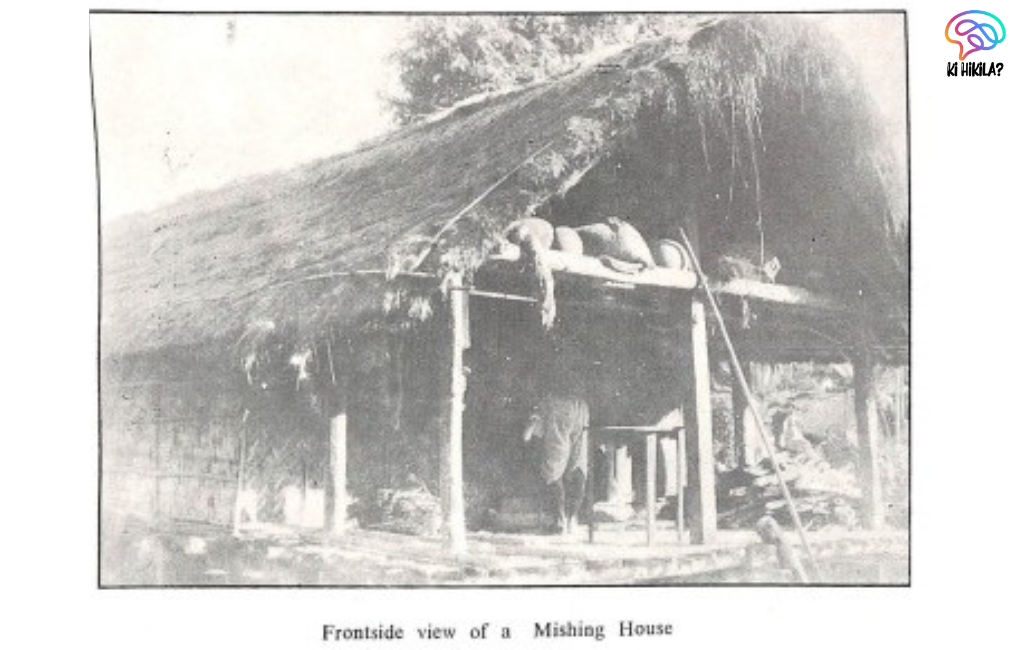
Living in flood-prone areas, the Mishing Tribe of Assam builds homes on raised bamboo platforms, about 5 feet high, to withstand inundation. A typical house spans 60 by 20 feet, housing 30-40 people in a single hall without partitions—extended families under one roof. Thatched roofs and bamboo walls provide ventilation, with east, south, or north-facing orientations for auspiciousness. Guests are entertained in a front portico, while looms for weaving are placed underneath. Pigs roam below the platform, cattle in adjacent sheds, and fowls in coops. Granaries are rare; paddy is stored indoors. The fireplace, “Merăm,” is sacred, used for cooking and offerings, off-limits to outsiders.
Central to village life is the “Morung,” a bachelors’ dormitory and community hall adorned with primitive wood carvings. It hosts festivals, assemblies, and dispute resolutions via the “Kebang” (village council). Though its role as a youth training center has diminished, it revives during events. In some villages, Vaishnavite “Namghars” have supplanted traditional functions.
Economy and Daily Life: Agriculture at the Core

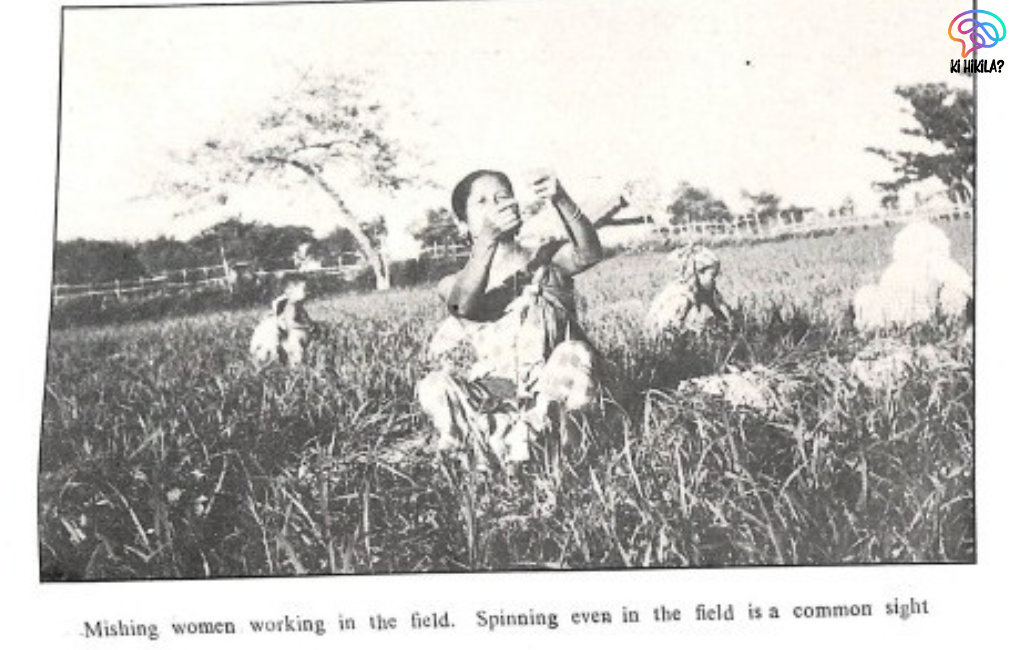
Agriculture sustains the Mishing Tribe of Assam, primarily subsistence-level Ahu paddy cultivation in marshy fields. Men plow and thresh, while women transplant and weed. Subsidiary crops include mustard, sweet potatoes, pulses, cotton, maize, and bananas. Religious rites mark the cycle: “Ali-Ai-Ligang” for sowing, “Sarag Puja” for protection, and “Dabur Puja” for post-harvest thanksgiving, honoring Kuber, the goddess of wealth.
Land is individually owned, with women contributing economically through pig and poultry rearing, funding clothes and ornaments. Hunting and fishing, once communal, are now individual pursuits. Weapons like spears, bows, and firearms target game, while bamboo traps and nets catch fish—now sold in markets, breaking old taboos.
Rice dominates diets, paired with local vegetables, fish, and meat. Pork and fowl are delicacies; preserved fish “Ngo San” honors guests. “Apong” (rice beer) is ubiquitous, brewed by women under purity rules, serving as both drink and food. Food taboos follow deaths or hunts.

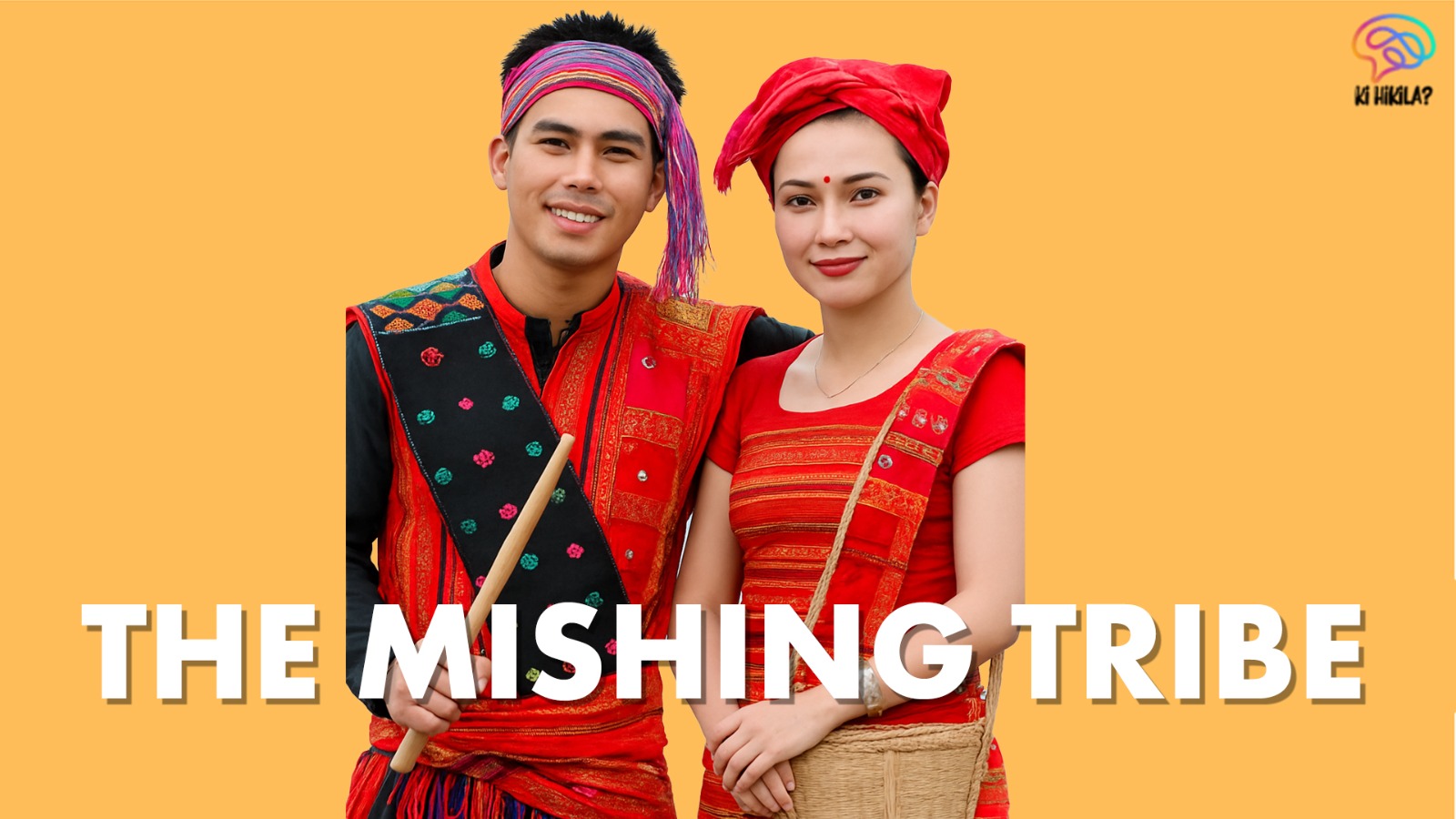
Women weave family attire: “Sumpă” skirts, “Galuk” breast cloths, and “Hurs” headdresses for females; men wear modern clothes with “Kaping” waistcloths. Festive garb includes colorful “Yambo,” “Riwi Gäseng,” “Ege” for women, and “Miboogáluk Tangali,” “Gonroo” for men.
Social Structure: Clans, Kinship, and Community
The Mishing Tribe of Assam divides into “Bärogam” and “Dahgam” sections, possibly from historical village administrations with 12 and 10 “Gams” (chiefs) respectively. Sub-clans like Moying, Chāyāng (Dahgam) and Doley, Kutum (Bärogam) prohibit intra-clan marriages, deriving names from nature or ancestors. Kinship is descriptive: “Abu” for father, “Näne” for mother, with terms like “Baboi” for multiple relations.

Families are extended, patrilineal, with sons inheriting equally. Daughters inherit only if no sons exist and they cover funeral costs. The “Kebang,” led by a non-hereditary “Gam,” adjudicates disputes, though panchayats have eroded its authority. Youth organizations “Yäme Mimbir,” led by “Dekä Borä” and “Tiri Bora,” foster cooperation in festivals and village development.
Marriages are formal (“Midang”) or informal (elopement “Duglälänäm” or kidnapping). Formal ones involve proposals, bridegroom visits with labor (“Magbo Ginlink”), and feasts with bride price (“Alig”). Informal types, often due to poverty, involve penalties but social acceptance.
Beliefs, Rites, and Festivals: Spiritual Harmony
Animistic beliefs dominate, with “Uie” spirits causing ills, appeased by “Mibu” priests through offerings. Spirits include ancestral “Urom,” weather “Täleng,” calamity “Dabur,” and benevolent “Gumin.” Increasingly, the Mishing Tribe of Assam embraces Hinduism, particularly Vaishnavite “Bhakatia” cult blending tantrism—reciting scriptures alongside meat and beer offerings.
Burials use log coffins in common grounds, followed by purifications: “Tilani” (third day), “Mähekia” (month), and “Daha” (year) with feasts.
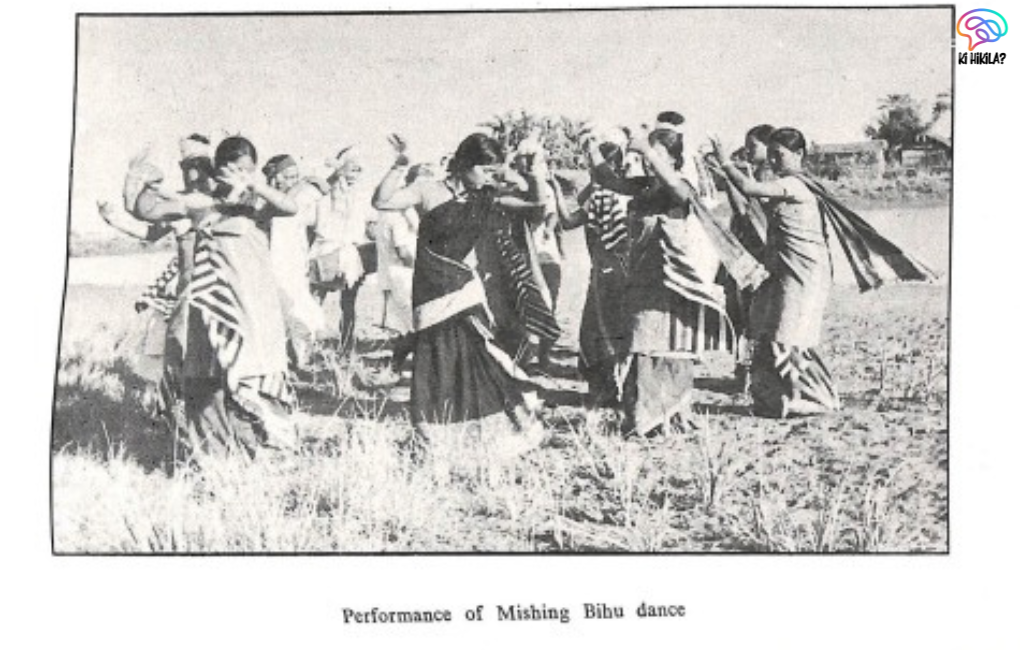
Festivals like “Ali-Ai-Ligang” (sowing, with dances and “Gumrak” troupes), “Porag” (harvest, with prayers and feasts), and “Amrok” (ancestor offerings) feature “Apong,” pork, and rhythmic dances to drums and flutes.
Modern Changes: Adaptation and Challenges
The Mishing Tribe of Assam is evolving: Vaishnavism influences religion, education yields professionals, and modern medicine coexists with traditional cures. Yet, floods, poverty, and external influences challenge traditions. Schools teach Mishing language, but dropouts persist. Welfare schemes often bypass the needy due to middlemen.
In conclusion, the Mishing Tribe of Assam embodies resilience, cultural richness, and communal spirit. As they navigate modernity, their riverine heritage remains a beacon of Northeast India’s diversity, inviting deeper appreciation and support for their preservation.