Important Facts About Members of Rajya Sabha You Should Know

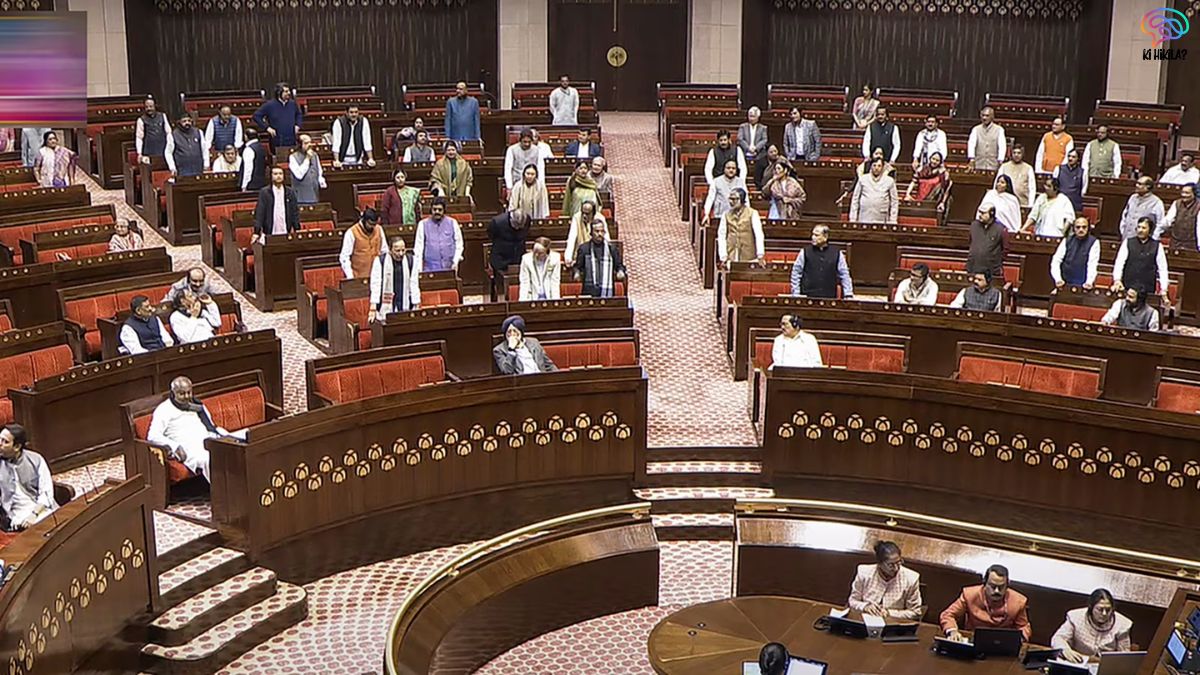
Did you know that India’s Rajya Sabha can have up to 250 members, but at present it has only 245? The Upper House of Parliament plays a very important role in making laws and protecting the federal structure of our country.
Thank you for reading this post, don't forget to subscribe!When you are preparing for competitive exams, understanding the Members of the Rajya Sabha becomes extremely important. Many students feel confused about how these members are elected, what qualifications they need, what powers they enjoy, and how they are different from Lok Sabha members. Often, study materials provide incomplete information or explain concepts in complicated language that is hard to remember during exams.
After carefully studying the Constitution of India and analysing thousands of previous year exam questions, we have created this complete and reliable guide on Members of Rajya Sabha. This is not just another article filled with basic facts. It is designed to work as your final revision note before the exam.
By the end of this guide, you will clearly understand how Members of Rajya Sabha are elected, what qualifications they must fulfil, what special powers they hold, and why this knowledge is crucial for scoring well in exams like UPSC, State PSC, SSC, Banking, and other competitive tests.
What makes this guide special is its simple and clear explanation of the election process, a complete list of member qualifications, a detailed breakdown of their powers and duties, and practical examples that make important facts easy to remember.
What is the Rajya Sabha?
The Rajya Sabha is the upper house of India’s Parliament. Parliament has two houses. One is the Lok Sabha, which is the lower house, and the other is the Rajya Sabha, which is the upper house. The term Rajya Sabha means Council of States because it represents the states and union territories of India.
The Rajya Sabha is a permanent body. This means it never dissolves completely, unlike the Lok Sabha. Instead, one third of its members retire every two years, and new members are elected in their place. This system ensures that the house continues to function without interruption.
One of the main roles of the Rajya Sabha is to review and improve the laws passed by the Lok Sabha. It also protects the interests of states at the national level. When states feel their concerns need attention in national decision-making, the Rajya Sabha acts as their voice.
Why the Rajya Sabha Was Created
The makers of the Indian Constitution carefully studied parliamentary systems around the world before designing India’s Parliament. They examined the United States Senate and the British House of Lords. Their goal was to create a house where experienced and knowledgeable people could guide the law-making process.
Dr. B R Ambedkar and other leaders believed that having two houses would prevent rushed decisions. If the Lok Sabha passes a law too quickly, the Rajya Sabha can review it in detail and suggest improvements. This checking system helps protect democracy and ensures better quality laws.
How Rajya Sabha Differs From Lok Sabha
The Lok Sabha directly represents the people because citizens vote to elect its members. In contrast, the Rajya Sabha represents the states. Its members are elected by elected representatives of state legislative assemblies.
This difference makes the Rajya Sabha more stable. It is less affected by sudden public emotions or political waves. As a result, it can focus more on long-term national interests rather than short-term political pressure.
Total Number of Rajya Sabha Members
According to Article 80 of the Constitution of India, the Rajya Sabha can have a maximum of 250 members. At present, in 2026, the Rajya Sabha has 245 members. This includes 233 elected members from states and union territories and 12 members nominated by the President of India.
The total number does not always remain the same. It depends on the number of states and union territories. When new states are created or boundaries change, the number of Rajya Sabha seats may also change. For example, when Telangana was formed as a separate state in 2014, new seats were added for it.
Breakdown of Current Membership
Out of the current 245 members, 233 are elected representatives. These members come from 28 states and 3 union territories, namely Delhi, Jammu and Kashmir, and Puducherry. The remaining 12 members are nominated by the President.
States are allotted seats based on population. Uttar Pradesh, which has the largest population, has 31 Rajya Sabha seats. Smaller states such as Sikkim, Tripura, and Meghalaya have only one seat each.
The President’s 12 Nominated Members
The 12 nominated members are chosen because of their excellence in specific fields. The President nominates individuals who have made outstanding contributions to literature, science, art, or social service.
Many well-known personalities have served as nominated members. These include Lata Mangeshkar, Sachin Tendulkar, Mary Kom, and Dr Subramanian Swamy.
The idea behind nomination is simple and practical. Some highly talented individuals may never contest elections, yet their knowledge and experience can greatly improve parliamentary discussions. These nominated members do not represent any state. Instead, they represent excellence and expertise.
How Members Get Elected to the Rajya Sabha
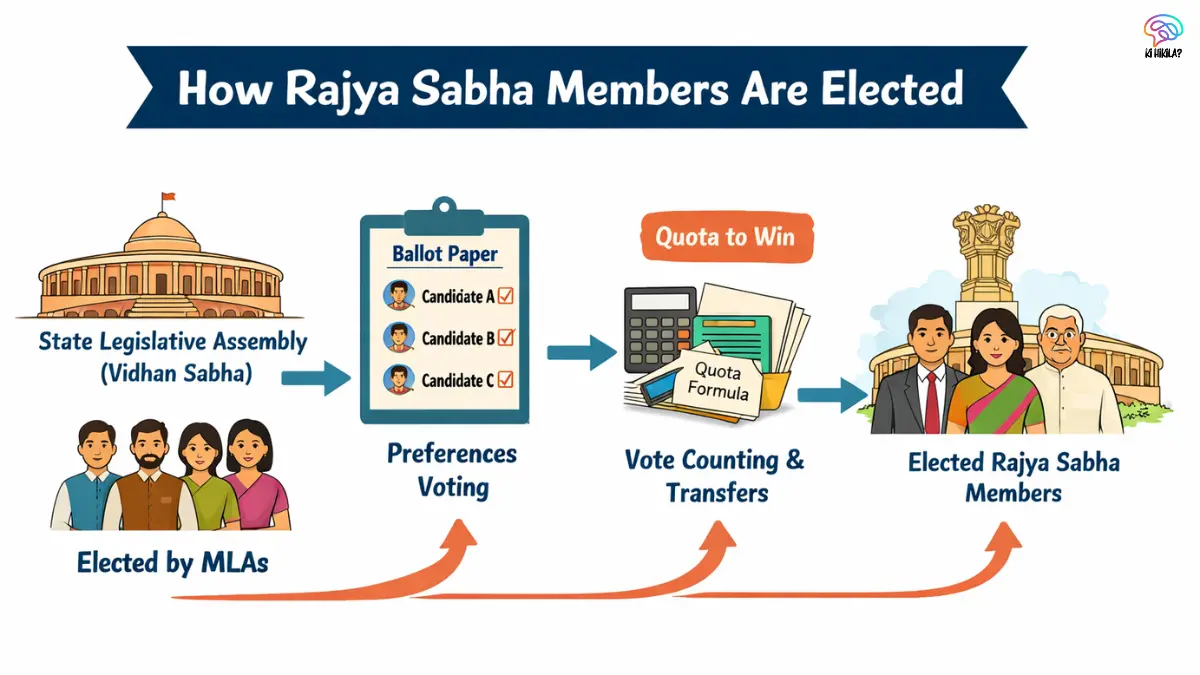
Members of the Rajya Sabha are not directly elected by common citizens like you and me. Instead, they are chosen through an indirect election system. This method may sound complicated at first, but it is actually quite simple once you understand the process.
Each state has a Legislative Assembly, also known as the Vidhan Sabha. The Members of Legislative Assembly, or MLAs, vote to elect Rajya Sabha members from their state. This election follows a system called proportional representation with a single transferable vote.
The Election Process Explained Simply
Suppose your state has five Rajya Sabha seats. Different political parties nominate their candidates for these seats. All MLAs of the state assembly receive ballot papers with the names of these candidates.
Each MLA ranks the candidates by writing numbers such as 1, 2, 3, 4, and 5 next to their preferred candidates. Number one shows the first preference, number two shows the second preference, and so on.
To win a seat, a candidate must secure a minimum number of votes known as the quota. This quota is calculated using a fixed mathematical formula. Once a candidate reaches the quota, they are declared elected. If a candidate receives more votes than required, the extra votes are transferred to other candidates based on second or later preferences.
This process continues until all available seats are filled. The system ensures fair representation and allows even smaller or regional parties to win seats if they have sufficient support in the state assembly.
When Do These Elections Happen?
As discussed earlier, one-third of Rajya Sabha members retire every two years. Elections are held to fill these vacant seats. The Election Commission of India announces the election schedule, and voting is conducted in state legislative assemblies on the same day across the country.
Unlike Lok Sabha elections, which involve large public campaigns and rallies, Rajya Sabha elections are quiet and limited. Only MLAs participate in voting, so there are no public meetings or door-to-door campaigns.
Qualifications Required to Become a Rajya Sabha Member
Not everyone can become a member of the Rajya Sabha. The Constitution of India clearly mentions certain qualifications that a person must fulfil. These qualifications are given under Article 84 of the Constitution.
Age Requirement for Members of Rajya Sabha
A person must be at least 30 years old to become a Rajya Sabha member. This age limit is higher than that of the Lok Sabha, where the minimum age is 25 years. The Constitution makers wanted the Rajya Sabha to include more mature and experienced individuals who could carefully examine laws and national issues.
Citizenship Requirement
The candidate must be a citizen of India. A person holding the citizenship of any other country cannot become a Rajya Sabha member. Dual citizenship is not allowed. This rule ensures that members remain loyal to the country and protect national interests.
Voter Registration Requirement
The candidate must be registered as a voter in any part of India. This requirement shows that the person actively participates in India’s democratic system.
Additional Legal Requirements
A person must not hold any office of profit under the Government of India or any state government. The person must be of sound mind and should not be declared mentally unsound by any court. The person must not be an undischarged insolvent, meaning they should not have unpaid debts declared by a court. The person should also not be disqualified under any law made by Parliament.
No Requirement to Live in the Represented State
An important feature of Rajya Sabha membership is that a person does not need to live in the state they represent. Unlike Lok Sabha elections, where candidates must contest from a specific constituency, Rajya Sabha members can represent any state if they have enough support from that state’s MLAs.
For example, a person living in Kerala can become a Rajya Sabha member from West Bengal. This rule allows capable and knowledgeable individuals to represent states beyond their place of residence. However, it also has a drawback, as such members may not always understand the local issues of the state they represent.
Term of Office for Rajya Sabha Members
Each Rajya Sabha member serves a term of six years. This term is longer than the five-year term of Lok Sabha members. The longer tenure provides stability and allows members to focus on long-term national issues without frequent election pressure.
The Retirement System of Members of Rajya Sabha
The Rajya Sabha is a permanent body and never dissolves completely. Instead, one-third of its members retire every two years. This means that around 81 or 82 members retire at the same time, and elections are held to fill those seats.
When a person is first elected to the Rajya Sabha, it is decided by a draw of lots whether they will retire after two years, four years, or six years. This random method ensures fairness in the rotation system.
Can Members Be Re-Elected
Yes, members can be re-elected to the Rajya Sabha. There is no limit on the number of terms a person can serve. Some members have served for several decades, contributing their experience and expertise over long periods.
What Happens if a Member Resigns or Dies
If a member resigns, dies, or is disqualified before completing their term, a bye election is conducted to fill the vacant seat. The new member serves only for the remaining period of the original six-year term. This maintains the retirement cycle of the Rajya Sabha.
Powers and Functions of Rajya Sabha Members
Rajya Sabha members play an important role in running the country. Although their powers differ from those of Lok Sabha members in some areas, they remain a crucial part of the legislative system.
Legislative Powers of Members of Rajya Sabha
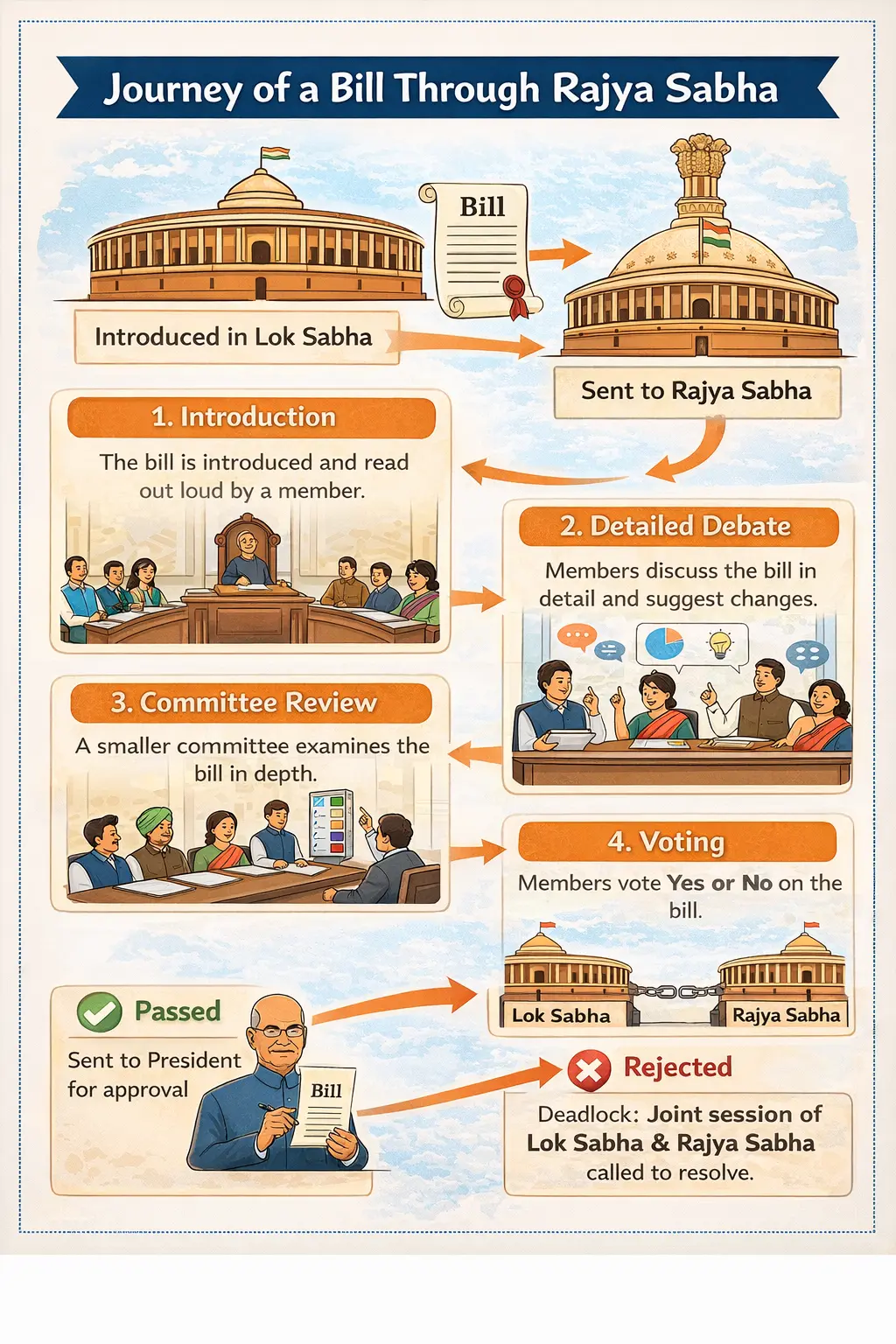
Rajya Sabha members can introduce and discuss most types of bills, except Money Bills. They examine bills passed by the Lok Sabha, take part in debates, and suggest amendments. If the Rajya Sabha rejects a bill or suggests changes, the bill is sent back to the Lok Sabha for reconsideration.
For ordinary bills, both houses have equal powers. A bill becomes law only when both the Lok Sabha and the Rajya Sabha agree. If there is a disagreement, the President may call a joint sitting of both houses where members vote together.
Special Powers of the Rajya Sabha
The Rajya Sabha has two special powers that the Lok Sabha does not have.
First, if two-thirds of the members present and voting agree, the Rajya Sabha can pass a resolution allowing Parliament to make laws on subjects listed in the State List for national interest. This power temporarily shifts law-making authority from states to Parliament.
Second, the Rajya Sabha can create new All India Services such as IAS, IPS, and IFS through a two-thirds majority resolution. This power helps in creating services that function across all states for national unity and administration.
Limited Powers in Money Matters
The Rajya Sabha has limited authority over Money Bills, which deal with taxation and government spending. In such matters, the Lok Sabha holds greater power because it directly represents the people who pay taxes.
When a Money Bill is sent to the Rajya Sabha, members can only suggest recommendations. They cannot reject or amend the bill on their own. The Lok Sabha may accept or reject these suggestions. The bill becomes law within 14 days, even if the Rajya Sabha does not agree.
Role in Electing the President and Vice President
Members of the Rajya Sabha play an important role in electing the President of India. The President is elected by an Electoral College that includes all Members of Parliament from both Lok Sabha and Rajya Sabha, along with all elected Members of Legislative Assemblies from the states.
Each Rajya Sabha member’s vote has a fixed value. This value is calculated using a constitutional formula that considers population and the number of elected representatives. This system ensures balanced and proportional representation of both houses of Parliament.
Role in Electing the Vice President
The Vice President of India is elected by an Electoral College consisting only of Members of Parliament. This includes members of both Lok Sabha and Rajya Sabha. State legislative assembly members do not participate in this election.
In this election, each Member of Parliament has one vote of equal value. There is no difference between the vote of a Lok Sabha member and a Rajya Sabha member.
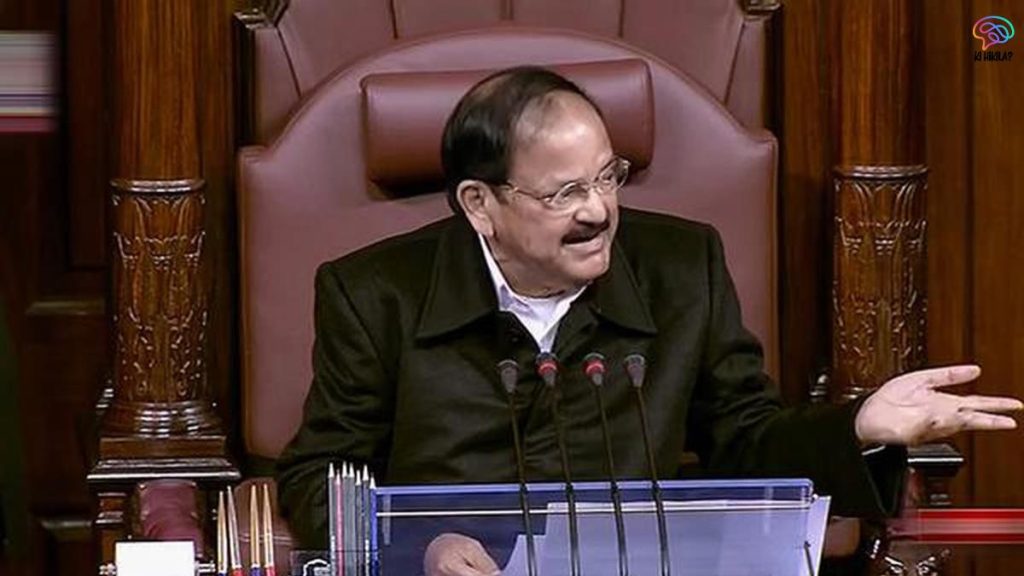
The Vice President also serves as the Chairman of the Rajya Sabha. This is a unique constitutional position. As Chairman, the Vice President presides over Rajya Sabha proceedings, maintains order during debates, and guides members on parliamentary rules and procedures.
Salary, Allowances, and Facilities of Rajya Sabha Members
Rajya Sabha members receive a monthly salary and several allowances for performing their parliamentary duties. As of 2026, each member receives a monthly salary of ₹1,00,000.
In addition to the salary, members receive a daily allowance of ₹2,000 for each day they attend Rajya Sabha sittings.
Constituency Allowance
Each member is given a constituency allowance of ₹70,000 per month. This allowance is meant to help maintain an office, staff, and public interaction in the state they represent.
Since Rajya Sabha members do not represent a specific constituency like Lok Sabha members, they can use this allowance anywhere within their state.
Travel and Communication Facilities
Rajya Sabha members are entitled to free air travel on Air India for themselves and one companion while on official duty. They also receive free railway travel on all Indian Railways routes.
Members are provided with free telephone connections at their Delhi residence and their home state residence. Internet facilities and stationery are also provided to support official work.
Office Space and Housing
Each Rajya Sabha member is allotted office space within the Parliament complex in New Delhi. They are also provided with furnished government accommodation in Delhi.
If government accommodation is not available, members are given a house rent allowance instead.
Pension Benefits of Members of Rajya Sabha
After completing at least five years of service, Rajya Sabha members become eligible for a pension. The pension amount depends on the total years of service.
Members are also entitled to lifelong medical facilities at government hospitals across India.
Disqualification of Rajya Sabha Members
A Rajya Sabha member can be disqualified under certain conditions. These conditions are mentioned in Article 102 of the Constitution of India.
Voluntary Grounds of Disqualification
A member is disqualified if they hold any office of profit under the central or state government. A member is also disqualified if declared of unsound mind by a court or if declared an undischarged insolvent due to unpaid debts.
Disqualification Under Anti Anti-Defection Law
The Tenth Schedule of the Constitution, also known as the Anti-Defection Law, provides grounds for disqualification based on party defection.
If a member voluntarily gives up party membership or votes against party directions, they may be disqualified. The Chairman of the Rajya Sabha decides such cases.
This law was introduced in 1985 to prevent frequent party switching for personal gain. While it has strengthened party discipline, it has also reduced the independence of individual members.
Disqualification Due to Absence
If a member remains absent from all Rajya Sabha sittings for sixty consecutive days without permission, they can be disqualified. Such a disqualification must be approved by the house.
State-wise Distribution of Rajya Sabha Seats
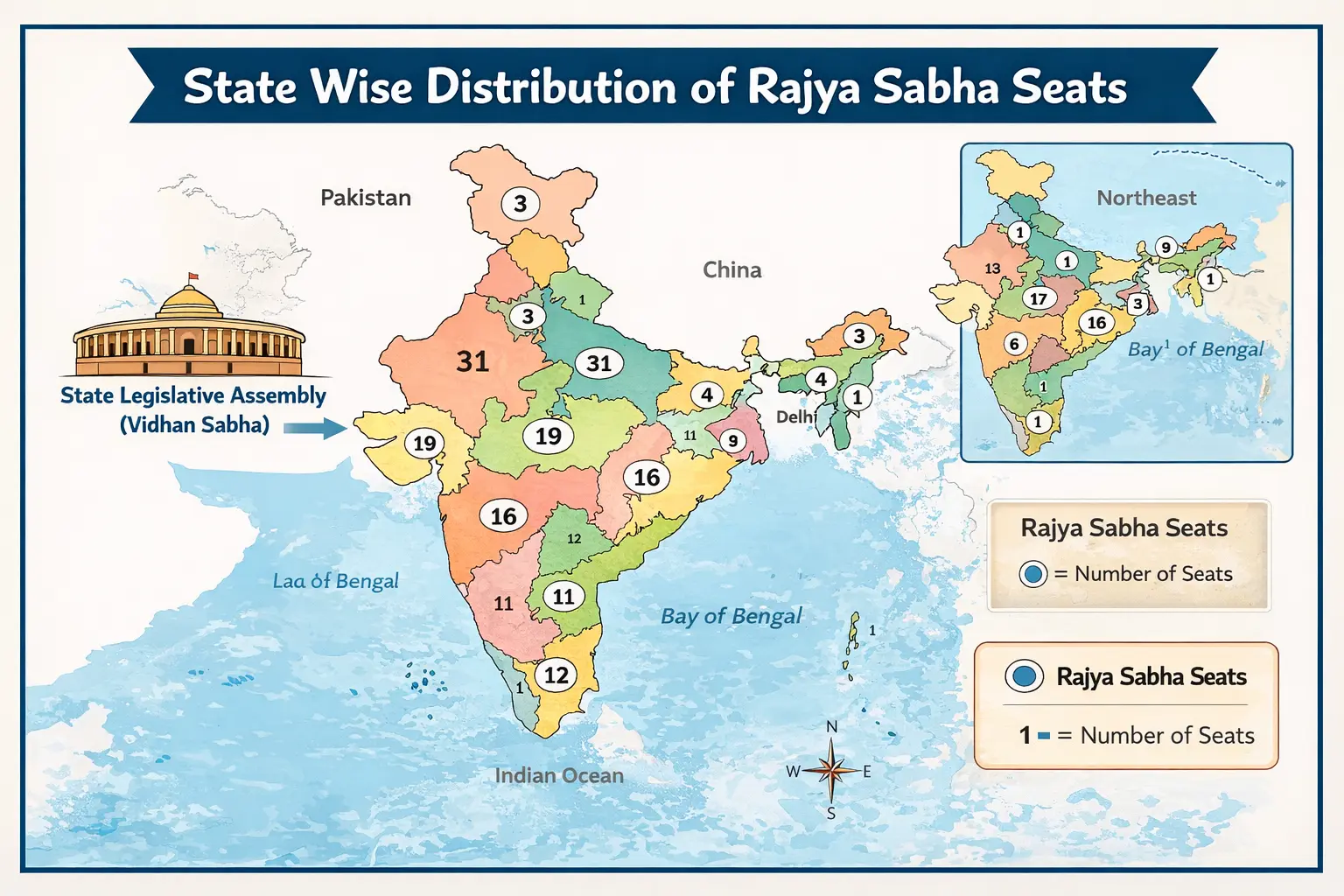
Rajya Sabha seats are distributed among states based on population. This distribution is mentioned in the Fourth Schedule of the Constitution.
States with the highest number of seats include Uttar Pradesh with 31 seats, Maharashtra with 19 seats, Tamil Nadu with 18 seats, Bihar with 16 seats, West Bengal with 16 seats, Karnataka with 12 seats, and Andhra Pradesh with 11 seats.
States with the lowest number of seats include Sikkim, Tripura, Meghalaya, Manipur, Nagaland, Arunachal Pradesh, Mizoram, and Goa, each having one seat. Himachal Pradesh and Uttarakhand have three seats each.
Representation of Union Territories in the Rajya Sabha
Only three union territories have representation in the Rajya Sabha. Delhi has three seats, Jammu and Kashmir has four seats, and Puducherry has one seat.
Other union territories such as Chandigarh, Dadra and Nagar Haveli, Daman and Diu, Lakshadweep, and Andaman and Nicobar Islands do not have Rajya Sabha representation.
Union territories with legislative assemblies and larger populations are given representation, while smaller territories without assemblies are not.
Sessions and Meetings of the Rajya Sabha
The Rajya Sabha meets three times every year in different sessions. The Budget Session is held from January to May, the Monsoon Session from July to August, and the Winter Session from November to December.
How Sessions Are Conducted
Each session is summoned by the President of India. The gap between two sessions cannot exceed six months. This rule ensures that Parliament functions regularly.
During a session, the Rajya Sabha usually meets on working days from Monday to Friday. Each sitting generally begins at 11 AM and continues until the scheduled business is completed.
Question Hour
The first hour of every Rajya Sabha sitting is known as Question Hour. During this time, members ask questions to ministers about government policies, decisions, and administration.
Ministers are required to answer these questions. Questions may be starred, which require oral answers, or unstarred, which require written answers. Question Hour is one of the strongest tools for parliamentary accountability.
Zero Hour
Zero Hour follows Question Hour. Although it is not mentioned in the official rules of procedure, it has become an established parliamentary practice.
During Zero Hour, members can raise matters of urgent public importance without prior notice. This allows immediate discussion of pressing national issues.
Comparison Between Elected and Nominated Members
The twelve nominated members of the Rajya Sabha enjoy almost the same rights as elected members. They can take part in debates, vote on bills, ask questions, and work in parliamentary committees. However, there is one important difference. Nominated members cannot vote in the election of the President of India.
Why This Difference Exists
The Constitution follows a clear democratic principle. Only elected representatives of the people should take part in choosing the President of India. Since nominated members are not elected by voters or legislators, they are not given the right to vote in presidential elections. This rule maintains the democratic character of the highest constitutional office.
Contribution of Nominated Members
Nominated members have played a valuable role in enriching Rajya Sabha debates. Scientists have contributed to discussions on technology and innovation. Artists have guided cultural and heritage policies. Sportspersons have shared insights on sports development, while social workers have spoken on welfare and social justice.
Several well-known personalities have served as nominated members. These include former cricketer Sachin Tendulkar, Olympic boxer Mary Kom, classical dancer Sonal Mansingh, and many respected writers, scientists, and social activists. Their expertise adds depth and quality to parliamentary discussions.
Important Facts Every Student Should Remember
For competitive exams, these key facts about Rajya Sabha members are extremely important:
The maximum strength of the Rajya Sabha is 250 members, while the current strength is 245 members.
The composition includes 233 elected members and 12 members nominated by the President.
Each member has a term of six years.
One-third of the members retire every two years.
The minimum age to become a member is 30 years.
Members are elected indirectly through proportional representation by members of state legislative assemblies.
Special powers of the Rajya Sabha include the authority to allow Parliament to make laws on State List subjects in the national interest, with a two-thirds majority. It can also create new All India Services through a two-thirds majority resolution.
The Vice President of India serves as the ex officio Chairman of the Rajya Sabha.
In the case of Money Bills, the Rajya Sabha can only suggest changes and cannot reject or amend them.
The Rajya Sabha never dissolves completely and is a permanent house.
State representation is based on population. Uttar Pradesh has the highest number of seats with 31, while several smaller states have only one seat each.
Nominated members cannot vote in presidential elections, but can vote in vice presidential elections.
Common Mistakes Students Make
Many students confuse the powers of the Rajya Sabha with those of the Lok Sabha. It is important to remember that the Lok Sabha has greater power over Money Bills. For ordinary bills, both houses have equal authority. However, for creating All India Services and allowing Parliament to legislate on State List subjects, only the Rajya Sabha has special powers.
Another common mistake is assuming that Rajya Sabha members must live in the state they represent. This is incorrect. A person can represent any state if elected by that state’s legislative assembly.
Students also often forget that the Rajya Sabha is a permanent body. It never dissolves completely. Only one-third of its members retire every two years, which makes it more stable than the Lok Sabha.
50 Most Asked Questions on Rajya Sabha (PDF for Exams)
This downloadable PDF contains the 50 most frequently asked questions on the Rajya Sabha, carefully curated for UPSC, State PSC, and SSC examinations. It covers conceptual clarity, constitutional articles, exam-focused facts, and common traps that students often miss. Each question is written in simple language and structured for quick revision, making it ideal for last-minute preparation and mock practice.
Your Next Steps for Exam Success
Now that you clearly understand the Members of the Rajya Sabha, focus on smart revision.
Create a quick revision chart with all important numbers. These include 250 maximum members, 245 current members, 233 elected members, 12 nominated members, a six-year term, a minimum age of 30 years, and retirement of one-third members every two years. These facts appear frequently in exams.
Practice writing short answers on topics such as how Rajya Sabha members are elected, what qualifications are required, what special powers the Rajya Sabha has, and how the Rajya Sabha differs from the Lok Sabha. These questions are common in UPSC, State PSC, and SSC exams.
Read the Constitution directly for better retention. Focus on Article 80 for composition, Article 84 for qualifications, Article 102 for disqualifications, and the Fourth Schedule for state-wise seat distribution.
Finally, connect this knowledge with current affairs. Keep track of newly nominated members and recent Rajya Sabha elections in different states. This practical understanding is especially useful for interviews and descriptive answers.
1. Who are the Members of the Rajya Sabha?
Members of the Rajya Sabha are the elected or nominated representatives who serve in the Upper House of the Parliament of India. They discuss and pass laws, represent states and union territories, and participate in national decision-making.
2. How many Members of Rajya Sabha are there in total?
The Rajya Sabha has a maximum strength of 250 members. Out of these, 238 members are elected by states and union territories, and 12 members are nominated by the President of India for their special contribution in fields like literature, science, art, and social service.
3. How are Members of Rajya Sabha elected?
Members of Rajya Sabha are not directly elected by the public. Instead, they are elected by the elected members of the State Legislative Assemblies and by the representatives of Union Territories through a system of proportional representation by means of a single transferable vote.
4. What is the term of Members of Rajya Sabha?
Each Member of Rajya Sabha serves a term of six years. However, the Rajya Sabha is a permanent body and is never dissolved. Every two years, one-third of its members retire, and new members are elected.
5. What are the qualifications to become a Member of Rajya Sabha?
To become a Member of Rajya Sabha, a person must:
- Be a citizen of India
- Be at least 30 years old
- Possess qualifications laid down by Parliament from time to time
6. What role do Members of Rajya Sabha play in Parliament?
Members of Rajya Sabha discuss, debate, and pass bills, review laws made by the Lok Sabha, represent the interests of their respective states, and hold the government accountable. They also take part in constitutional amendments.
7. How are nominated Members of Rajya Sabha chosen?
The President of India nominates 12 Members of Rajya Sabha from fields such as literature, science, art, and social service. This ensures that the House benefits from the knowledge and expertise of distinguished personalities.
8. Can Members of Rajya Sabha become Ministers?
Yes, Members of Rajya Sabha can become Ministers, including the Prime Minister of India. For example, Dr. Manmohan Singh, who was a Member of Rajya Sabha, served as the Prime Minister from 2004 to 2014.
9. What is the difference between Members of Rajya Sabha and Members of Lok Sabha?
- Members of Rajya Sabha are elected by state legislatures, while Members of Lok Sabha are directly elected by the people.
- Rajya Sabha represents states and union territories, while Lok Sabha represents the people of India.
- Rajya Sabha is a permanent body, whereas Lok Sabha is dissolved every five years.
10. Why are Members of Rajya Sabha important?
Members of Rajya Sabha are important because they provide representation to states, bring in expert knowledge through nominated members, and act as a check on the Lok Sabha, ensuring that laws are carefully reviewed before becoming final.