



Beta Pictoris d: NASA Webb Discovers a New Exoplanet

Beta Pictoris d has become one of the latest discoveries in space science after astronomers confirmed the presence of a new giant exoplanet in the Beta Pictoris star system. The announcement was made on 15 July 2026, following detailed observations carried out by NASA’s James Webb Space Telescope (JWST) along with the European Southern Observatory’s Very Large Telescope (VLT) in Chile. The discovery adds another world to one of the most closely studied young planetary systems and gives scientists a better understanding of how planets form around young stars.
A Young Star System Full of Activity
The Beta Pictoris system is located around 63 light-years away from Earth in the constellation Pictor. It is considered very young compared to our Solar System, with an estimated age of about 23 million years. For comparison, the Sun and the Solar System are about 4.6 billion years old.

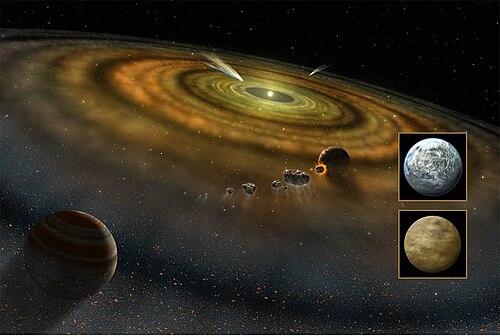
Because of its young age, Beta Pictoris has become an important target for astronomers studying the early stages of planetary development. The star is surrounded by a large disk of dust and gas, which is believed to be the leftover material from the formation of planets. Scientists have been observing this system for many years to understand how giant planets grow and interact with their surroundings.
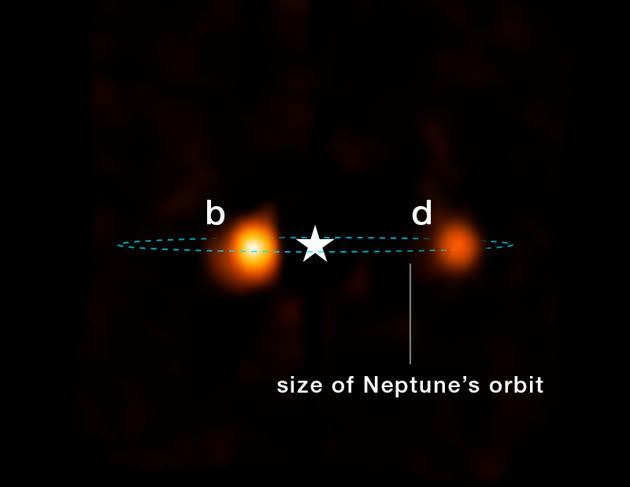
Before this latest discovery, two giant planets – Beta Pictoris b and Beta Pictoris c– had already been confirmed in the system.
Discovery of Beta Pictoris d
The newly identified planet, Beta Pictoris d, is now the third known giant planet orbiting the young star. Unlike many earlier discoveries that relied mainly on detecting a planet’s brightness or movement, researchers used a more advanced method that focused on the planet’s atmosphere.
Astronomers identified the planet through the chemical signature of carbon monoxide present in its atmosphere. Every gas absorbs and emits light in a unique way, creating what scientists call a chemical fingerprint. By studying this fingerprint, researchers were able to confirm the existence of the planet even though it is much fainter than its neighboring planets.
This achievement highlights how modern telescopes are becoming more capable of detecting distant worlds that were previously difficult to observe.
James Webb Telescope Played a Major Role
NASA’s James Webb Space Telescope was the main instrument used in this discovery. Scientists relied on Webb’s Near-Infrared Spectrograph (NIRSpec) Integral Field Unit, which can collect detailed information about light coming from distant objects.
Unlike ordinary telescopes that mainly observe visible light, the James Webb Space Telescope works primarily in the infrared part of the spectrum. Infrared observations allow astronomers to see through clouds of dust and detect objects that are too cool or too dim to be seen clearly with visible light.
The telescope has already transformed modern astronomy by studying distant galaxies, newborn stars, and the atmospheres of exoplanets. The discovery of Beta Pictoris d adds another milestone to its growing list of achievements.
Support from the Very Large Telescope
The observations were also supported by the Very Large Telescope (VLT), operated by the European Southern Observatory (ESO) in northern Chile.
The VLT is one of the world’s most powerful ground-based observatories. Working together with the James Webb Space Telescope allowed researchers to combine observations from space and Earth, improving the accuracy of their measurements and helping confirm the planet’s existence.
This partnership demonstrates how international scientific cooperation continues to improve our understanding of the universe.
Features of the Newly Found Planet
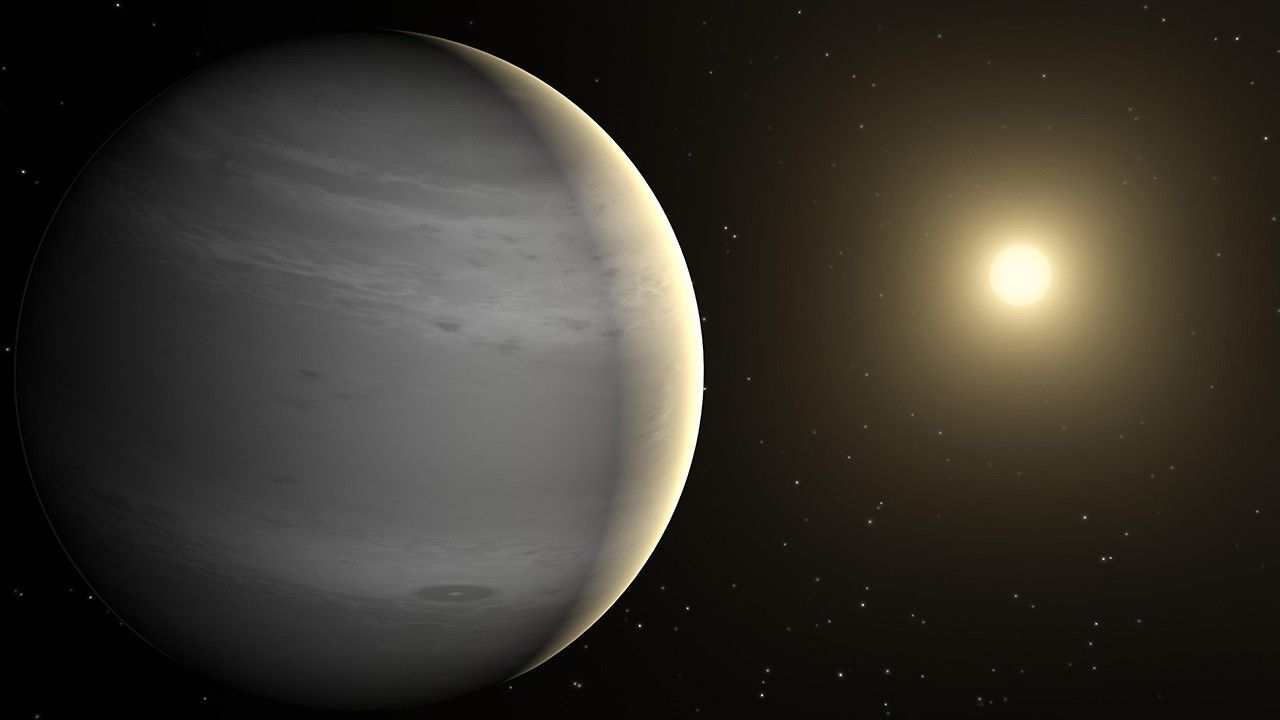
Beta Pictoris d is believed to be a gas giant, much like Jupiter. Scientists estimate that it has a mass of at least two to 2.4 times the mass of Jupiter.
Although it is still a giant planet, it is much fainter than Beta Pictoris b. Researchers estimate that Beta Pictoris d is nearly 100 times dimmer than its larger neighbor. This made it more challenging to detect.
The planet travels around its star at a distance of approximately 30 astronomical units (AU). One astronomical unit is the average distance between the Earth and the Sun, making Beta Pictoris d much farther from its star than Earth is from the Sun.
Researchers also describe it as one of the lightest exoplanets ever directly imaged, showing how telescope technology has improved in detecting smaller and dimmer planetary bodies.
Why This Discovery Matters
Finding another planet in the Beta Pictoris system provides scientists with more information about how planetary systems develop over time. Since the system is still relatively young, it offers a unique opportunity to observe conditions that may have existed in our own Solar System billions of years ago.
The discovery also shows that studying the chemical composition of planetary atmospheres can reveal planets that may not be easy to detect through traditional imaging methods. This approach is expected to help astronomers discover many more distant worlds in the future.
As telescope technology continues to improve, scientists hope to identify planets with different sizes, temperatures, and atmospheric compositions, bringing us closer to understanding the wide variety of planetary systems that exist across our galaxy.
Research Teams Behind the Discovery
The discovery was independently reported by two international research teams. One team was led by Aidan Gibbs from the University of California, San Diego. The second team was led by Ben Sutlieff from the University of Edinburgh together with Markus Bonse from the European Southern Observatory.
Both research groups reached similar conclusions after analysing observations collected by the James Webb Space Telescope and the Very Large Telescope. Their findings were published in The Astrophysical Journal Letters on 15 July 2026.
The discovery of Beta Pictoris d marks another important step in the ongoing exploration of planets beyond our Solar System. With advanced observatories continuing to scan the skies, astronomers expect many more exciting discoveries in the coming years, expanding our understanding of how planets are born and how planetary systems evolve across the universe.