


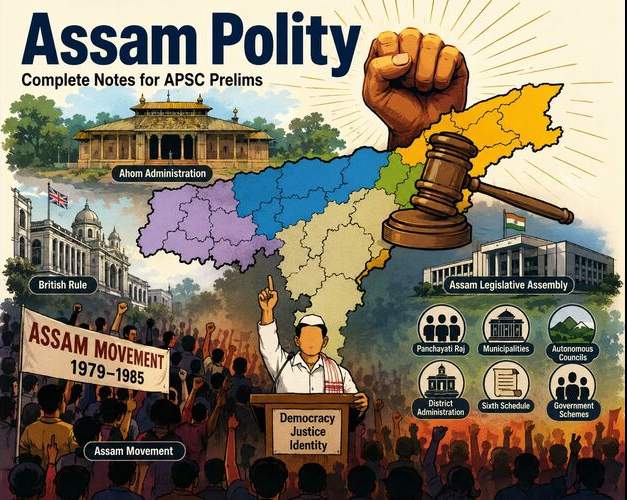
Complete Assam Polity Notes for APSC Prelims

Preparing for the APSC Prelims? Complete Assam Polity Notes for APSC Prelims is one of the most important topics for Assam Public Service Commission examinations. Questions from Assam’s political history, administration, local government, autonomous councils, and constitutional provisions appear regularly in the exam.
Evolution of Political Leadership & Governance of Assam
The political system of Assam has changed over thousands of years.

Ancient Period
- Assam was known as Pragjyotisha and later Kamarupa Kingdom.
- Kings ruled the state with the help of ministers and local officials.
- Religion and culture influenced governance.
Medieval Period
- The Ahom dynasty ruled Assam for nearly 600 years (1228–1826).
- They created a strong administrative system.
- The kingdom remained independent from the Mughals.
British Period
- After the Treaty of Yandabo in 1826, Assam came under British rule.
- The British introduced modern administration, revenue systems, police, and courts.
Independent India
- Assam became a state of India.
- It adopted democratic governance under the Indian Constitution.
- Today, governance is carried out by elected representatives.
APSC Tip: Remember the timeline:
- Kamarupa Kingdom
- Ahom Rule
- British Rule
- Independent Assam
Ancient & Medieval Polity (Ahom Administration)
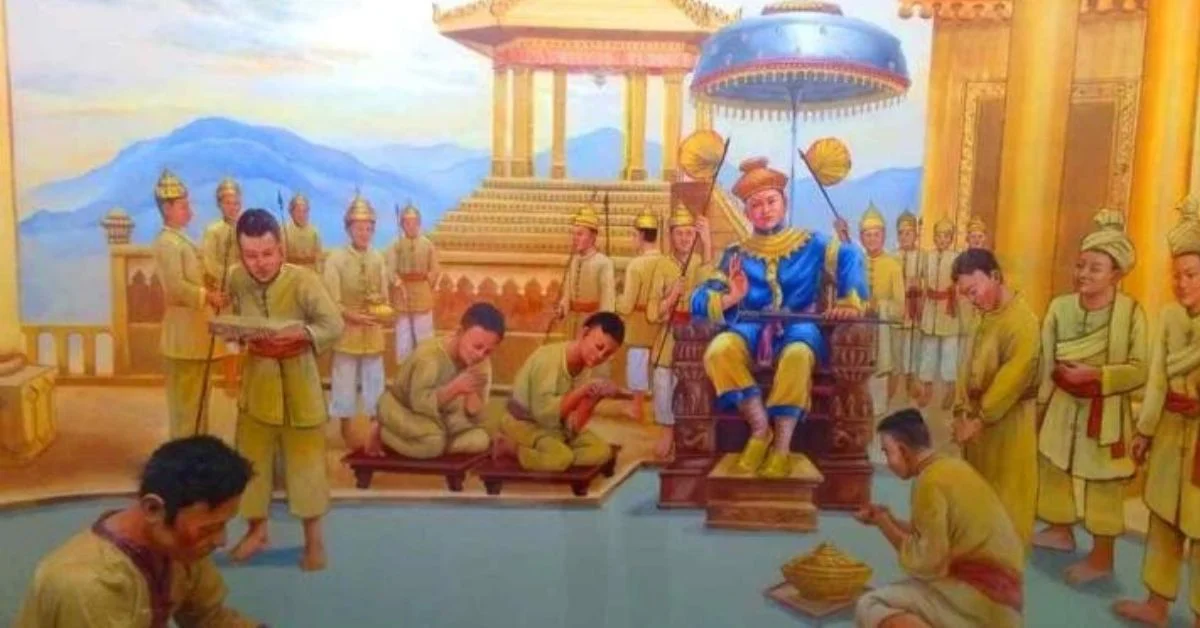
The Ahom administration is one of the most frequently asked topics in Assam GK.
Founder
- Sukaphaa established the Ahom Kingdom in 1228 AD.
Important Features
Swargadeo
- The king was called Swargadeo.
- He was the supreme authority.
Patra Mantris
The king was assisted by important ministers called:
- Burhagohain
- Borgohain
- Borpatragohain
Paik System
One of the most important administrative systems.
Features:
- Every adult male was called a Paik.
- Paiks provided military and public service.
- Land was given in return for service.
Khel System
People were grouped according to occupations like:
- Farming
- Blacksmith
- Boat making
- Weaving
Revenue
The Ahoms mainly collected taxes through labour instead of cash.
British Colonial Administration in Assam
The British took control after the Treaty of Yandabo (1826).
Major Administrative Changes
- Introduction of Deputy Commissioners
- Modern police administration
- Revenue collection
- Civil courts
- Tea plantation administration
- Railway development
Important Acts
- Government of India Act 1919
- Government of India Act 1935
The 1935 Act gave Assam greater provincial autonomy.
Assam Movement & Political Developments
The Assam Movement is an important topic in APSC.
Assam Movement (1979–1985)
Main Objective
To identify and remove illegal immigrants.
Led By
- All Assam Students’ Union (AASU)
- All Assam Gana Sangram Parishad (AAGSP)
Assam Accord
Signed on 15 August 1985.
Major Points:
- Detection of illegal immigrants.
- Protection of Assamese identity.
- Economic development of Assam.
Administrative Structure of Assam
The administration follows the Constitution of India.
Governor
- Constitutional Head of the State.
Chief Minister
- Real executive head.
- Leads the Council of Ministers.
Council of Ministers
- Helps in running the government.
Assam Legislative Assembly
- Makes state laws.
High Court
- Assam comes under the Gauhati High Court, which also has jurisdiction over several northeastern states.
Sixth Schedule of the Indian Constitution
The Sixth Schedule provides special administrative arrangements for tribal areas.
Purpose
- Protect tribal culture.
- Promote self-governance.
- Preserve customs and traditions.
Powers
Autonomous councils can make laws regarding:
- Land
- Forests
- Local customs
- Village administration
Autonomous Councils of Assam
Several autonomous councils function in Assam.
Some important councils include:
- Bodoland Territorial Council (BTC)
- Rabha Hasong Autonomous Council
- Tiwa Autonomous Council
- Mising Autonomous Council
- Deori Autonomous Council
- Sonowal Kachari Autonomous Council
- Thengal Kachari Autonomous Council
Their aim is to promote development while protecting the identity of different communities.
District Administration (DC, SP, BDO)
Deputy Commissioner (DC)
The DC is the administrative head of a district.
Functions:
- Revenue collection
- Disaster management
- Election work
- Law and order coordination
Superintendent of Police (SP)
Responsible for:
- Law and order
- Crime prevention
- Police administration
Block Development Officer (BDO)
Responsible for:
- Rural development
- Government welfare schemes
- Panchayat implementation
Panchayati Raj System in Assam
The Panchayati Raj System promotes local self-government in rural areas.
Three-Tier Structure
1. Gaon Panchayat
Works at village level.
2. Anchalik Panchayat
Works at block level.
3. Zila Parishad
Works at district level.
Main functions:
- Rural roads
- Drinking water
- Sanitation
- Agriculture
- Rural development
Municipalities & Urban Local Bodies
Urban local governments manage cities and towns.
Types:
- Municipal Corporation
- Municipal Board
- Town Committee
Responsibilities:
- Water supply
- Waste management
- Roads
- Street lights
- Public health
Autonomous Hill Councils (BTC, KAAC, DHAC)
These councils provide self-governance to tribal-majority areas.
Bodoland Territorial Council (BTC)
- Governs the Bodoland Territorial Region.
Karbi Anglong Autonomous Council (KAAC)
- Administers Karbi Anglong district.
Dima Hasao Autonomous Council (DHAC)
- Administers Dima Hasao district.
These councils receive powers under the Sixth Schedule.
Delimitation in Assam
Delimitation means fixing or changing the boundaries of Assembly and Parliamentary constituencies.
Objectives
- Equal representation.
- Fair elections.
- Population-based constituency adjustment.
Recent delimitation has changed the boundaries of several Assembly and Parliamentary constituencies in Assam.
Major Political Movements
Important political movements include:
Assam Movement (1979–1985)
Demand:
- Detection and deportation of illegal immigrants.
Language Movement
Focused on protecting the Assamese language.
Bodoland Movement
Demanded greater autonomy for the Bodo people.
Anti-Foreigner Movement
Focused on issues related to illegal migration.
Government Schemes of Assam
Some important Assam Government schemes include:
Orunodoi Scheme
Financial assistance for eligible women-led households.
Mukhya Mantri Nijut Moina
Supports girls’ education through financial incentives at different education levels.
Mukhya Mantri Atmanirbhar Asom
Supports entrepreneurship and self-employment.
Apun Bahan Scheme
Vehicle loan support for eligible government employees.
Arundhati Gold Scheme
Financial assistance for eligible newly married women, subject to government norms.
Assam Arogya Nidhi
Financial help for medical treatment of eligible patients.
Exam Tip: Read the objectives and beneficiaries of important schemes.
Major Political Parties of Assam
Important political parties include:
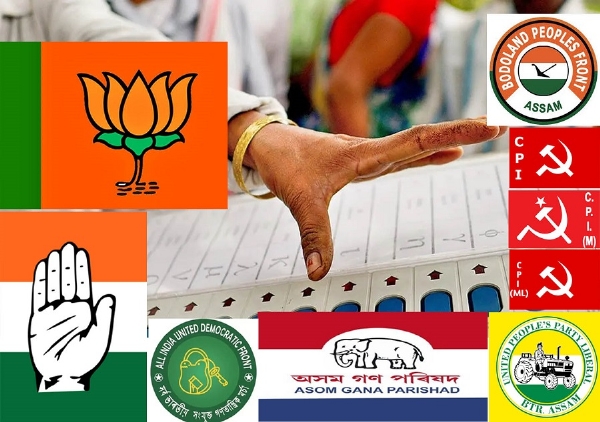
- Bharatiya Janata Party (BJP)
- Indian National Congress (INC)
- Asom Gana Parishad (AGP)
- All India United Democratic Front (AIUDF)
- United People’s Party Liberal (UPPL)
- Aam Aadmi Party (AAP)
- Communist Party of India (Marxist) [CPI(M)]
- Communist Party of India (CPI)
Know their important leaders, election symbols, and areas of influence for current affairs preparation.
Important APSC Prelims Facts
| Topic | Important Point |
|---|---|
| Treaty of Yandabo | 1826 |
| Founder of Ahom Kingdom | Sukaphaa |
| Ahom Rule | 1228–1826 |
| Assam Accord | 15 August 1985 |
| Sixth Schedule | Autonomous administration for tribal areas |
| Administrative Head of District | Deputy Commissioner |
| Police Head of District | Superintendent of Police |
| Rural Local Government | Panchayati Raj |
| Urban Local Government | Municipalities |
| Tribal Self-Governance | Autonomous Councils |
Quick Revision
- Assam has a rich political history from Kamarupa to modern democracy.
- The Ahom administration introduced the famous Paik System.
- British rule began after the Treaty of Yandabo (1826).
- The Assam Movement led to the Assam Accord in 1985.
- The Governor is the constitutional head, while the Chief Minister is the executive head.
- The Sixth Schedule provides autonomy to tribal areas.
- Panchayati Raj governs rural areas, while municipalities govern urban areas.
- Deputy Commissioner is the administrative head of a district.
- Important autonomous councils include BTC, KAAC, and DHAC.
- Government schemes and political parties are important for APSC current affairs.
Frequently Asked Questions
Is Assam Polity important for APSC Prelims?
Yes. Assam Polity is one of the most important sections in APSC Prelims and is frequently tested.
Which topics should I study first?
Start with the Ahom administration, Assam Movement, Sixth Schedule, district administration, Panchayati Raj, and important government schemes.
Are these notes useful for other Assam exams?
Yes. These notes are helpful for APSC, Assam Police, ADRE, Assam Secretariat, Grade III & IV, Assam TET, and other state-level competitive exams.
How can I revise Assam Polity quickly?
Revise important dates, constitutional provisions, administrative structures, autonomous councils, major political movements, and government schemes using short notes and previous years’ questions.
Conclusion
These Complete Assam Polity Notes for APSC Prelims cover all the essential topics needed for the examination, from the evolution of Assam’s governance to the Sixth Schedule, Panchayati Raj, autonomous councils, district administration, government schemes, and major political parties. Revise these notes regularly, practice previous years’ questions, and stay updated with current political developments in Assam to improve your score in the APSC Prelims.