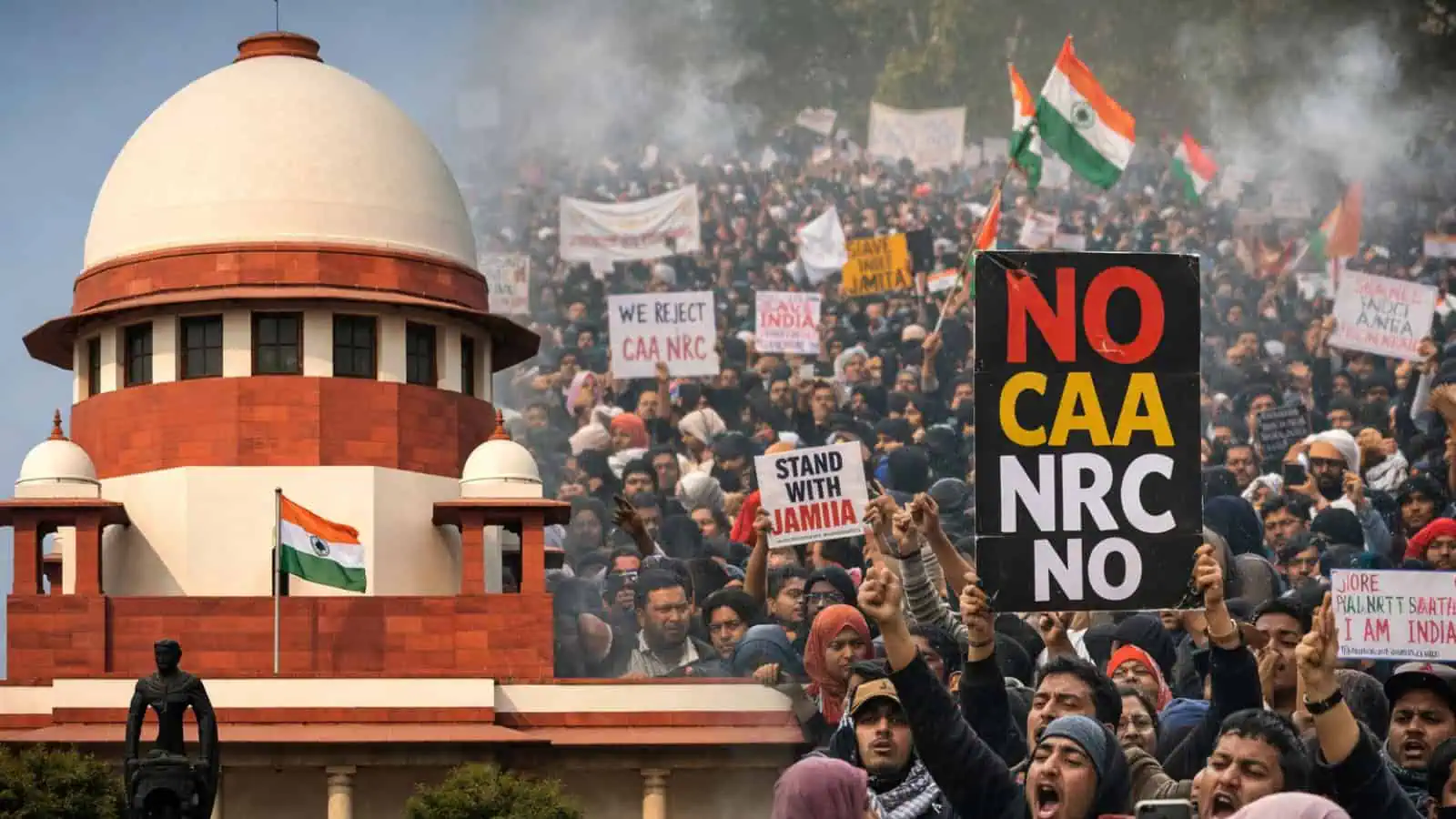
CAA Petitions Hearing From May 5: Supreme Court to Revisit Challenges to Citizenship Amendment Act

CAA Petitions Hearing From May 5 has once again come into national attention as the Supreme Court of India prepares to begin hearings on petitions challenging the Citizenship Amendment Act from May 5, 2026. The long pending legal battle around the controversial law is set to move forward after a gap of more than two years, raising expectations among petitioners, political parties, and civil society groups across the country.
Thank you for reading this post, don't forget to subscribe!A three judge bench led by Chief Justice of India Surya Kant, along with Justice Joymalya Bagchi and Justice Vipul Pancholi, will hear the matter. The bench issued procedural directions while scheduling the hearings and made it clear that different sets of petitions would be taken up in a phased manner.
Background of the Pending Petitions
The petitions challenge the constitutional validity of the Citizenship Amendment Act, which was enacted by Parliament in December 2019. Soon after its passage, the law sparked nationwide protests and legal challenges. Several individuals, organisations, and political parties approached the Supreme Court, arguing that the Act violates the basic structure of the Constitution.
The matter was last listed for hearing in March 2024. Since then, the petitions have remained pending while the government notified the rules under the Act. With the announcement that hearings will begin from May 5, 2026, the court is now expected to engage deeply with the constitutional questions raised by the challengers.
What the Citizenship Amendment Act Says
The Citizenship Amendment Act amends certain provisions of the Citizenship Act, 1955. It creates a fast track path to Indian citizenship for members of Hindu, Sikh, Buddhist, Jain, Parsi and Christian communities from Pakistan, Bangladesh and Afghanistan.
To be eligible, applicants must have entered India on or before December 31, 2014, and must have lived in the country for at least five years. The Act does not provide automatic citizenship. Instead, it allows eligible persons to apply for citizenship under relaxed conditions compared to the standard process.
The government has maintained that the law is meant to address humanitarian concerns and provide relief to religious minorities who faced persecution in the three neighbouring countries.
How the Court Plans to Hear the Matter
During the recent proceedings, senior advocate Indira Jaising urged the court to hear petitions relating to Assam and other North Eastern states separately. She pointed out that these petitions raise unique issues linked to Section 6A of the Citizenship Act and the Inner Line Permit system.
On the other side, the government was represented by the Solicitor General, who argued that petitions from Assam and Tripura should be categorised distinctly, as directed by the court in earlier orders.
The bench indicated that it would first hear petitions concerning the rest of India. After that, it would take up the Assam and Tripura specific cases. The hearings are scheduled for May 5 and May 6, with respondents expected to present their arguments in the later sessions.
Centre’s Position on the Law and CAA Petitions Hearing From May 5
One of the main criticisms of the Act is that it excludes Muslims from its scope. Petitioners argue that this selective inclusion violates the constitutional guarantee of equality before the law under Article 14 of the Constitution. According to them, religion cannot be a valid basis for granting or denying citizenship benefits.
In Assam, petitioners have raised additional concerns. They argue that the Act goes against the Assam Accord of 1985, which fixed March 24, 1971, as the cut off date for identifying and deporting illegal migrants. By allowing certain groups who entered India up to December 31, 2014, to apply for citizenship, the Act is said to dilute the protections promised under the Accord.
These regional concerns have made the case more complex, requiring the court to balance constitutional principles with local agreements and historical commitments.
Centre’s Position on the Law and CAA Petitions Hearing From May 5
The Union Government has consistently defended the Citizenship Amendment Act. It has told the court that the law does not affect the citizenship status or fundamental rights of any existing Indian citizen. According to the Centre, the Act only applies to a specific category of migrants who were forced to flee religious persecution.
The government has also argued that India has the sovereign right to frame its own citizenship policies. It maintains that the Act is a policy decision taken by Parliament and should not be interfered with unless it clearly violates constitutional provisions.

Why the Upcoming Hearings Matter
The CAA Petitions Hearing From May 5 is expected to have wide legal and political implications. The case touches upon key constitutional values such as equality, secularism, and federalism. It also affects relations between the Centre and states, especially in the North East.
Legal experts believe that the court’s observations during these hearings could provide clarity on how far Parliament can go in using religion as a criterion in citizenship laws. For many citizens, the hearings represent an important moment in the ongoing debate over the nature of Indian citizenship and constitutional identity.
As the Supreme Court begins detailed hearings, the country will be watching closely. The outcome may not only decide the future of the Citizenship Amendment Act but also shape the broader understanding of constitutional rights in India.