Employee Enrolment Scheme 2025 Launched to Boost Workforce Formalisation

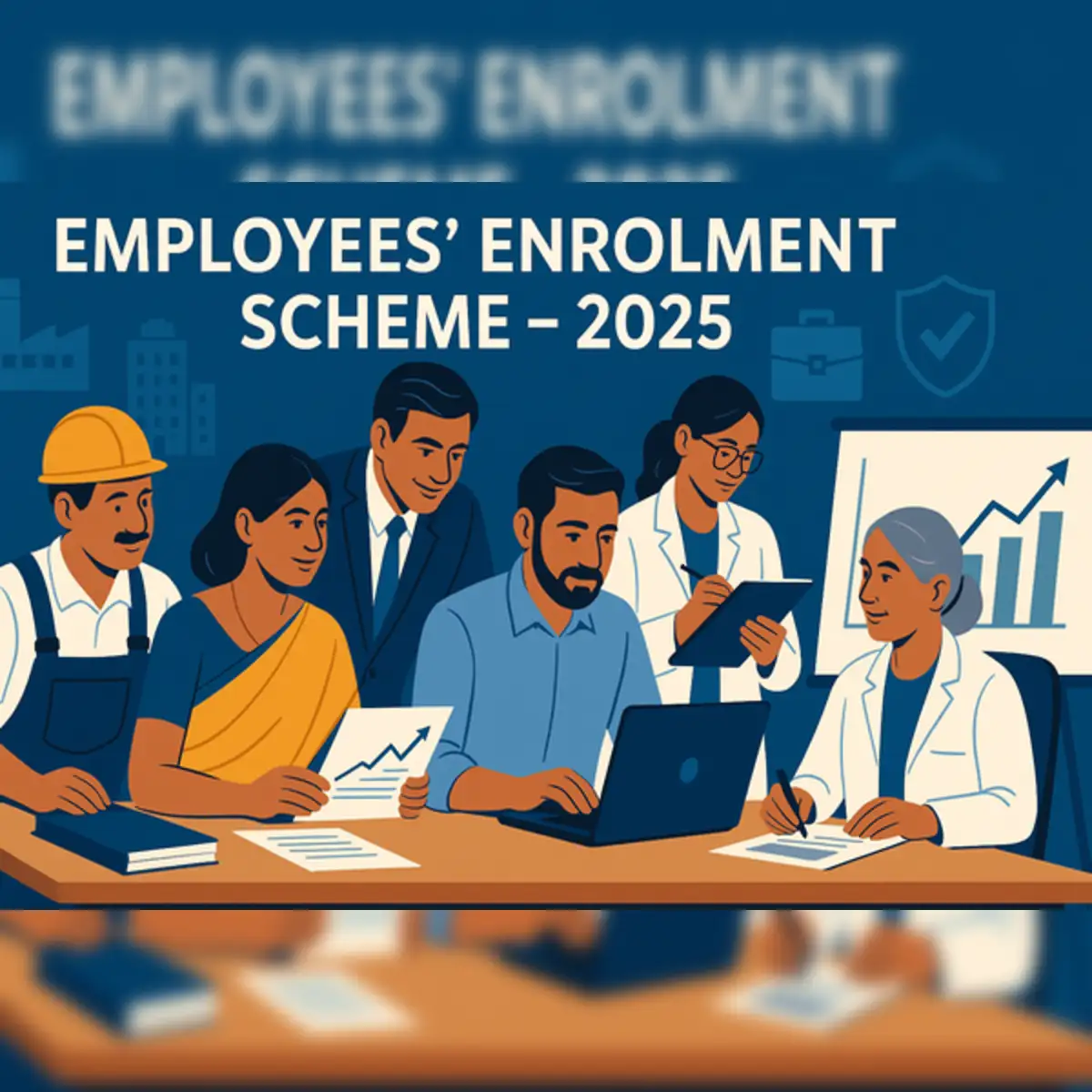
The Employee Enrolment Scheme 2025, launched by the Union Ministry of Labour and Employment, marks a major stride in India’s efforts to strengthen social security and workforce formalisation. Aimed at extending Employees’ Provident Fund (EPF) coverage to workers who were previously left out, the scheme offers employers a six-month window from November 1, 2025, to April 30, 2026 to voluntarily regularise EPF compliance for employees engaged between July 1, 2017, and October 31, 2025. By simplifying registration and easing penalties, the Employee Enrolment Scheme 2025 seeks to foster transparency, improve ease of doing business, and bring lakhs of informal sector workers under the protection of the formal economy.
Thank you for reading this post, don't forget to subscribe!A Special Window for Voluntary Regularisation
Under the Employee Enrolment Scheme 2025, employers will be able to declare their previously unregistered employees through the official EPFO portal. The government has structured the scheme in a manner that minimises financial burden on employers while expanding the coverage of social security benefits.
Notably, if an employee’s share of EPF contribution was not deducted earlier, it will now be completely waived. Employers, however, are required to deposit only their contribution share, along with applicable interest, administrative charges, and a nominal penalty of ₹100 per establishment. This flat penalty covers all three EPF schemes Provident Fund, Pension Scheme, and Deposit-Linked Insurance ensuring simplicity and cost efficiency.
This design reflects the government’s intent to promote voluntary compliance rather than punitive enforcement. By removing the fear of heavy penalties and prosecution, the Ministry hopes to bring a large section of India’s informal workforce into the formal social security network.

Inclusive and Transparent Implementation
A standout feature of the EES 2025 is its inclusivity. The Ministry has clarified that even establishments currently under inquiry under Section 7A of the EPF Act, Para 26B, or Para 8 of the Employees’ Pension Scheme (EPS) 1995 are eligible to participate. This broad eligibility ensures that the reform benefits all employers, including those facing procedural scrutiny.
Equally important is the assurance that no suo motu enforcement action will be initiated by the EPFO during the scheme period. This clause, aimed at building trust between the government and employers, underlines the voluntary spirit of the programme. It sends a clear message the focus is on inclusion and partnership, not penalisation.
Through this scheme, the Ministry expects to enrol lakhs of informal and contractual workers who have so far remained outside the EPF ecosystem. This will significantly enhance India’s social security net and contribute to the vision of “Universal Social Protection for All.”
Reform Vision and Institutional Strength
Unveiling the Employee Enrolment Scheme 2025, Union Minister Mansukh Mandaviya hailed it as a “milestone in India’s march toward a fair and inclusive labour economy.” Addressing the gathering, he highlighted EPFO’s pivotal role in safeguarding workers’ financial futures and urged the organisation to set new global benchmarks in efficiency and empathy.
Mandaviya’s remarks captured the broader vision of the initiative: to make India’s social security ecosystem more responsive, citizen-centric, and transparent. He emphasised that true reform lies not merely in creating systems but in building institutions that understand and respect the human element behind every policy.
Labour Secretary Vandana Gurnani, echoing this sentiment, underlined that every reform must be driven by “dignity for the worker.” She pointed out that sustainable economic growth can only be achieved when the workforce feels secure, valued, and protected.
Digital Transformation and EPFO 3.0
The Employee Enrolment Scheme 2025 comes at a time when the Employees’ Provident Fund Organisation (EPFO) is undergoing significant digital and structural modernisation. EPFO Commissioner Ramesh Krishnamurthi announced the rollout of the EPFO 3.0 platform, which promises to transform how employers and employees interact with the organisation.
This next-generation digital platform will enable faster enrolment, real-time compliance monitoring, and enhanced user accessibility. Some of the major initiatives include:
- Aadhaar-based authentication for seamless verification and identity management.
- Centralised pension payment systems to ensure timely and transparent disbursal.
- Simplified withdrawal and claim processes, reducing paperwork and delays.
- Integration with DigiLocker and Unified Mobile App for New-age Governance (UMANG) for a single-point interface.
By integrating such technologies, the EPFO aims to move toward a fully paperless.