IISc Brain Co-Processors Moonshot for Stroke Rehabilitation

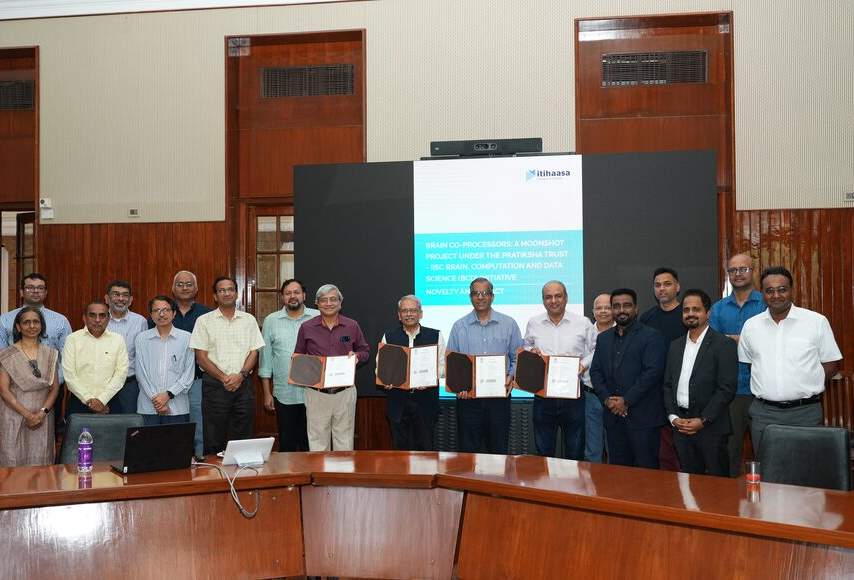
The Indian Institute of Science (IISc), Bengaluru, has launched the IISc Brain Co-Processors Moonshot, an ambitious research initiative aimed at developing advanced neural technologies that combine neuromorphic hardware with artificial intelligence. The project seeks to create brain co-processors capable of enhancing or restoring brain functions, particularly for individuals who have suffered neurological damage.
Thank you for reading this post, don't forget to subscribe!The initiative is supported by the Pratiksha Trust, founded by Infosys co-founder Kris Gopalakrishnan and Sudha Gopalakrishnan. A memorandum of understanding formalizing this collaboration was signed at IISc in the presence of senior researchers and institutional leaders. The project represents a significant step toward developing cutting-edge neurotechnology in India.
AI-Powered Brain Co-Processors
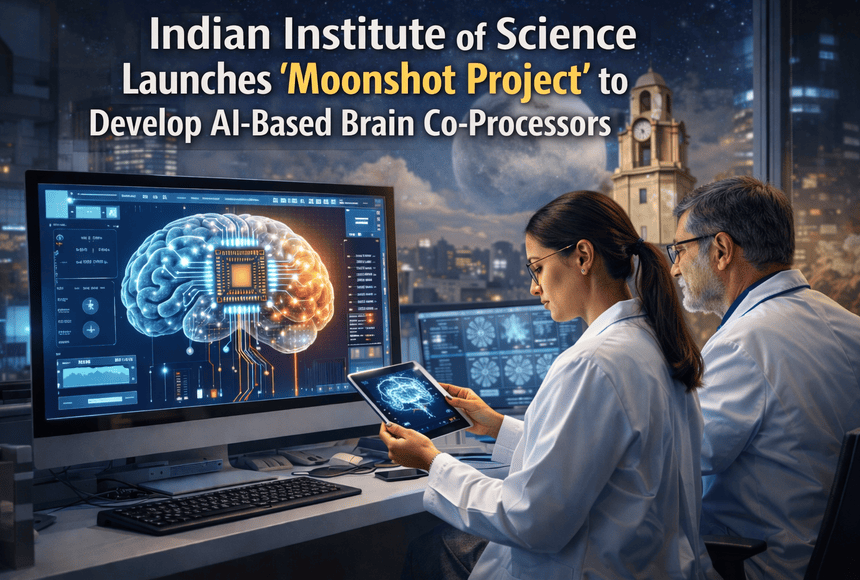
Brain co-processors are a new class of neurotechnology designed to work alongside the human brain. Under the IISc Brain Co-Processors Moonshot, scientists aim to build both implantable and non-invasive devices capable of recording neural signals and processing them through artificial intelligence algorithms.
These devices will function as closed-loop systems. They will continuously monitor brain activity, interpret neural patterns and send corrective signals back to the brain through neural stimulation or neurofeedback. By doing so, the technology could help restore lost motor or cognitive functions and improve the quality of life for patients with neurological conditions.
Neuromorphic computing plays a central role in this project. This technology mimics the structure and functioning of the human brain, enabling efficient processing of complex neural signals while consuming less power compared to traditional computing systems.
Focus on Stroke Rehabilitation
One of the primary goals of the IISc Brain Co-Processors Moonshot is to assist stroke survivors in recovering lost motor abilities. Strokes involving the middle cerebral artery often result in severe motor impairments, affecting everyday activities such as reaching, grasping or coordinated movement.
In the first phase of the project, researchers will develop a non-invasive neural co-processor that provides sensorimotor feedback to stroke patients. This system will help patients perform goal-directed movements by decoding brain signals and providing supportive feedback.
At the same time, researchers will begin work on an implantable version of the technology that can directly interact with brain regions responsible for movement and coordination. In the later phase, a minimally invasive embedded co-processor will be developed to restore sensorimotor coordination in individuals with long-term neurological deficits.
Building Indigenous Neurotechnology
A major objective of the IISc Brain Co-Processors Moonshot is to strengthen India’s capabilities in neurotechnology. Researchers plan to design implant hardware, neuromorphic computing systems and AI software within the country.
The project will also generate India-specific neurological datasets, including stereo EEG and electrocorticography recordings, which are essential for developing advanced AI models. These datasets will help improve the accuracy of brain signal decoding systems.
In addition, open-source AI tools, datasets and visualization platforms will be created to support collaborative research. By making these resources widely accessible, the initiative aims to accelerate innovation in neuroscience and neurotechnology across the scientific community.
Collaboration and Clinical Research
The project builds on IISc’s Brain, Computation and Data Science program, which brings together experts from neuroscience, electrical engineering, bioelectronics and neuromorphic computing. More than 20 faculty members are expected to contribute to the research effort.
Researchers will also collaborate with neurologists, therapists and healthcare institutions across India and internationally. Clinical validation will play a key role in the project, ensuring that the technology meets medical standards and can be used effectively in real-world healthcare settings.
Through the IISc Brain Co-Processors Moonshot, scientists hope to develop innovative solutions that can transform neurological rehabilitation and help patients regain essential motor and cognitive abilities.