India IMF GDP Rank Sixth: India Slips in Global Economy Rankings

India has slipped to the sixth position in global GDP rankings for 2025, according to the latest estimates by the International Monetary Fund (IMF). Although India continues to be one of the fastest-growing major economies, its ranking has been affected mainly by currency changes. This shift is seen as a temporary setback in India’s journey to become the third-largest economy.
Thank you for reading this post, don't forget to subscribe!IMF Data and Global GDP Rankings
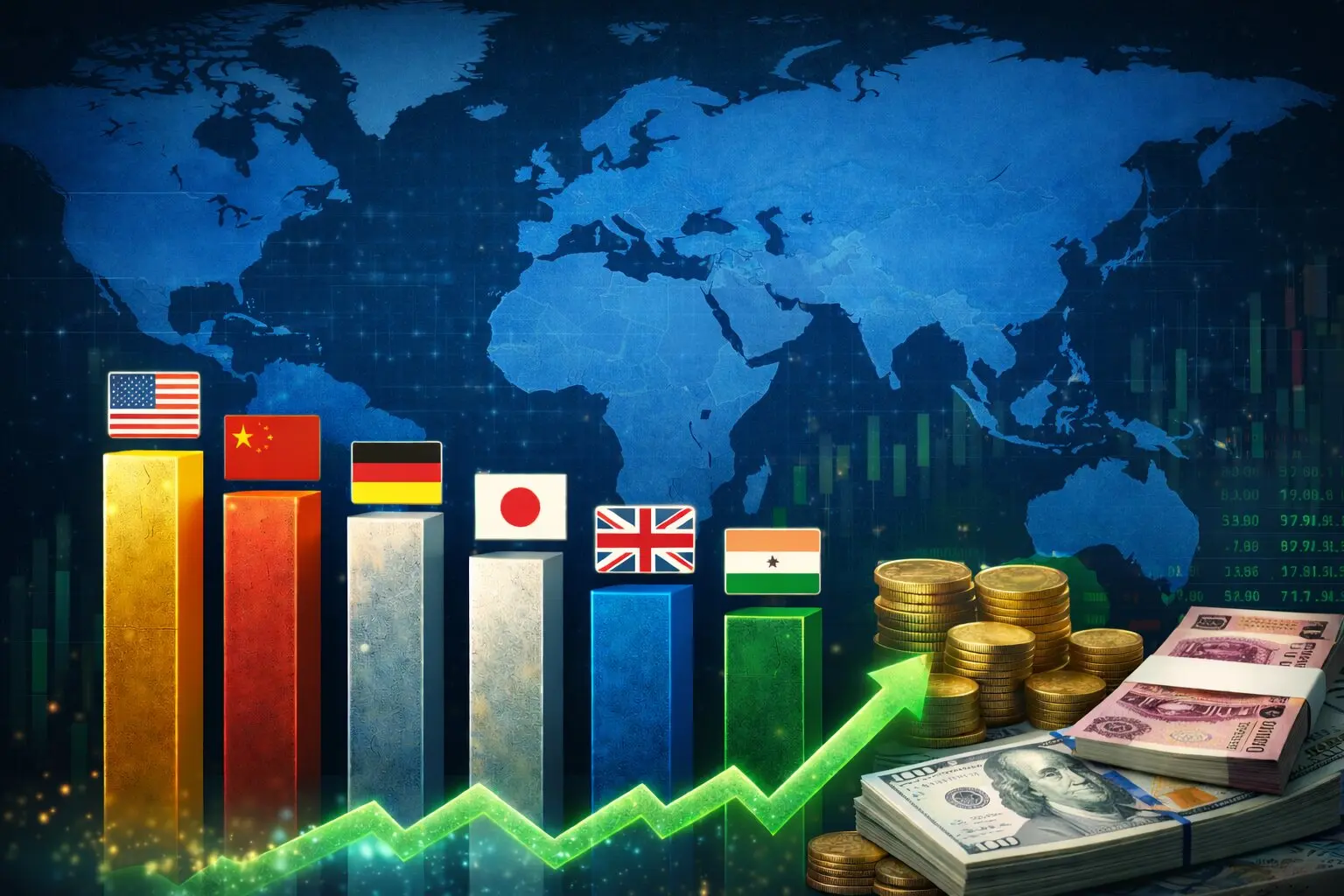
As per IMF estimates, India’s nominal GDP is around $3.92 trillion in 2025. This places it behind the United Kingdom, which has a GDP of about $4 trillion. Japan ranks fourth with $4.44 trillion, while Germany holds the third position at $4.7 trillion. The United States remains the largest economy with $30.8 trillion, followed by China at $19.6 trillion. In 2024, India was ranked fifth, ahead of the UK.
Impact of Rupee Depreciation
The main reason for India IMF GDP Rank Sixth is the fall of the Indian Rupee against the US Dollar. Since global GDP rankings are calculated in dollar terms, a weaker rupee lowers the value of India’s economy when compared globally. Over the past year, the rupee has been under pressure due to a strong US dollar, rising interest rates in the US, and global economic uncertainties. These factors have affected many developing economies.
Growth Outlook and Future Projections
Despite the current drop, India’s growth outlook remains positive. IMF projections suggest that India could regain the fourth position by 2027 with a GDP of around $4.58 trillion, surpassing the UK. Looking further ahead, India is expected to become the third-largest economy by 2031 with a projected GDP of $6.79 trillion, overtaking Japan.
Policy Implications and Economic Strategy
The India IMF GDP Rank Sixth situation highlights the importance of maintaining currency stability along with economic growth. While real GDP shows internal economic strength, global rankings depend on nominal GDP in US dollars. This means policymakers need to focus on stable exchange rates, strong financial systems, and balanced economic policies. Strengthening these areas can help India improve its global position and achieve long-term economic goals.