
Indian IT Sector Risk: US HIRE Act Threatens Exports and STEM Opportunities

Indian IT Sector Risk is gaining attention as recent US protectionist measures pose significant challenges to India’s technology exports and the careers of Indian students in STEM fields. The proposed Halting International Relocation of Employment (HIRE) Act, introduced in the US Senate, aims to curb outsourcing by imposing heavy taxes on payments made to foreign service providers. Analysts warn that if passed, this legislation could dramatically reshape India’s IT landscape and influence thousands of Indian students pursuing education and careers in the US.
Thank you for reading this post, don't forget to subscribe!Indian IT Sector Risk: Context of the HIRE Act
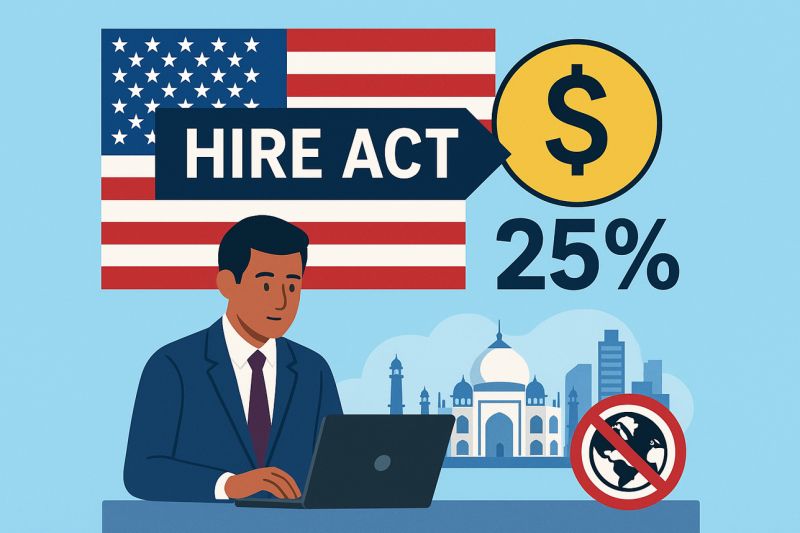
The HIRE Act introduces a 25 per cent excise tax on payments made to foreign service providers, directly targeting companies that outsource critical technology and IT services abroad. Additionally, it denies tax deductions for such expenses, which effectively makes offshored IT services nearly 60 per cent more expensive after accounting for the combined taxes and penalties. The legislation also contemplates a 50 per cent duty on imported hardware, including servers, networking equipment, and specialized components, which could significantly increase operational costs for US companies relying on foreign technology infrastructure. Beyond the immediate financial impact, these measures are designed to discourage long-term outsourcing arrangements and encourage domestic hiring, reflecting a broader US strategy to protect local employment, reduce dependence on international labor, and strengthen the competitiveness of domestic tech industries. Experts warn that if implemented, the Act could create a ripple effect across global supply chains, disrupt existing service agreements, and force US companies to reevaluate their strategies for cost optimization and talent sourcing.
Implications for the Indian IT Industry
India’s IT sector depends heavily on exports, with nearly 60 per cent of revenue generated from overseas clients, primarily in the US. The HIRE Act threatens to increase the cost of outsourcing, putting pressure on American companies to reconsider long-term contracts with Indian IT firms. Smaller IT companies are particularly vulnerable, as higher costs could limit their ability to compete in global markets.
Onshore alternatives present challenges for US firms, including increased operational costs, potential delays, and the loss of specialized expertise that Indian IT professionals provide. Despite these risks, many companies may feel compelled to gradually increase domestic hiring in response to the legislation.
Impact on Indian Students in the United States
The HIRE Act’s broad definition of “foreign person” could extend to international students on non-immigrant visas, such as F1 visa holders under the Optional Practical Training (OPT) program. These students form a critical part of the US tech workforce, particularly in emerging sectors like AI, data science, and cybersecurity. If wages paid to them face similar taxation, it could significantly reduce employment opportunities, limit career advancement, and affect their long-term prospects in the US STEM ecosystem.
US STEM Talent Shortage and Economic Logic
The US is grappling with a shortage of STEM graduates in high-demand fields including artificial intelligence, cybersecurity, and semiconductor design. Domestic universities have not been able to meet industry demand, making Indian students and professionals highly valuable. Despite protectionist rhetoric, outsourcing remains economically viable, often 20-40 per cent cheaper than onshore alternatives. This suggests that, while legislation may create temporary hurdles, international talent will remain an important component of US tech growth.
Indian IT Sector Risk: Strategic Response for India
To mitigate the impact of the HIRE Act, India must prepare its students for global uncertainties by promoting diversified study options in countries like Germany, Canada, and Australia. At the same time, Indian IT companies should invest in emerging and deep technologies such as AI, biotechnology, and advanced research and development. Such initiatives will enhance competitiveness and reduce reliance on any single international market, safeguarding long-term growth.
Indian IT Sector Risk: Future Outlook
The HIRE Act has faced opposition from corporate lobbyists and stalled in the past. However, the current political climate in the US favors protectionist policies, increasing the possibility of its enactment. The implications for India’s IT exports, global market position, and the careers of Indian STEM students are substantial. Stakeholders in India’s IT ecosystem and education sector must closely monitor developments and adapt strategies to preserve opportunities in an increasingly complex international environment.