




Passport Citizenship India Rule

Passport Citizenship India is a topic gaining attention as the government has once again clarified that a passport is not a final proof of citizenship. On 24 June 2026, during Passport Seva Divas, the Ministry of External Affairs explained that this legal position has been in place for many years.
Thank you for reading this post, don't forget to subscribe!This clarification comes at a time when identity and documentation are widely discussed due to digital systems and verification processes. Many people assume that having a passport automatically confirms citizenship, but the legal framework says otherwise.
What a Passport Really Means
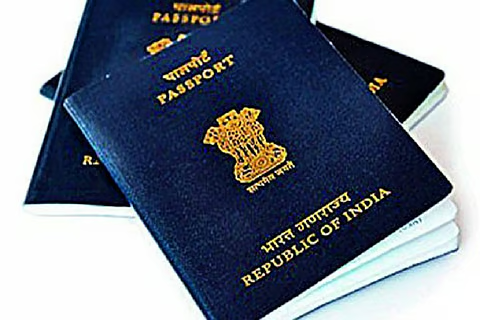
A passport is mainly a travel document. It allows a person to travel internationally and serves as an identity proof in many situations. In India, passports are issued under the Passports Act, 1967.
Interestingly, the law allows passports to be issued even to non-citizens in certain cases if it is considered necessary. This means that while a passport confirms identity and nationality for travel purposes, it does not legally prove citizenship in all situations.
Citizenship Under Indian Law
Citizenship in India is governed by the Citizenship Act, 1955. This law defines who is considered a citizen and what documents can be used to prove it.
Courts and authorities look at various forms of evidence when determining citizenship. These include birth certificates, parental records, and other official documents. Citizenship is treated as a legal status that must be supported by proper records.
This is why a single document like a passport is not enough to establish citizenship.
Court Views on Citizenship Proof
Indian courts have also clarified this issue in the past. The Bombay High Court stated in 2013 that having a passport does not automatically prove citizenship.
Similarly, the Supreme Court of India has made it clear in recent discussions that identity documents serve different purposes. For example, Aadhaar is widely used for identity verification but is not considered proof of citizenship.
These legal views reinforce the government’s position and help avoid confusion.
Role of Aadhaar and Other Documents
Documents like Aadhaar are commonly used in daily life for identification. Issued under the Aadhaar Act, 2016, it provides a unique identity number.
However, Aadhaar only confirms identity and residence, not citizenship. This distinction is important, especially in administrative processes and verification systems.
Similarly, voter ID cards, birth certificates, and other records may be required depending on the situation.
Passport Rules and Legal Notes
Indian passports also carry an important note printed inside. It states that the passport remains the property of the Government of India and must be returned if required.
This shows that a passport is part of a controlled legal system. It is issued for specific purposes and does not act as a standalone legal proof of citizenship.
Such rules are part of the broader framework that governs identity documents in the country.
Current Relevance in Digital India
The discussion around Passport Citizenship India is especially relevant today as India moves toward digital governance. Online verification, e-KYC systems, and digital identity platforms are becoming more common.
With these developments, understanding the difference between identity proof and citizenship proof becomes important. People are using multiple documents for different purposes, and each has its own legal value.
This clarity helps avoid confusion in official processes and ensures proper documentation.
Broader Context of Citizenship Verification
Citizenship verification is a sensitive and important issue in any country. In India, systems like the National Register of Citizens have been discussed in this context.
Such initiatives aim to maintain accurate records, but they also highlight the need for clear legal definitions and proper documentation.
The government’s clarification on passports fits into this broader discussion about identity and citizenship.
Understanding the Difference Matters
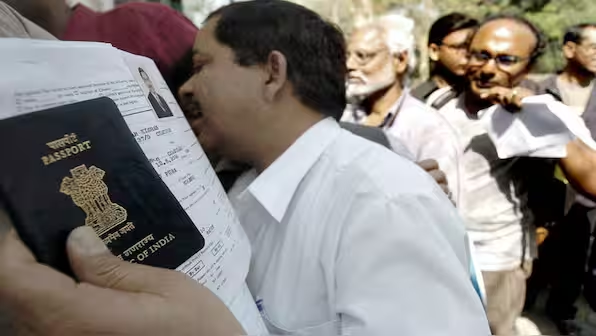
The key takeaway from the Passport Citizenship India discussion is the difference between identity and legal status. A passport proves who you are and allows travel, but citizenship requires additional legal proof.
As systems become more digital and interconnected, knowing these differences is becoming increasingly important for individuals and institutions alike.