

TAPAS-1 Thermal Imaging Payload Launch

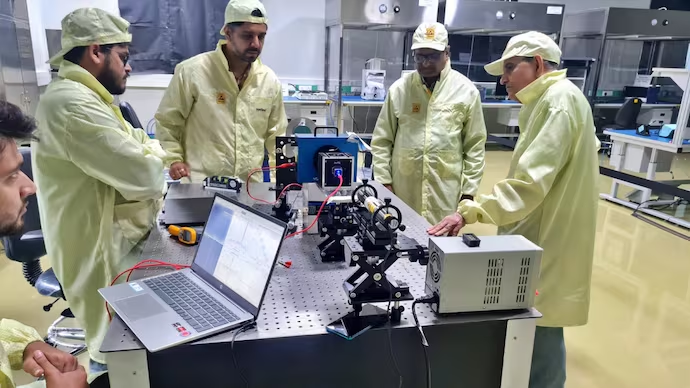
TAPAS-1 is set to mark an important development in India’s private space sector as Ahmedabad-based spacetech startup SatLeo Labs prepares to launch its thermal-imaging payload on October 1, 2026. The 3-kilogram payload will travel aboard a SpaceX Falcon 9 rocket as part of the Transporter-18 mission.
Thank you for reading this post, don't forget to subscribe!The payload will be launched from Vandenberg Space Force Base in California, United States, through Dhruva Space’s LEAP-2 platform. Once deployed, TAPAS-1 will collect thermal information from Earth using long-wave infrared sensing.
TAPAS-1 Designed for Thermal Imaging
TAPAS-1 is described as India’s first dedicated commercial CubeSat-category thermal payload. Unlike conventional optical cameras that mainly capture visible light, the payload is designed to detect thermal energy from the Earth’s surface.
The satellite payload will operate in a sun-synchronous orbit at around 500 kilometres above Earth. Its long-wave infrared sensor will measure surface temperature and generate thermal maps that can be used for different Earth-observation applications.
Thermal information can provide details that may not be visible in normal satellite images. Differences in surface temperature can help identify changes in crops, water availability, cities, forests and industrial areas.
Long-Wave Infrared Technology
The main technology behind TAPAS-1 is long-wave infrared sensing. This type of sensing detects thermal radiation and can provide information about the temperature characteristics of objects and surfaces.
Traditional optical satellite images can be affected by factors such as darkness or cloud conditions. Thermal imaging provides another type of information that can complement conventional Earth-observation data.
By collecting thermal information from around 500 km above Earth, TAPAS-1 is expected to demonstrate how compact commercial satellites can support applications that require regular temperature monitoring.
Applications in Agriculture
One of the planned applications of TAPAS-1 is agriculture. Thermal data can help identify differences in crop and soil conditions by detecting changes in surface temperature.
Such information can be useful for monitoring water stress in crops. Areas experiencing a shortage of water can show different thermal characteristics from adequately irrigated areas.
The data could therefore support agricultural monitoring and help organisations understand conditions across larger areas without depending entirely on ground-based observations.
Monitoring Urban Heat
TAPAS-1 also has applications in urban heat mapping. Cities can become significantly warmer than surrounding areas because of buildings, roads, concrete surfaces and limited vegetation.
Satellite-based thermal information can help identify areas with higher surface temperatures. This type of information can be useful for studying urban heat patterns and monitoring how temperatures vary across different parts of a city.
As cities expand, regular thermal observations can provide additional information for environmental monitoring and urban planning.
Climate and Water Monitoring
Another planned use of TAPAS-1 is climate monitoring. Long-term thermal observations can help track changes in surface temperatures across different regions.
The payload is also designed for water stress monitoring. Thermal observations can provide information about the condition of land and vegetation in areas where water availability is changing.
Such data can be combined with other satellite and ground-based information to understand environmental changes more clearly.
Forest Fires and Disaster Monitoring
Thermal imaging is also useful for detecting unusual heat signatures. One of the planned applications of TAPAS-1 is forest-fire detection.
Fire and high-temperature areas can produce thermal signals that may be detected from space. Satellite observations can provide information over large areas and help identify locations that require further monitoring.
The payload is also expected to have applications in wider disaster monitoring, where thermal information may provide additional data during or after certain events.
SatLeo Labs and Its Space Plans
SatLeo Labs was founded in Ahmedabad in 2023 by Shravan Singh Bhati, Dr. Ranendu Ghosh and Urmil Bakhai. The company is developing satellite-based thermal-imaging technology for commercial and Earth-observation applications.
TAPAS-1 is planned as the first step in a larger satellite programme. SatLeo Labs plans to launch eight more satellites of the same type by 2029.
The company aims to eventually develop a constellation of 10 to 15 thermal-imaging satellites. A larger constellation could provide more frequent observations of different areas and increase the amount of thermal data available for commercial applications.
TAPAS-2 Already Under Manufacture
The company has also started work on its next satellite. TAPAS-2 is currently under manufacture and is planned for launch in mid-2027.
The development of TAPAS-2 alongside the launch of TAPAS-1 shows the company’s plan to move from a single demonstration mission toward a larger thermal-imaging satellite network.
A constellation of several satellites could improve coverage and allow thermal observations to be collected more frequently.
Launch Through Dhruva Space
TAPAS-1 will be deployed through Dhruva Space’s LEAP-2 platform as part of the Transporter-18 mission.
The launch vehicle will be a SpaceX Falcon 9, one of the rockets used for commercial satellite deployment. The mission is scheduled to operate from Vandenberg Space Force Base in California.
Using a rideshare mission allows smaller satellite payloads to travel to orbit along with other spacecraft instead of requiring a dedicated rocket launch.
Funding and Commercial Interest
SatLeo Labs has secured around ₹60 crore in funding to support its space technology programme. The company has also received Letters of Intent worth about US$52 million.
According to the company information, around 60% of these Letters of Intent have come from international companies. This indicates commercial interest in thermal-imaging data and related satellite services beyond the Indian market.
The planned satellite constellation could allow SatLeo Labs to provide thermal data for agriculture, environmental monitoring, infrastructure, disaster management and other sectors.
India’s Private Space Sector Expands
The TAPAS-1 mission comes as India’s private space sector continues to develop new satellite technologies and commercial space services.
Private companies are increasingly working on Earth observation, launch services, satellite manufacturing, communication systems and other space technologies. Smaller satellites and rideshare launches have also created opportunities for startups to test and deploy new technologies at comparatively lower launch requirements.
TAPAS-1 combines a compact satellite payload with thermal-imaging technology aimed at practical applications on Earth. Its launch will provide SatLeo Labs with an opportunity to demonstrate the technology in orbit and begin building toward its planned satellite constellation.