

Composition and Layers of Earth’s Atmosphere: Structure and Functions

Composition and Layers of Earth’s Atmosphere is one of the most important topics in geography and environmental studies. The atmosphere is the blanket of gases that surrounds the Earth. Without the atmosphere, life on Earth would not be possible. It gives us air to breathe, protects us from harmful rays of the Sun, controls temperature, and helps in rainfall and weather formation.
The Earth’s atmosphere is made up of different gases and is divided into several layers. Each layer has its own characteristics and importance. Some layers help in weather formation, while others protect the Earth from dangerous radiation and burning meteors.

What is the Atmosphere?
The atmosphere is a thick layer of gases surrounding the Earth. It is held around the Earth by gravity. It extends thousands of kilometers above the Earth’s surface and gradually merges into outer space.
The atmosphere is not solid or uniform. It becomes thinner as we move higher from the Earth’s surface. It contains gases, dust particles, and water vapor.
The atmosphere performs many important functions such as:
- Providing oxygen for breathing
- Protecting living beings from harmful ultraviolet rays
- Maintaining temperature balance
- Helping in rainfall and weather changes
- Burning meteors before they reach Earth
Without the atmosphere, Earth would become too hot during the day and too cold during the night.
Composition of Earth’s Atmosphere
The atmosphere is made up of different gases. Some gases are found in large amounts, while others are present in very small quantities.
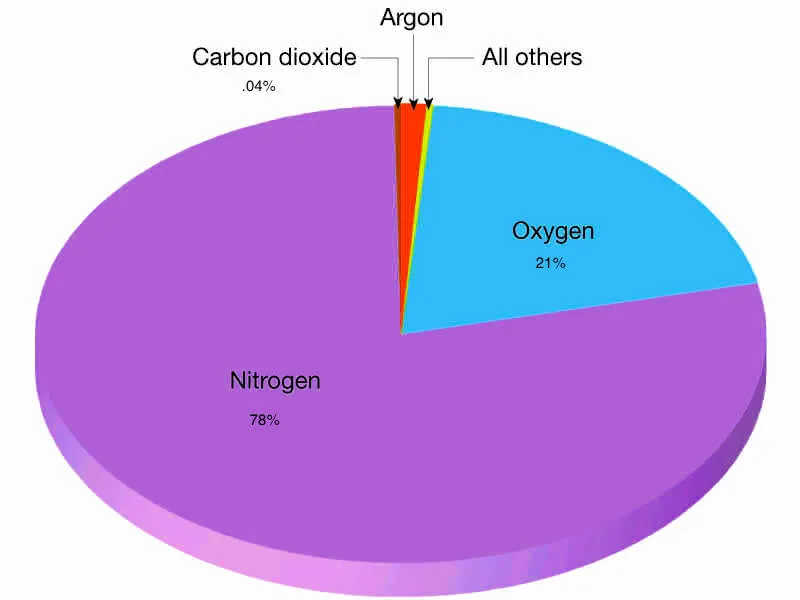
Main Gases in the Atmosphere
Nitrogen (78%)
Nitrogen is the most abundant gas in the atmosphere. It forms about 78% of the total air.
Importance of nitrogen:
- Helps plants grow
- Important for the formation of proteins
- Maintains balance in the atmosphere
- Reduces the speed of burning and combustion
Although humans cannot directly use nitrogen from the air, plants use it through the nitrogen cycle.
Oxygen (21%)
Oxygen is the second most abundant gas in the atmosphere.
Importance of oxygen:
- Essential for breathing
- Supports burning
- Used by animals and humans for survival
- Plants release oxygen during photosynthesis
Without oxygen, life on Earth would not exist.
Argon (0.93%)
Argon is an inactive gas present in small amounts. It does not react easily with other substances.
Uses of argon:
- Electric bulbs
- Welding processes
- Scientific equipment
Carbon Dioxide (0.04%)
Carbon dioxide is present in very small quantities, but it is extremely important.
Sources of carbon dioxide:
- Respiration
- Burning of fossil fuels
- Industries
- Forest fires
- Volcanic eruptions
Importance of carbon dioxide:
- Used by plants during photosynthesis
- Helps maintain Earth’s temperature
- Supports the greenhouse effect
Too much carbon dioxide causes global warming and climate change.
Other Gases
The atmosphere also contains small amounts of:
- Neon
- Helium
- Methane
- Krypton
- Hydrogen
- Ozone
Even though these gases are present in very small quantities, some of them play important roles in protecting the Earth.
Water Vapor and Dust Particles
Apart from gases, the atmosphere also contains water vapor and dust particles.
Water Vapor
Water vapor enters the atmosphere through evaporation from oceans, rivers, lakes, and plants.
Importance of water vapor:
- Formation of clouds
- Rainfall and snowfall
- Controls weather and climate
- Traps heat in the atmosphere
The amount of water vapor changes from place to place.
Dust Particles
Dust particles include smoke, pollen, sea salt, and ash.
Importance of dust particles:
- Help in cloud formation
- Scatter sunlight
- Create beautiful sunrise and sunset colors
Too much dust and pollution can cause breathing problems and environmental damage.
Layers of Earth’s Atmosphere
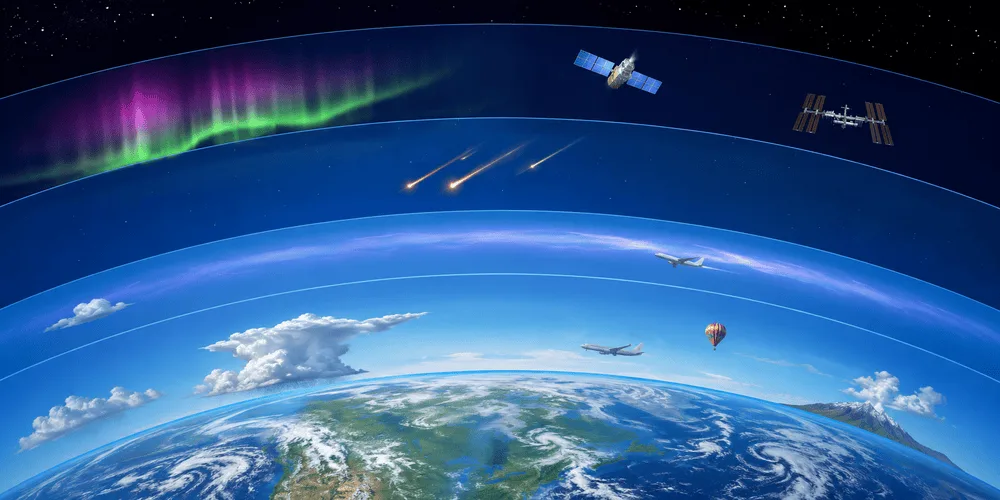
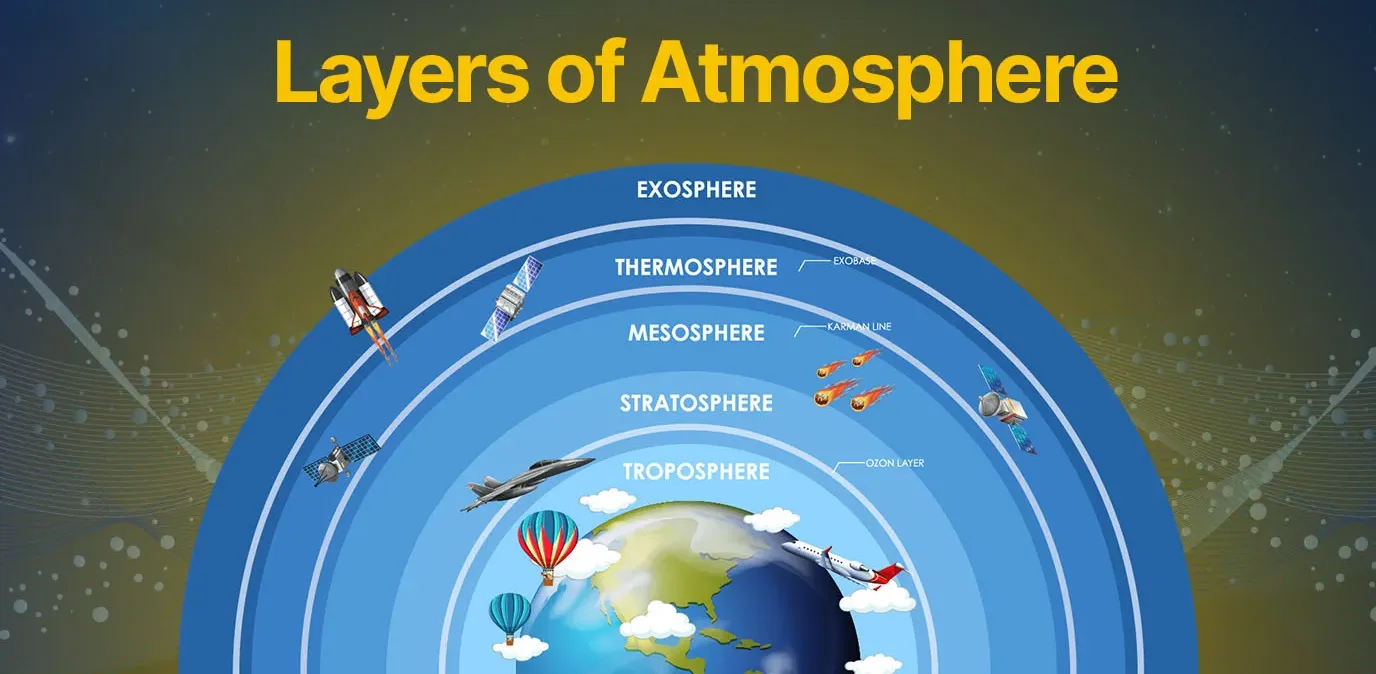
The atmosphere is divided into different layers according to temperature and height. These layers are:
- Troposphere
- Stratosphere
- Mesosphere
- Thermosphere
- Exosphere
Another important region called the ionosphere overlaps some of these layers.
Troposphere
The troposphere is the lowest layer of the atmosphere.
Height
- Around 8 km near the poles
- Around 18 km near the equator
- Average height is about 12 km
Important Features
- Most weather activities occur here
- Clouds, rain, storms, and winds form in this layer
- Contains about 75% of atmospheric gases
- Contains almost all water vapor and dust particles
Temperature decreases as height increases.
The upper boundary of the troposphere is called the tropopause.
Importance of the Troposphere
- Supports life
- Provides oxygen for breathing
- Helps in rainfall
- Controls climate and weather
Most aircraft fly in the upper part of the troposphere.
Stratosphere
The stratosphere lies above the troposphere.
Height
- Extends from about 12 km to 50 km
Important Features
- Contains the ozone layer
- Temperature increases with height
- Very little weather disturbance
- Air is stable and clear
The ozone layer absorbs harmful ultraviolet rays from the Sun.
The upper boundary of the stratosphere is called the stratopause.
Importance of the Stratosphere
- Protects life from harmful UV rays
- Suitable for jet aircraft because of stable air
- Helps maintain temperature balance
Without the ozone layer, humans could suffer from skin cancer, eye diseases, and other health problems.
Ozone Layer
The ozone layer is a special part of the stratosphere.
What is Ozone?
Ozone is a gas made up of three oxygen atoms.
Formula:O3
Importance of the Ozone Layer
- Absorbs harmful ultraviolet radiation
- Protects humans, animals, and plants
- Maintains ecological balance
Ozone Depletion
Human activities release chemicals like chlorofluorocarbons (CFCs), which damage the ozone layer.
Effects of ozone depletion:
- Skin cancer
- Eye cataracts
- Harm to marine life
- Damage to crops
Many countries now work together to protect the ozone layer.
Mesosphere
The mesosphere is above the stratosphere.
Height
- Extends from about 50 km to 80 km
Important Features
- Temperature decreases with height
- Coldest layer of the atmosphere
- Meteors burn up here
The upper boundary is called the mesopause.
Importance of the Mesosphere
- Protects Earth from meteors
- Prevents many space rocks from reaching the surface
If meteors were not destroyed here, they could cause major damage on Earth.
Thermosphere
The thermosphere lies above the mesosphere.
Height
- Extends from about 80 km to 700 km
Important Features
- Temperature rises sharply
- Contains very thin air
- Includes the ionosphere
- Northern and Southern lights occur here
The temperature can rise up to 2000°C because this layer absorbs strong solar radiation.
International Space Station
The International Space Station orbits in the thermosphere.
Importance of the Thermosphere
- Helps in radio communication
- Absorbs harmful solar radiation
- Supports satellite activities
Ionosphere
The ionosphere is not a separate layer. It overlaps the mesosphere and thermosphere.
Important Features
- Contains electrically charged particles called ions
- Reflects radio waves back to Earth
- Helps in long-distance communication
Importance of the Ionosphere
- Radio broadcasting
- GPS and navigation systems
- Communication systems
Without the ionosphere, radio communication would become very difficult.
Exosphere
The exosphere is the outermost layer of the atmosphere.
Height
- Extends from about 700 km to 10,000 km
Important Features
- Extremely thin air
- Mostly hydrogen and helium gases
- Merges slowly into outer space
Most satellites orbit in this layer.
Importance of the Exosphere
- Important for satellite communication
- Helps in space research
This layer acts as the transition between Earth’s atmosphere and space.
Temperature Changes in Atmospheric Layers
Different layers of the atmosphere show different temperature patterns.
| Layer | Temperature Pattern |
|---|---|
| Troposphere | Temperature decreases with height |
| Stratosphere | Temperature increases with height |
| Mesosphere | Temperature decreases with height |
| Thermosphere | Temperature increases with height |
These temperature changes occur because different layers absorb solar energy differently.
Importance of Earth’s Atmosphere
The atmosphere is extremely important for all living organisms.
Protection from Harmful Radiation
The atmosphere blocks harmful ultraviolet rays from the Sun. The ozone layer acts like a shield.
Without this protection, life would become impossible.
Maintains Earth’s Temperature
The atmosphere traps heat and keeps Earth warm.
This process is called the greenhouse effect.
Without the atmosphere:
- Days would become extremely hot
- Nights would become freezing cold
The atmosphere maintains a suitable temperature for life.
Helps in Weather Formation
All weather activities occur because of the atmosphere.
These include:
- Rainfall
- Wind
- Storms
- Clouds
- Snowfall
Weather is important for farming, water supply, and ecosystems.
Supports the Water Cycle
The atmosphere plays a major role in the water cycle.
Steps in the water cycle:
- Evaporation
- Condensation
- Cloud formation
- Rainfall
This cycle provides fresh water to plants, animals, and humans.
Supports Life
The atmosphere provides:
- Oxygen for breathing
- Carbon dioxide for plants
- Nitrogen for plant growth
It creates conditions necessary for survival.
Burns Meteors
Many meteors entering Earth’s atmosphere burn up due to friction in the mesosphere.
This protects Earth from dangerous impacts.
Greenhouse Effect and Global Warming
Some gases in the atmosphere trap heat. These gases are called greenhouse gases.
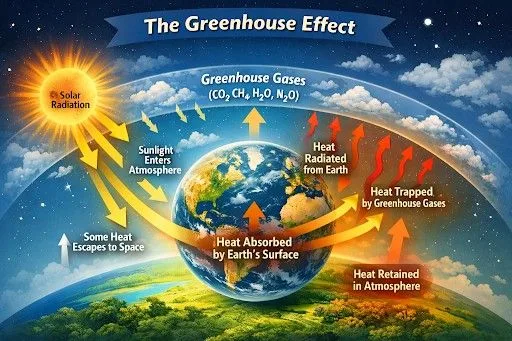
Main greenhouse gases:
- Carbon dioxide
- Methane
- Water vapor
- Nitrous oxide
Greenhouse Effect
The greenhouse effect is a natural process that keeps Earth warm enough for life.
Global Warming
Human activities increase greenhouse gases in the atmosphere.
Causes:
- Burning fossil fuels
- Deforestation
- Industrial pollution
- Vehicle emissions
Effects:
- Rising temperatures
- Melting glaciers
- Sea level rise
- Extreme weather
- Droughts and floods
Protecting the atmosphere is necessary to reduce global warming.
Air Pollution and Its Effects
Air pollution occurs when harmful substances mix with the atmosphere.
Sources of Air Pollution
- Factories
- Vehicles
- Burning coal and wood
- Dust and smoke
- Chemical emissions
Effects of Air Pollution
- Breathing problems
- Global warming
- Acid rain
- Damage to plants and animals
- Climate change
Reducing pollution is necessary for protecting the atmosphere.
Ways to Protect the Atmosphere
Everyone can help protect the atmosphere.

Important Steps
- Plant more trees
- Reduce pollution
- Use renewable energy
- Save electricity
- Use public transport
- Reduce plastic use
- Avoid harmful chemicals
Governments and people must work together to protect the environment.
Conclusion
Composition and Layers of Earth’s Atmosphere is an important topic that explains how the atmosphere supports life on Earth. The atmosphere is made up of gases like nitrogen, oxygen, and carbon dioxide. It also contains water vapor and dust particles that help in weather formation.
The atmosphere is divided into different layers such as the troposphere, stratosphere, mesosphere, thermosphere, and exosphere. Each layer has unique features and functions. Some layers protect Earth from harmful radiation, while others help in communication and weather formation.
The atmosphere protects living beings, controls climate, supports the water cycle, and maintains Earth’s temperature. However, pollution and global warming are damaging the atmosphere. Therefore, protecting the atmosphere is very important for the future of our planet and all living organisms.
FAQs
1. What is the atmosphere of Earth?
The atmosphere is a layer of gases surrounding the Earth that supports life and protects the planet.
2. What are the main gases found in the atmosphere?
The main gases are nitrogen, oxygen, argon, and carbon dioxide.
3. Which is the lowest layer of the atmosphere?
The troposphere is the lowest layer of the atmosphere where weather changes occur.
4. What is the importance of the ozone layer?
The ozone layer protects Earth from harmful ultraviolet rays of the Sun.
5. In which layer do meteors burn up?
Most meteors burn up in the mesosphere.
6. Which layer contains the International Space Station?
The International Space Station is found in the thermosphere.
7. Why is the atmosphere important for life?
The atmosphere provides oxygen, controls temperature, and protects living beings from harmful radiation.
8. What causes global warming?
Global warming is mainly caused by the increase of greenhouse gases like carbon dioxide in the atmosphere.